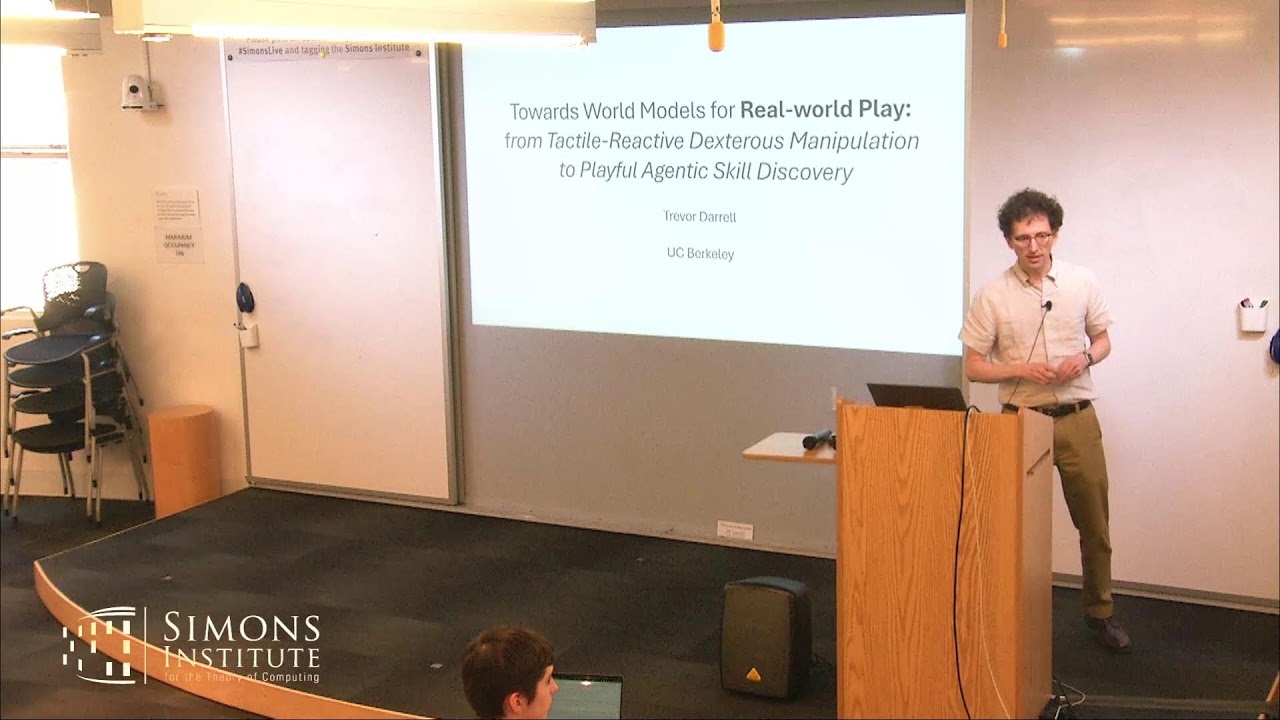
World Modeling: Evaluation and State Computation
Keywords
Summary
108 words
Critical Evaluation
The talk provides a valuable overview of ongoing research in world modeling, with a focus on evaluation and state computation. The speaker demonstrates a strong command of the subject, grounding his work in established literature (e.g., Dillon & Spelke) and formal methods (Gauss Code). The REMAP benchmark is well-designed, isolating geometric reasoning and revealing clear limitations in current multimodal LLMs. The human-model gap is striking and highlights the need for further progress. The KnotGym environment is innovative, offering a controlled yet challenging testbed for manipulation, with exact verification via Gauss Code. However, the results from RL methods are limited, and the MLLM evaluation is preliminary, with only one example shown. The state separation hypothesis is intriguing but presented as a ‘fresh result’ with limited detail, making it difficult to assess its validity. The talk is technically rigorous, but the audience is assumed to have a background in AI. The sources cited are appropriate, though the talk primarily presents the speaker’s own work. The title accurately reflects the content. Overall, the talk is informative and thought-provoking, but some claims require further validation.
181 words
Title / Content Match
The title accurately reflects the content, covering evaluation of world models and a hypothesis about state computation.
Quality & Reliability
8/10
The talk presents original research from the speaker's group, with references to established work (Dillon & Spelke) and formal methods (Gauss Code). The claims are supported by experimental evaluations, though some results are preliminary.
Key Moments
Markers derived by PSI from the transcript: the creator did not define chapters.
- Introduction to world models and three aspects: consistency, simulation, and state representation.
- Discussion of cross-perspective spatial reasoning and the REMAP benchmark.
- Presentation of REMAP results showing human-model gap.
- Introduction to KnotGym and knot manipulation tasks.
- Results of RL methods on KnotGym, showing performance drop with complexity.
- Discussion of state separation hypothesis and preliminary results.
- Conclusion and future directions.
Cited Sources
- Simons Institute Talk Page — Official talk page with abstract and related resources.
Concurring Sources
- Dillon & Spelke (2018) — Developmental psychology study on perspective-taking, supporting the REMAP design.
Contribution & Novelties
The talk contributes novel benchmarks (REMAP, KnotGym) for evaluating world models, and introduces the state separation hypothesis. These provide new tools and insights for the AI community.
Pour aller plus loin :
- Dillon & Spelke (2018) — Foundational study on spatial reasoning in children.
- Gauss Code — Formal representation of knots used for verification.
- Dreamer — Model-based RL method with implicit world model.
63 words
Radar Profile
The radar profile shows high scores in information quantity, quality, and reliability, with a moderate technical level. This indicates a well-balanced talk that is both informative and credible, though not overly technical.