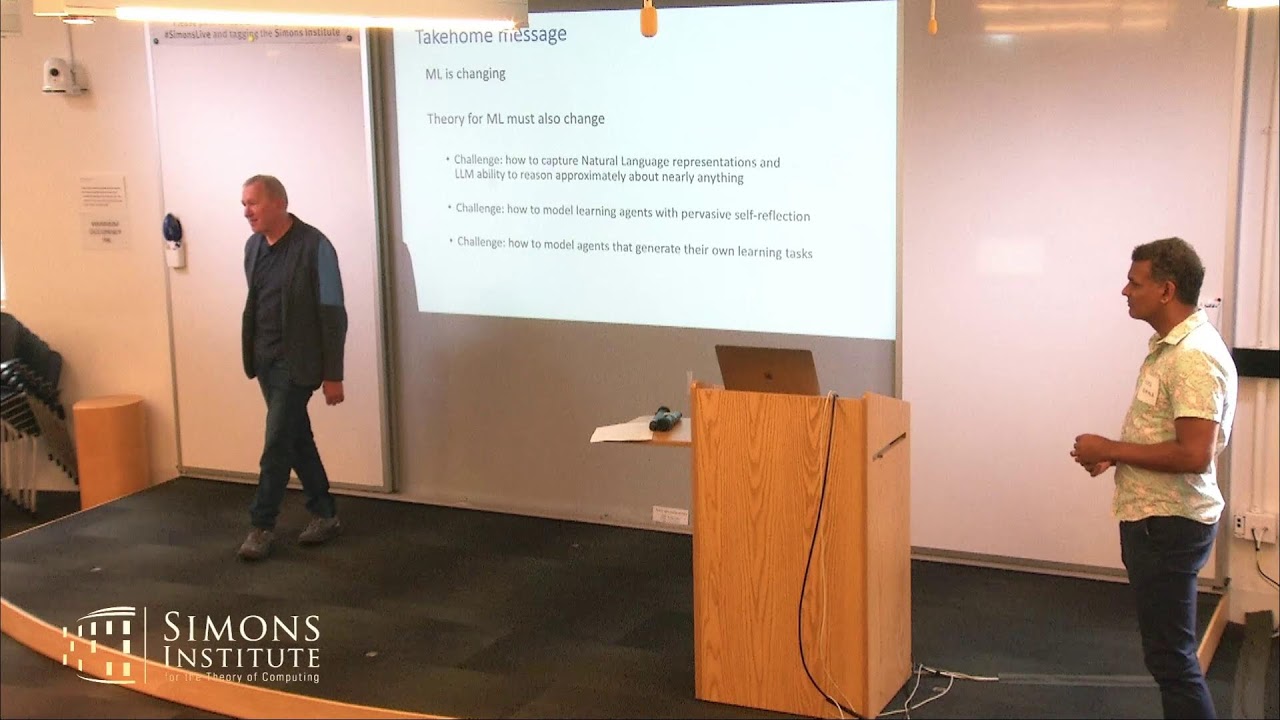
Questions for Theory in the New Age of Machine Learning
Keywords
Summary
177 words
Critical Evaluation
The talk is intellectually stimulating and timely, given the rapid advances in LLMs. Mitchell, a respected figure, challenges conventional wisdom and proposes a new direction for ML theory. The main example is compelling: using an LLM to generate justifications and distill them into a rubric is a concrete demonstration of reasoning-driven learning. The approach is novel and could inspire new theoretical frameworks. However, the talk is more of a position piece than a rigorous analysis. The example is illustrative but not a full-scale experiment; there is no detailed evaluation of the rubric’s quality or generalizability. The theoretical questions raised are important but not formally developed. Mitchell does not provide a formal model or proofs, which is expected for a keynote but limits the depth. The talk also touches on other examples (e.g., generating new hints) but does not elaborate. The sources are not explicitly cited in the talk, but the description links to the Simons Institute page. Overall, the talk is valuable for its insights and potential to guide future research, but it lacks the rigor of a formal paper. The adéquation between title and content is good, as it indeed raises questions for theory. The talk does not include any advertising or sponsorship segments.
205 words
Title / Content Match
The title accurately reflects the content: the talk raises theoretical questions for machine learning in the era of LLMs.
Quality & Reliability
8/10
The talk is given by a renowned expert in machine learning, Tom Mitchell, at a prestigious venue (Simons Institute). It presents novel ideas and examples, but it is an opinion piece rather than a peer-reviewed study. The claims are plausible and supported by illustrative experiments, but not fully rigorous.
Key Moments
Markers derived by PSI from the transcript: the creator did not define chapters.
- Introduction by Venkat Guruswami and Santosh Vempala
- Tom Mitchell introduces the talk and challenges conventional wisdom
- Example 1: Building a classifier using LLMs, with the CK-12 dataset
- The learning algorithm: generating justifications and distilling a rubric
- Theoretical implications: new framing of PAC learning with LLM as oracle
- Questions about sample complexity and hypothesis class complexity
- Discussion of ambiguity in natural language descriptions of functions
- Conclusion and outlook for theory in the new age of ML
Cited Sources
- Simons Institute talk page — Official page for the talk, providing details and possibly slides.
Concurring Sources
- Simons Institute talk page — Official page for the talk, providing details and possibly slides.
Contribution & Novelties
The talk introduces a novel paradigm for machine learning where LLMs serve as reasoning engines, enabling learning from few examples via natural language justifications. This challenges traditional PAC learning assumptions and opens new theoretical questions.
Pour aller plus loin :
- PAC learning — Foundational framework for learning theory, relevant to the discussion of sample complexity.
- Large language models — Overview of LLMs, the core technology discussed.
- Inductive bias — Concept of prior knowledge in learning, central to the talk’s argument.
80 words
Radar Profile
The radar profile shows high scores in quality and reliability, reflecting the expert status and reputable venue, but moderate scores in quantity and technical depth, indicating a concise talk with limited formal detail.