Private Information Retrieval and Oblivious RAM
Keywords
Summary
179 words
Critical Evaluation
The talk provides a valuable and up-to-date survey of ORAM and PIR, emphasizing practical deployment and recent theoretical advances. Elaine Shi is a leading expert, and her presentation is clear and well-structured. The real-world applications (Signal, blockchain, LLMs) effectively illustrate the importance of access pattern hiding. The distinction between ORAM and PIR is well explained, and the discussion of TEEs as a current practical solution, while acknowledging their limitations, is balanced. The talk does not delve into full technical details or proofs, but it is intended as a survey for a knowledgeable audience. The speaker mentions her own company’s implementation, which could be seen as a potential conflict of interest, but she also cites other work and discusses open challenges. The content is scientifically sound, and the sources mentioned (e.g., the empirical paper on Ethereum centralization) are credible. The talk does not include a formal comparison of all existing schemes, but it provides a good overview. The adéquation between title and content is excellent. Overall, this is a high-quality talk that would be useful for researchers and practitioners interested in privacy-enhancing technologies.
182 words
Title / Content Match
The title accurately reflects the content, which covers both Private Information Retrieval and Oblivious RAM, their differences, applications, and recent progress.
Quality & Reliability
8/10
Talk by a leading researcher in the field, presenting a survey of ORAM and PIR with real-world applications and recent results. The content is technically accurate and well-structured, but as a survey talk, it does not provide full proofs or experimental details. The speaker is a recognized expert, and the talk is hosted by a reputable institution (Simons Institute).
Key Moments
Markers derived by PSI from the transcript: the creator did not define chapters.
- Introduction to real-world applications: Signal's private contact discovery, blockchain private order flow, and privacy-preserving LLMs.
- Explanation of why encryption alone is insufficient: access patterns leak sensitive information.
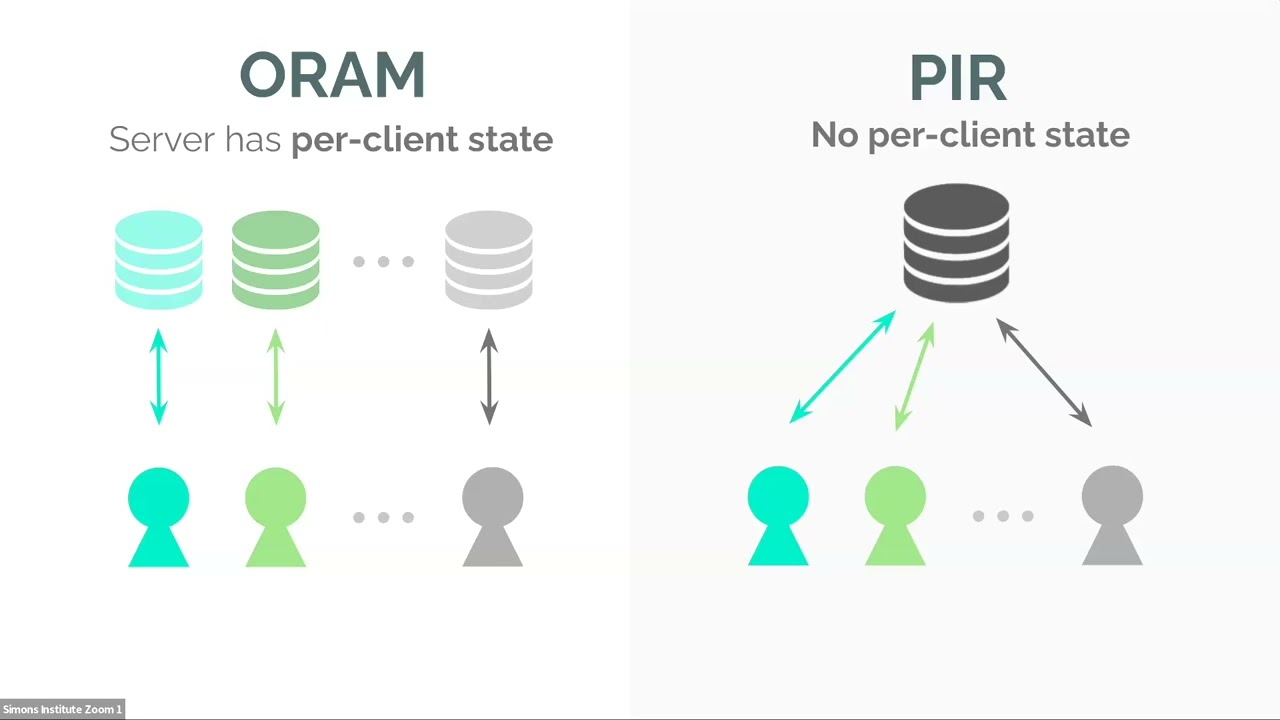
- Definition of ORAM and PIR, and the key difference: ORAM supports per-client state, PIR is for global databases.
- Discussion of TEE-based solutions and why industry currently relies on them, despite the desire to avoid trusted hardware.
- Overview of recent ORAM implementations achieving microsecond-level query times on large databases.
- Introduction to client-preprocessing PIR and its advantages and challenges.
- Discussion of open problems and future directions, including handling database updates and removing trusted hardware.
Cited Sources
- Simons Institute talk page — Official page for the talk, providing context and possibly slides.
Concurring Sources
- Simons Institute talk page — The talk is hosted by the Simons Institute, a reputable institution, and the speaker is a leading researcher.
Contribution & Novelties
This talk provides a comprehensive and current overview of ORAM and PIR, bridging theory and practice. It highlights recent deployments (Signal, Meta) and ongoing efforts in blockchain and AI, and discusses the trade-offs between TEE-based solutions and purely cryptographic approaches. The speaker also presents recent performance results from her own company, indicating that ORAM can be practical at scale.
Pour aller plus loin :
- Oblivious RAM — Foundational concept for hiding access patterns.
- Private Information Retrieval — Overview of PIR and its variants.
- Trusted Execution Environment — Hardware-based security used in current deployments.
- Secure Multi-Party Computation — Cryptographic alternative to TEEs.
101 words
Radar Profile
The radar profile shows high scores in quantity and quality of information, with slightly lower technical depth, reflecting a survey talk that is informative but not highly technical. The reliability score is high, consistent with the speaker's expertise and the institutional setting.