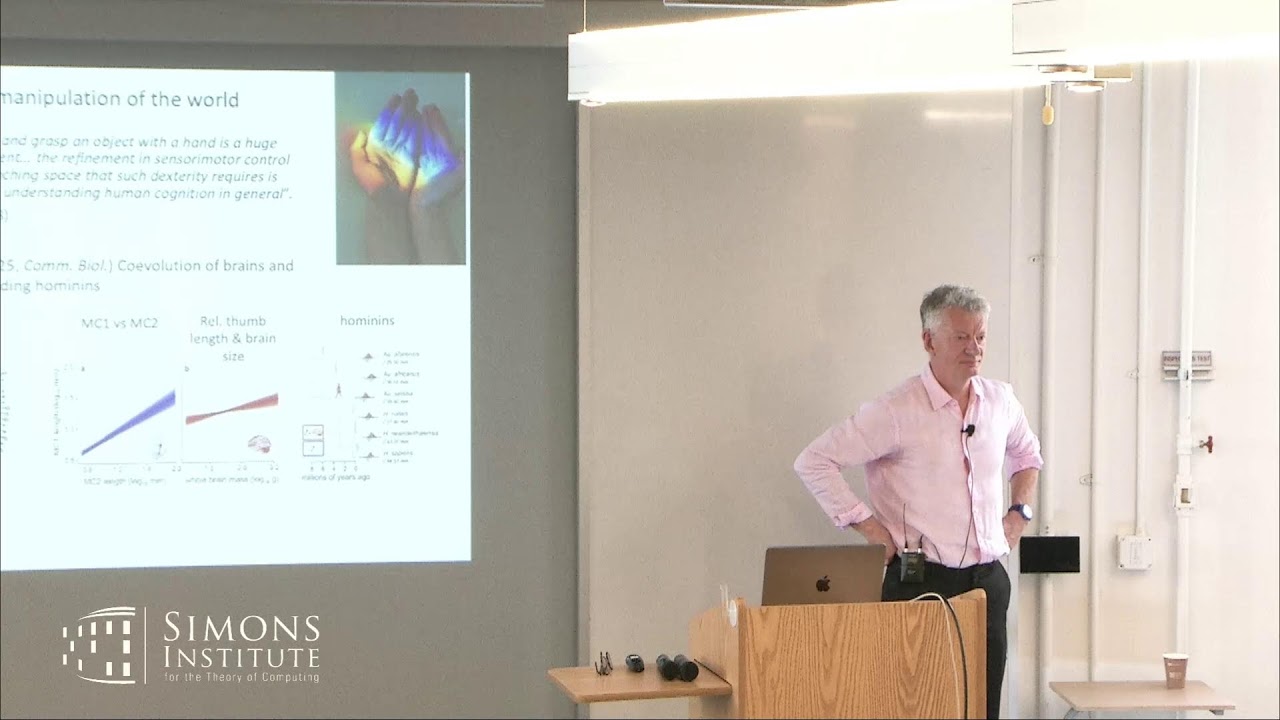
Embodied cognitive evolution
Keywords
Summary
130 words
Critical Evaluation
The talk provides a compelling and well-argued perspective on brain evolution, grounded in extensive comparative data and statistical methods. Barton effectively challenges the prevailing ’neocortex-centric’ view by presenting evidence that human frontal lobes are not disproportionately expanded, and by emphasizing the role of sensorimotor systems. His arguments are logically structured and supported by specific examples, such as the relationship between brain size and visual specializations in primates. The use of phylogenetic comparative methods is appropriate and adds rigor, though the talk is necessarily a high-level overview. The speaker acknowledges the crudeness of the measurements but justifies their use for broad evolutionary comparisons. The cultural critique of top-down control in neuroscience is insightful and adds depth. However, the talk is an opinion piece based on the speaker’s research, and some claims, such as the ‘23 times background rate’ for human brain expansion, are presented without detailed statistical context. The sources cited are primarily the speaker’s own publications and a few others, which could be seen as a limitation. Overall, the talk is scientifically sound, thought-provoking, and well-presented, though it represents a particular viewpoint within the field.
185 words
Title / Content Match
The title accurately reflects the content, which focuses on how brain evolution is driven by sensorimotor demands and embodied interaction with the environment.
Quality & Reliability
8/10
The talk is based on peer-reviewed research and established comparative methods, but it presents a specific viewpoint and relies on the speaker's expertise rather than a systematic review.
Key Moments
Markers derived by PSI from the transcript: the creator did not define chapters.
- Introduction: Robert Barton introduces himself as an evolutionary biologist studying brain evolution.
- Explanation of phylogenetic comparative methods and their use in studying brain evolution.
- Example of brain size evolution across mammals, showing variable rates and acceleration in primates.
- Introduction of mosaic evolution concept, using fish brains as examples.
- Critique of the standard view that neocortex is the 'intelligent' part, and discussion of cultural influences.
- Presentation of evidence that human frontal lobes are not disproportionately large.
- Discussion of the sea squirt and the idea that brains are for adaptive sensorimotor control.
- Emphasis on visual specializations in primates and their correlation with brain size.
- Co-evolution of neocortex and cerebellum, and its implications for embodied cognition.
Cited Sources
- Simons Institute talk page — Official page for the talk, providing context and possibly slides.
Concurring Sources
- Simons Institute talk page — The talk itself is the primary source, and the page provides official context.
Contribution & Novelties
The talk offers a fresh perspective on cognitive evolution by emphasizing the role of sensorimotor systems and challenging the neocortex-centric view. It synthesizes decades of comparative research to argue that brains are primarily for adaptive behavior, not abstract reasoning. This embodied view has implications for AI and cognitive science, suggesting that true intelligence may require physical interaction with the world.
Pour aller plus loin :
- Embodied cognition — Relevant to the idea that cognition is shaped by the body.
- Phylogenetic comparative methods — The statistical approach used in the talk.
- Mosaic evolution — Concept discussed in the talk.
- Cerebellum — Key brain structure highlighted for its role in motor control and cognition.
112 words
Radar Profile
The radar profile shows high scores in information quality and reliability, with moderate technical level and information quantity. This indicates a well-supported, expert-level talk that is accessible to a broad audience.