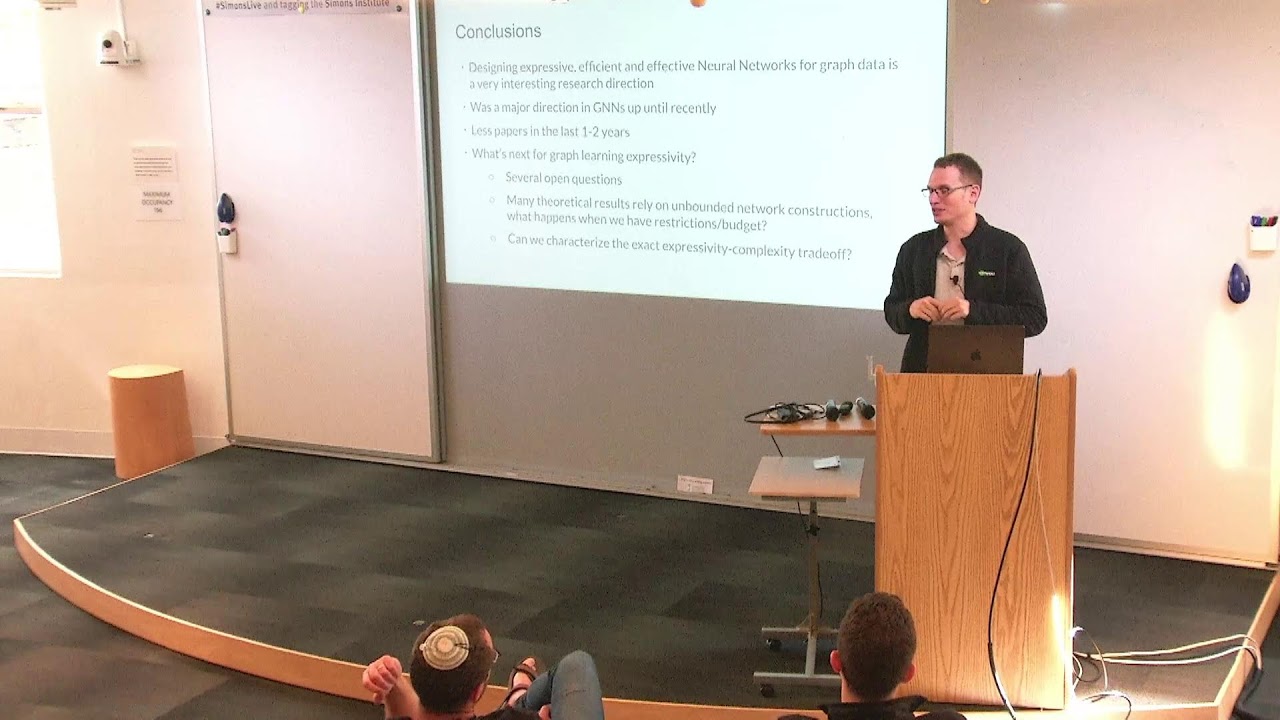
Boot Camp on Graph Learning
Keywords
Summary
182 words
Critical Evaluation
The video serves as an excellent introductory bootcamp for researchers new to graph learning, particularly those with a theoretical computer science background. The presentation by Ameya Velingker is clear and well-structured, covering the fundamental concepts and early methods in a digestible manner. The content is scientifically accurate and reflects the state of the art up to the early 2020s, though it does not delve into the latest advancements. The argumentation is logical, building from basic definitions to the motivation for graph-specific learning methods. The sources cited are primarily the workshop itself and the Simons Institute, which are reputable but not primary research references. The video’s strength lies in its pedagogical value, effectively bridging the gap between TCS and graph learning. However, it lacks depth in certain areas, such as the mathematical formalization of graph neural networks, which might be expected from a TCS audience. The adéquation between title and content is perfect, as it is indeed a bootcamp. The presence of a brief welcome and organizational remarks does not detract from the core content. Overall, the video is a valuable resource for those seeking a concise introduction to graph learning, but it is not a comprehensive review of the field.
200 words
Title / Content Match
The title accurately reflects the content, which is a bootcamp introducing graph learning concepts.
Quality & Reliability
8/10
High-quality tutorial by established researchers from Technion, NVIDIA, and RWTH Aachen, hosted at the Simons Institute. Content is technically accurate and well-structured, but as a bootcamp it is introductory and does not provide original research.
Key Moments
Markers derived by PSI from the transcript: the creator did not define chapters.
- Welcome and introduction by Sampath Kannan, director of the Simons Institute.
- Christopher Morris introduces the workshop goals and schedule.
- Ameya Velingker begins the bootcamp on graph learning fundamentals.
- Discussion of graph applications and task types (node, edge, graph level).
- Comparison of grid/sequence data with graph topology, motivating specialized methods.
- Introduction to early methods: node embeddings (DeepWalk, Node2Vec) and graph kernels.
- Explanation of embedding learning via similarity scores and supervised/unsupervised approaches.
Cited Sources
- Simons Institute Talk Page — Official page for the talk, providing details and possibly slides.
Concurring Sources
- Simons Institute Talk Page — Official page for the talk, providing details and possibly slides.
Contribution & Novelties
The video provides a concise and accessible introduction to graph learning, particularly valuable for theoretical computer scientists. It synthesizes foundational concepts and early methods, offering a springboard for deeper exploration. The workshop format encourages interdisciplinary dialogue, which is a novel contribution to bridging TCS and graph learning.
Pour aller plus loin :
- Graph Neural Networks: A Review of Methods and Applications — Comprehensive survey of GNNs.
- DeepWalk: Online Learning of Social Representations — Original paper on DeepWalk.
- node2vec: Scalable Feature Learning for Networks — Original paper on node2vec.
- Graph Kernels — Overview of graph kernels.
95 words
Radar Profile
The radar profile shows high scores in quality and reliability, moderate in quantity and technical level, indicating a solid but not exhaustive introduction. The video is well-suited for its intended purpose as a bootcamp.