A Unified Framework for Succinct Garbling from Homomorphic Secret Sharing
Keywords
Summary
181 words
Critical Evaluation
The talk provides a high-level overview of a novel framework for succinct garbling, connecting it to homomorphic secret sharing. The speaker, Rachel Lin, is a recognized expert in secure computation, and the content is based on recent research results, likely published in top venues. The presentation is technically rigorous, with clear explanations of the core ideas and comparisons to prior work. However, as a conference talk, it omits many technical details, such as the exact construction and security proofs, which are crucial for a full evaluation. The speaker acknowledges this by referring to the paper for specifics. The argumentation is solid, building on established concepts like free XOR and affine labels, and the connection to HSS is insightful. The sources cited are primarily the speaker’s own work and related recent papers, which are appropriate for the topic. The adequacy between title and content is good, as the talk indeed presents a unified framework. The main limitation is the lack of concrete efficiency numbers and a detailed comparison with existing implementations, which would help assess practical relevance. Overall, the talk is valuable for researchers in the field, offering a new perspective on succinct garbling and potential avenues for future work.
199 words
Title / Content Match
The title accurately reflects the content, which presents a unified framework for succinct garbling using homomorphic secret sharing.
Quality & Reliability
8/10
Talk by a leading researcher at a prestigious institute, presenting recent research results with technical depth. The content is based on established cryptographic concepts and recent works, but as a conference talk, it lacks full proofs and detailed analysis.
Key Moments
Markers derived by PSI from the transcript: the creator did not define chapters.
- Introduction and overview of garbled circuits
- Discussion on the size of garbled circuits and rate
- Introduction to arithmetic garbled circuits and affine labels
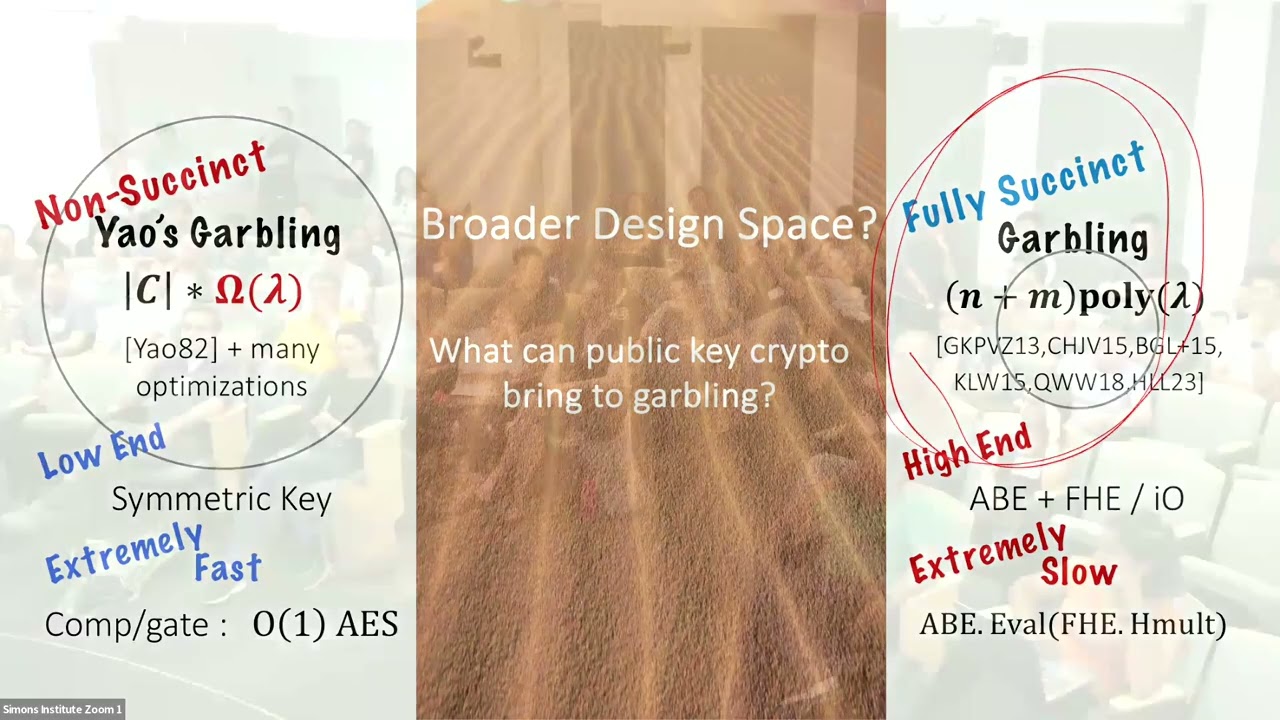
- Comparison of symmetric-key vs public-key garbling
- Motivation for partially succinct garbling
- Recent advances in rate-1 garbling
- Connection between garbling and homomorphic secret sharing
- Introduction of algebraic homomorphic MAC
- Technical details of the framework
- Extensions and open questions
Cited Sources
- Simons Institute talk page — Official page for the talk, providing abstract and related materials.
Concurring Sources
- Simons Institute talk page — The talk page confirms the presentation details and provides context.
Contribution & Novelties
The talk presents a unified framework that connects succinct garbling with homomorphic secret sharing, introducing algebraic homomorphic MAC as a new tool. This provides a new perspective on achieving rate-1 garbling for arithmetic circuits, using groups as the underlying assumption, which was not previously known. The framework also extends to layered circuits, achieving rates slightly below 1. This work bridges the gap between symmetric-key and public-key approaches, offering a middle ground in terms of efficiency and succinctness.
Pour aller plus loin :
- Homomorphic Secret Sharing — Overview of HSS, a key concept in the talk.
- Garbled Circuit — Background on garbled circuits and their applications.
- Applebaum, Ishai, and Kushilevitz 2011 — Original paper on arithmetic garbled circuits, foundational to the talk.
121 words
Radar Profile
The radar profile shows high scores in technical depth and information quality, with slightly lower scores in quantity and reliability due to the talk's concise nature and lack of full proofs. This indicates a technically strong but concise presentation.