WhAM: Towards A Translative Model of Sperm Whale Vocalization
Keywords
Summary
114 words
Critical Evaluation
The presentation provides a clear and insightful overview of a novel approach to modeling sperm whale vocalizations. The speaker demonstrates a strong command of the technical details, explaining the architecture and training process in an accessible manner. The use of VampNet as a base model is well-justified, and the fine-tuning strategy on animal sounds and sperm whale data is logical. The evaluation of the model’s outputs, including human listening tests and analysis of internal representations, adds credibility to the claims. However, the talk is more of an expert opinion and work-in-progress report than a peer-reviewed study, and some details are glossed over. The speaker acknowledges limitations, such as the reliance on a pre-trained codec and the subjective nature of prompting schemes. The discussion of future directions is thoughtful, but the lack of quantitative results in the presentation limits the depth of the evaluation. Overall, the talk is valuable for researchers interested in bioacoustics and generative models, but it is not a comprehensive scientific study.
164 words
Title / Content Match
The title accurately reflects the content: the presentation introduces WhAM, a model for translating audio into sperm whale codas, and discusses its capabilities and limitations.
Quality & Reliability
8/10
The talk is given by a researcher who just completed his PhD, presenting joint work with colleagues. The approach is based on established methods (VampNet, neural audio codecs) and includes evaluation of the model's outputs. The speaker is transparent about limitations and future work. The talk is part of a workshop co-hosted with Project CETI, indicating relevance and credibility in the field.
Key Moments
Markers derived by PSI from the transcript: the creator did not define chapters.
- Introduction to CETI and the decoding pipeline
- Motivation for WhAM: limitations of inter-click interval analysis
- Overview of VampNet and its architecture
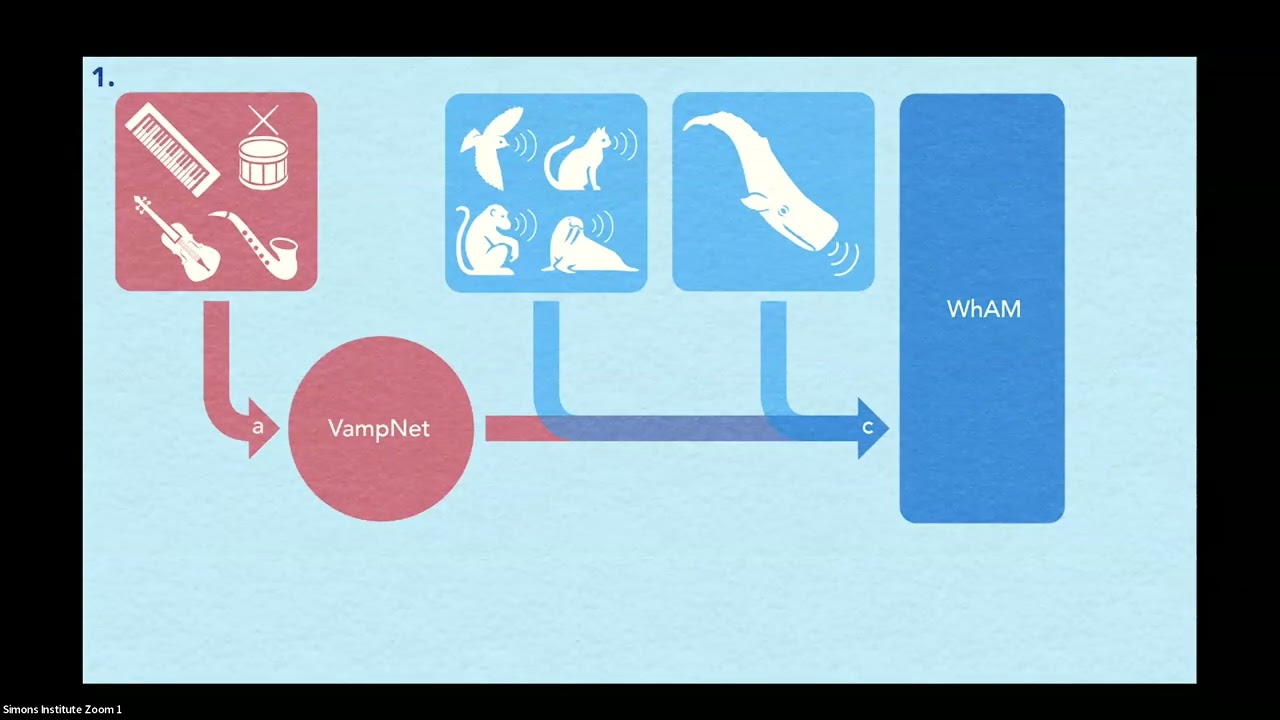
- Training process: domain adaptation and species-specific fine-tuning
- Evaluation: can WhAM generate indistinguishable codas?
- Translation capabilities from diverse input domains
- Analysis of internal representations and semantic grounding
- Future directions and open questions
Cited Sources
- Simons Institute Talk Page — Official page for the talk, providing additional context and possibly slides.
Concurring Sources
- VampNet — The base model architecture used for WhAM, demonstrating the effectiveness of masked acoustic token modeling.
- Descript Audio Codec — The neural audio codec used for tokenization, which is a standard tool in audio generation.
Dissenting Sources
- Gašper's work on sperm whale vowels — Gašper's phonological approach suggests that discrete features like vowels carry additional information beyond inter-click intervals, which contrasts with the purely acoustic approach of WhAM.
Contribution & Novelties
The talk introduces WhAM, a novel model for generating sperm whale codas via acoustic translation. This is a significant step beyond previous work that focused on discrete inter-click intervals, as it leverages continuous acoustic information. The model’s ability to translate from diverse audio inputs and its internal representations that capture some semantic grounding are promising for future research in non-human communication.
Pour aller plus loin :
- VampNet — The base model for WhAM, a music generation model using masked acoustic tokens.
- Descript Audio Codec — The neural audio codec used for tokenization.
- Project CETI — The initiative behind this research, aiming to decode sperm whale communication.
- Watkins Marine Mammal Sound Database — A key dataset used for domain adaptation.
- Dominica Sperm Whale Project — Source of golden data for species-specific fine-tuning.
131 words
Radar Profile
The radar profile shows high scores in quality of information and reliability, reflecting the speaker's expertise and the solid foundation of the work. The quantity of information is moderate, as the talk focuses on a specific model rather than a broad survey. The technical level is high, suitable for an audience familiar with machine learning and audio processing.