Representation of the world in the human brain
Keywords
Summary
141 words
Critical Evaluation
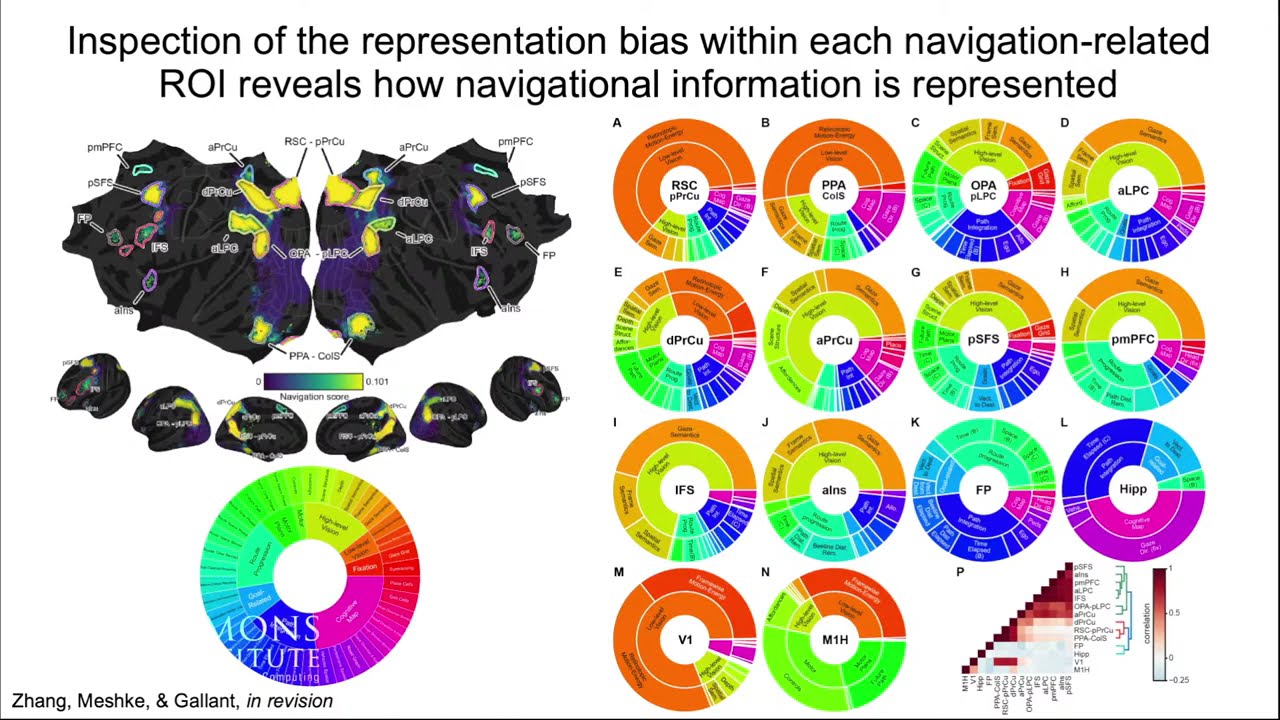
The talk provides a compelling and detailed account of a sophisticated experimental approach to understanding brain representations during naturalistic behavior. Gallant’s methodological rigor is evident in his emphasis on separating training and test data, using a large set of hypotheses, and employing encoding models to map features to brain activity. The use of a virtual environment with ground truth data is a significant strength, allowing for precise feature extraction. The identification of 11 navigation-specific regions is a valuable contribution, though the talk does not delve into the specific functions of each region in depth. The argumentation is solid, but the talk is more of an overview than a deep dive into the results. The speaker’s candid admission of the field’s bias towards linear systems and the nascent state of world model research in neuroscience is refreshing and highlights a gap between AI and neuroscience. The sources cited are primarily the speaker’s own work, and while this is appropriate for a research talk, it limits the breadth of external validation. The title accurately reflects the content, and the talk is well-structured. Overall, this is a high-quality presentation that offers valuable insights into the neural basis of navigation and the challenges of integrating world model concepts into neuroscience.
206 words
Title / Content Match
The title accurately reflects the content, which focuses on how the brain represents the world during navigation, though the talk also touches on broader world models.
Quality & Reliability
8/10
The talk is delivered by a leading expert in computational neuroscience, based on extensive peer-reviewed research. The methodology is rigorous, with careful attention to model validation and data separation. However, as a conference talk, it presents a high-level overview without full methodological details, and some claims are simplified for the audience.
Key Moments
Markers derived by PSI from the transcript: the creator did not define chapters.
- Introduction: Gallant introduces his background and the talk's structure.
- Description of the virtual navigation experiment and its naturalistic nature.
- Explanation of the encoding model approach and the 38 hypotheses tested.
- Discussion of the feature spaces and the data-intensive nature of the method.
- Presentation of results: 11 navigation-related brain regions identified.
- Analysis of the information represented in each region and the complexity of the graph.
- Discussion of the limitations of traditional neuroscience approaches and the potential for world models.
- Conclusion and Q&A.
Cited Sources
- Simons Institute talk page — Official page for the talk, providing context and possibly additional materials.
Concurring Sources
- Simons Institute talk page — The talk is part of a series on world models and social reasoning, aligning with the topic.
Contribution & Novelties
The talk presents a novel, large-scale naturalistic fMRI study that tests a comprehensive set of hypotheses about navigation-related brain representations. It demonstrates the feasibility of using encoding models to map complex, real-world-like stimuli to brain activity, and identifies 11 navigation-specific regions. The speaker also highlights the gap between current neuroscience approaches and the concept of world models in AI, suggesting a need for new theoretical frameworks.
Pour aller plus loin :
- Predictive coding — A theoretical framework relevant to world models in the brain.
- Grid cells — Key neural components for spatial navigation.
- Default mode network — Brain network involved in internal thought, mentioned in the talk.
107 words
Radar Profile
The radar profile shows high scores in information quantity, quality, technical level, and reliability, indicating a well-rounded and authoritative presentation. The talk is dense with technical detail and backed by rigorous methodology, making it a valuable resource for researchers.
💬 No comments were provided for analysis.