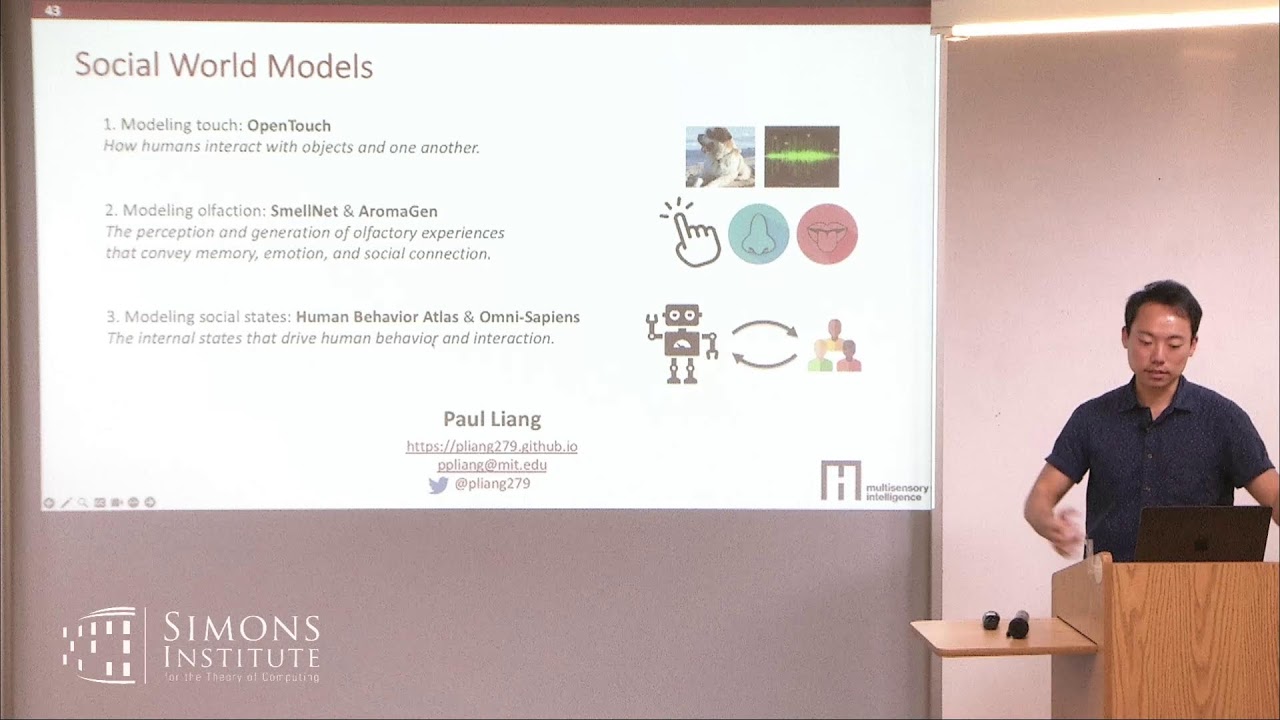
Social World Models
Keywords
Summary
111 words
Critical Evaluation
The talk provides a compelling overview of Social World Models, a nascent but crucial area for AI. Paul Liang effectively contrasts physical and social world models, highlighting the unique challenges of modeling internal states, ambiguity, and long-horizon interactions. The presentation is well-structured, moving from conceptual framing to concrete research contributions. The tactile sensing work is particularly strong, with detailed descriptions of open-source glove designs, calibration, and data collection, culminating in the OpenTouch dataset. The inclusion of fine-grained tasks like slip recovery and two-hand manipulation demonstrates practical relevance. The olfaction segment, while brief, addresses a significant gap in AI research, and the proposed digital smell transmission has intriguing implications for social connection. The foundation models for social understanding are presented as a logical next step, though details are sparse. The talk’s strength lies in its integration of multiple modalities and its emphasis on real-world data collection. However, it is primarily a research overview rather than a deep dive into any single method, and the evaluation of these models is not discussed in depth. The speaker’s expertise is evident, and the work is grounded in peer-reviewed publications, but the talk itself is not a formal scientific presentation. The title accurately reflects the content, and the talk offers valuable insights for researchers and practitioners. The main limitation is the lack of critical discussion of limitations or alternative approaches, which would strengthen the scientific rigor. Overall, this is a high-quality talk that contributes to the conceptualization and advancement of socially intelligent AI.
248 words
Title / Content Match
The title accurately reflects the content, which focuses on extending world models to social domains, covering touch, olfaction, and social foundation models.
Quality & Reliability
8/10
The talk is given by a recognized researcher (Paul Liang, MIT) at a prestigious venue (Simons Institute). It presents original research contributions, including datasets and models, with technical details. The content is well-structured and grounded in the speaker's own published work, though it is a single perspective and not peer-reviewed in this format.
Key Moments
Markers derived by PSI from the transcript: the creator did not define chapters.
- Introduction to Social World Models and contrast with physical world models.
- Definition of social world models: states, actions, outcomes in social context.
- Technical challenges: multisensory perception, interaction, multi-agent, long horizons, ambiguity.
- Position paper on advancing social intelligence in AI agents.
- Overview of three research thrusts: touch, olfaction, social foundation models.
- Tactile sensing gloves: design, calibration, and data collection.
- OpenTouch dataset: largest multimodal dataset with vision, touch, and hand pose.
- Fine-grained tasks: two-hand manipulation, slip recovery, fingertip sensors.
- Olfaction: AI for smell perception and digital transmission.
- Foundation models for understanding internal human states.
- Future directions and conclusion.
Cited Sources
- Simons Institute Talk Page — Official talk page with abstract and related information.
Concurring Sources
- Simons Institute Talk Page — Official talk page with abstract and related information.
Contribution & Novelties
The talk introduces the concept of Social World Models, extending physical world models to social domains, and presents novel contributions in tactile sensing (open-source gloves, OpenTouch dataset), olfaction (AI for smell), and social foundation models. It emphasizes the importance of modeling internal unobserved states and addresses unique challenges like ambiguity and pluralism.
Pour aller plus loin :
- Theory of Mind — Relevant to modeling internal states of others.
- Multimodal learning — Core to integrating touch, vision, and language.
- Tactile sensor — Background on tactile sensing technology.
86 words
Radar Profile
The radar profile shows high scores across all dimensions, indicating a well-rounded and informative talk. The lowest score is in technical depth, but it remains strong, reflecting the talk's balance between conceptual overview and technical details.