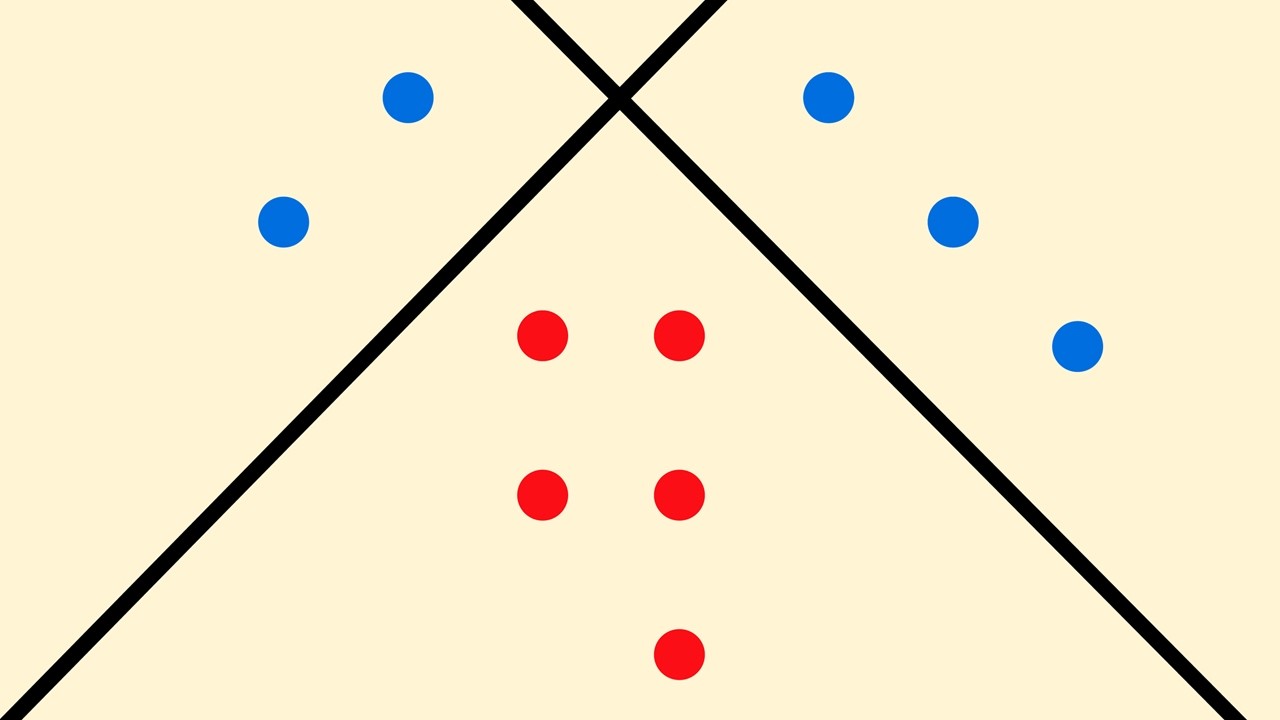
Red Points and Blue Points
Keywords
Summary
161 words
Critical Evaluation
The talk presents a significant theoretical contribution to computational learning theory. The main result, an algorithm for learning intersections of halfspaces with complexity exponential in sqrt(n log(1/rho) log k), is a substantial improvement over previous work, which was exponential in k or 1/rho. The algorithm matches known lower bounds up to logarithmic factors, indicating that it is essentially optimal for this problem. The proof is presented clearly on the board, making the key ideas accessible to an expert audience. The talk also provides a thorough historical context, referencing important prior results and lower bounds. The speaker is a leading researcher in the field, and the work is joint with Shyamal Patel, suggesting a rigorous collaboration. However, the result is not yet peer-reviewed, and the talk is a conference presentation rather than a published paper. The technical level is high, assuming familiarity with PAC learning, VC dimension, and statistical query models. The talk does not include experimental validation, but this is typical for theoretical work. The title is somewhat informal but accurately reflects the problem of separating red and blue points. Overall, this is a high-quality presentation of original research with strong theoretical foundations.
193 words
Title / Content Match
The title is catchy but vague; the talk is about learning intersections of halfspaces, which is well represented by the red/blue points metaphor.
Quality & Reliability
8/10
Presentation of original research with rigorous mathematical proofs, referencing prior work and lower bounds. The result is not yet peer-reviewed but is presented by a leading expert in the field.
Key Moments
Markers derived by PSI from the transcript: the creator did not define chapters.
- Introduction and tribute to Avrim Blum
- Problem definition: red and blue points separated by k hyperplanes
- Discussion of VC dimension and sample complexity
- Definition of margin and robust distributions
- History of algorithms: random projections, Klivans-Servedio, etc.
- Lower bounds from statistical queries and lattice problems
- Main theorem: algorithm with complexity exponential in sqrt(n log(1/rho) log k)
- Corollary for Boolean cube with integer weights
- Extension to soft margins
- Proof sketch on the board
Cited Sources
- Simons Institute talk page — Official page for the talk, providing abstract and related information.
Concurring Sources
- Klivans and Servedio (2008) — Previous algorithm for learning intersections of halfspaces with margin, improved by the new result.
- Blum and Rivest (1992) — NP-hardness of training three-node neural networks, motivating the problem.
Dissenting Sources
- Statistical query lower bound (Klivans and Sherstov 2007) — Shows that any SQ algorithm for k=sqrt(n) halfspaces with margin 1/poly(n) requires 2^Omega(sqrt(n)) time, matching the new algorithm's complexity.
- Cryptographic lower bound (Tiegel 2024) — Based on unique shortest vector problem, also gives 2^Omega(sqrt(n)) lower bound, further supporting optimality.
Contribution & Novelties
The talk presents a new algorithm for learning intersections of halfspaces with a margin, achieving complexity exponential in sqrt(n log(1/rho) log k), which is a significant improvement over previous results. The algorithm matches statistical query and cryptographic lower bounds up to logarithmic factors, suggesting it is essentially optimal. The proof is elegant and presented on the board, making the key ideas accessible. The result also extends to soft margins and has implications for learning over the Boolean cube.
Pour aller plus loin :
- PAC learning — Foundational framework for the learning model used.
- VC dimension — Measure of sample complexity for learning.
- Statistical query model — Model used for lower bounds.
- Intersection of halfspaces — Geometric concept central to the problem.
121 words
Radar Profile
The radar profile shows high scores in quality of information and technical level, with slightly lower scores in quantity and reliability. This reflects a dense, technical talk with strong theoretical content, but limited breadth and not yet peer-reviewed.