End-to-End Simulation of Chemical Dynamics on a Quantum Computer
Keywords
Summary
198 words
Critical Evaluation
The talk provides a rigorous and well-structured overview of quantum algorithms for chemical dynamics, with a strong emphasis on end-to-end complexity and error control. Kassal’s argument for dynamics as a key opportunity for quantum advantage is compelling, as he correctly notes that dynamics is unitary and thus efficiently simulable on quantum computers, unlike electronic structure which is QMA-hard in the worst case. The analog simulation approach using trapped ions is innovative and demonstrates practical progress, with experimental results showing accurate reproduction of molecular dynamics and the ability to simulate open systems by exploiting noise. However, the talk is primarily a high-level overview; the technical details of the digital algorithm are presented at a level that assumes familiarity with quantum simulation concepts, and the audience is likely specialized. The speaker does not delve into the specific error bounds or the assumptions underlying the algorithm, which would be crucial for a full assessment of its practicality. The resource estimates for photochemical applications are promising but are based on theoretical analysis and have not been experimentally validated. The talk does not address potential challenges such as the overhead of fault-tolerant quantum error correction or the difficulty of preparing initial states for larger molecules. Overall, the content is scientifically sound and represents a significant contribution to the field, but it is a presentation of ongoing research rather than a definitive solution. The lack of a detailed discussion of limitations and open problems is a minor weakness. The title accurately reflects the content, and the talk is well-organized, with clear transitions between the analog and digital approaches. The speaker’s enthusiasm and expertise are evident, and the talk effectively communicates the potential of quantum simulation for chemical dynamics.
282 words
Title / Content Match
The title accurately reflects the content, which focuses on a complete quantum algorithm for simulating chemical dynamics, including initial state preparation, time evolution, and measurement.
Quality & Reliability
8/10
Presentation by a recognized expert in quantum chemistry simulation, based on peer-reviewed research. The talk is technical and rigorous, with clear explanations of methods and limitations. However, as a conference talk, it is not a full peer-reviewed publication, and some details are omitted.
Key Moments
Markers derived by PSI from the transcript: the creator did not define chapters.
- Introduction by moderator and start of Ivan Kassal's talk.
- Kassal introduces the topic and contrasts electronic structure with dynamics.
- Overview of the grid of quantum chemistry simulation approaches.
- Explanation of why dynamics is a promising area for quantum advantage.
- Introduction to analog simulation using trapped ions.
- Experimental demonstration of geometric phase interference around a conical intersection.
- Programmability of the analog simulator demonstrated with different molecules.
- Simulation of open quantum systems by adding noise.
- Resource efficiency comparison between qubit-only and mixed qubit-boson simulation.
- Introduction to the digital end-to-end algorithm for chemical dynamics.
- Details of the algorithm: grid representation, initial state preparation, time evolution, and measurement.
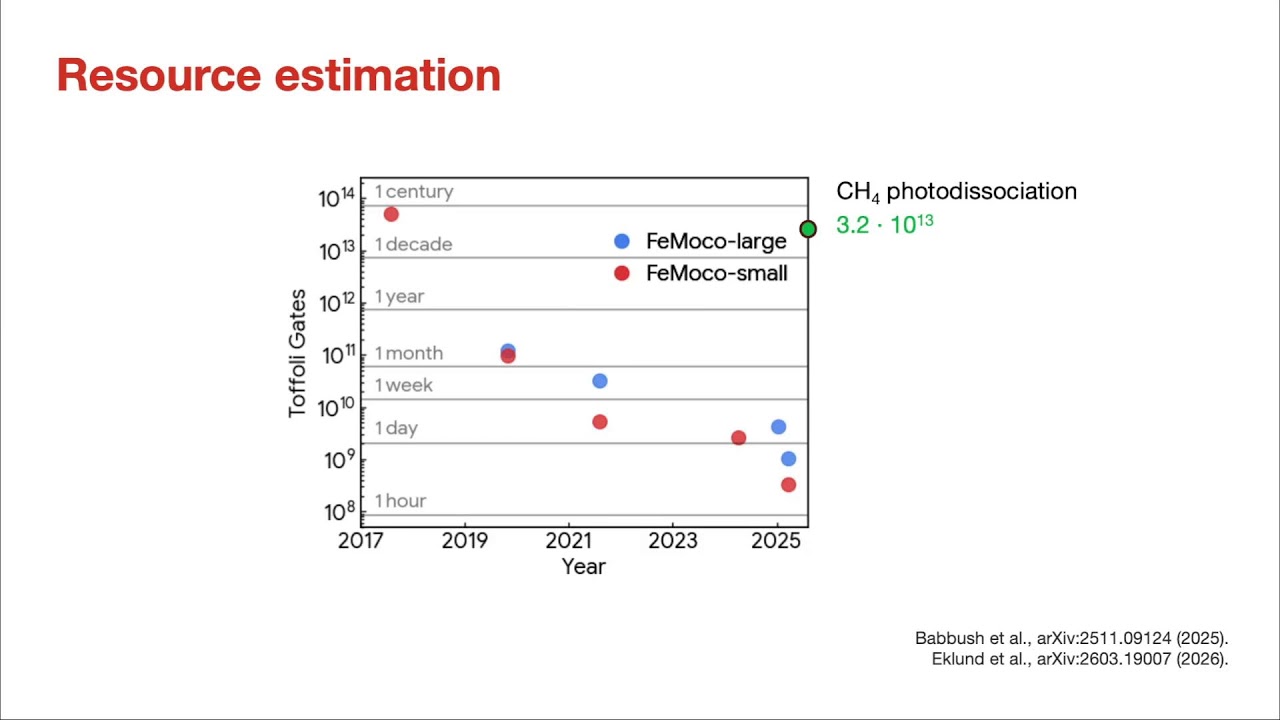
- Resource estimates for photochemical applications and conclusion.
Cited Sources
- Simons Institute talk page — Official page for the talk, providing abstract and related information.
Concurring Sources
- Simons Institute talk page — The abstract on this page aligns with the content presented in the talk.
Contribution & Novelties
The talk presents a novel end-to-end quantum algorithm for simulating chemical dynamics with rigorous error bounds and sublinear scaling in grid size. It also introduces an analog simulation approach using trapped ions that offers significant resource efficiency improvements. The work addresses a gap in quantum chemistry simulation by focusing on dynamics rather than static electronic structure.
Pour aller plus loin :
- Quantum computing for chemistry — Overview of quantum computing applications in chemistry.
- Born-Oppenheimer approximation — Key concept in quantum chemistry, relevant to the breakdown discussed.
- Conical intersection — Central to non-adiabatic dynamics and the talk’s motivation.
- Trapped ion quantum computer — Technology used in the analog simulation experiments.
- Qubitization — Technique used in the digital algorithm for time evolution.
120 words
Radar Profile
The radar profile shows high scores in technical level and information quality, reflecting the advanced and rigorous nature of the talk. The lower score in quantity of information is due to the concise presentation format, which limits the depth of coverage. Overall, the talk is highly specialized and technically strong.