Probably Approximately Precision and Recall Learning
Keywords
Summary
161 words
Critical Evaluation
The talk presents a novel and rigorous formalization of precision-recall learning, a topic of practical importance in recommendation systems and information retrieval. Mansour, a distinguished researcher, provides a clear motivation and carefully defines the learning model, emphasizing the one-sided nature of the data. The technical content is solid, building on PAC learning theory, and the analysis of sample complexity is a significant contribution. However, the presentation is informal and assumes a high level of familiarity with the field, which may limit accessibility. The talk does not include a full proof of the results, but rather sketches the main ideas, which is typical for a workshop presentation. The sources cited are limited to the Simons Institute page, and no external references are provided, which reduces the verifiability of the claims. The adéquation between the title and content is excellent, as the talk directly addresses the learning of precision and recall objectives. The inclusion of personal anecdotes and historical context adds a human touch but does not detract from the scientific value. Overall, the talk is a valuable contribution to the field, though it would benefit from more detailed references and a more structured presentation of the technical results.
197 words
Title / Content Match
The title accurately reflects the content, which focuses on learning with precision and recall objectives in a probably approximately correct framework.
Quality & Reliability
8/10
Talk by a leading learning theorist at a prestigious institute, presenting a formal model for precision-recall learning with rigorous analysis. The content is technical and builds on established PAC learning theory. The presentation is informal but the underlying work is solid, though not peer-reviewed in this format.
Key Moments
Markers derived by PSI from the transcript: the creator did not define chapters.
- Introduction and birthday wishes to Avrim Blum.
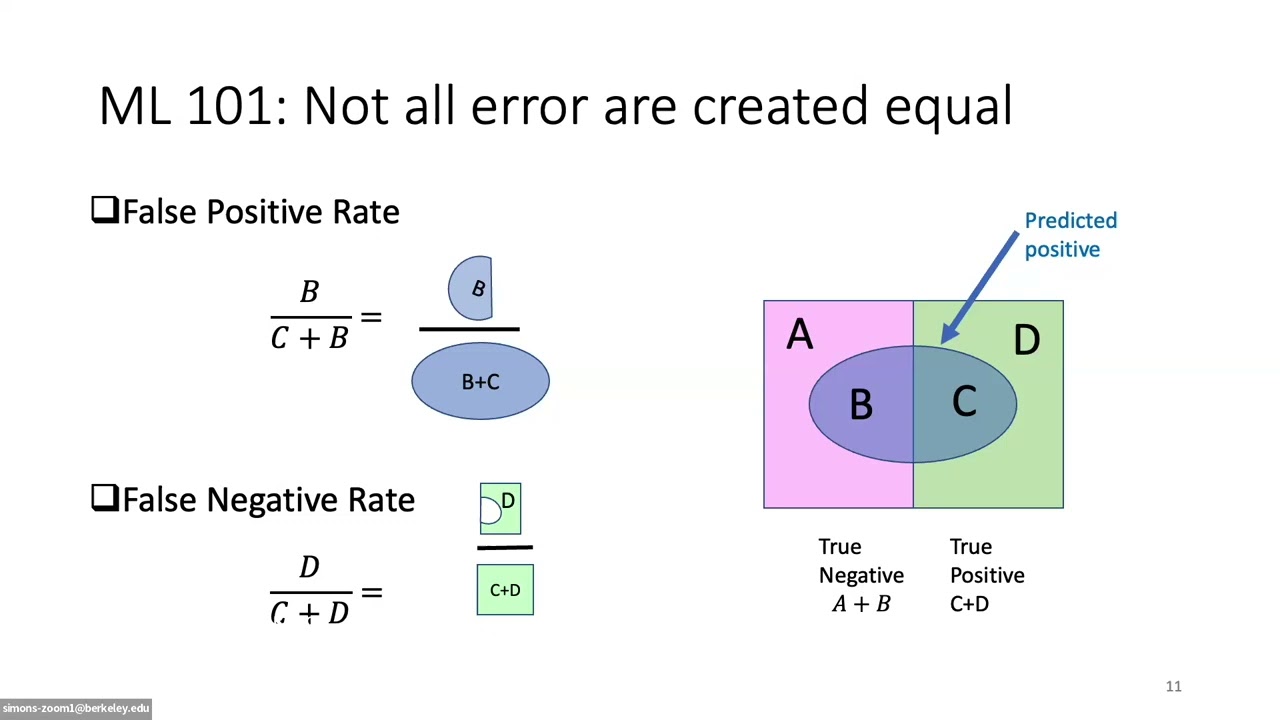
- Mansour introduces the topic of Type I and Type II errors and the importance of balancing precision and recall.
- Historical context: Cyril Cleverdon's work on precision and recall in information retrieval.
- Formal definition of the learning model: bipartite graph, users and items, and the objective of minimizing average precision and recall loss.
- Challenges: ERM is useless, and unbiased estimation is impossible due to one-sided data.
- Discussion of the realizable setting and sample complexity results.
- Transition to the agnostic setting and open problems.
- Conclusion and acknowledgments.
Cited Sources
- Simons Institute Talk Page — Official page for the talk, providing context and possibly slides.
Concurring Sources
- Precision and recall — Standard definitions of precision and recall.
Contribution & Novelties
The talk introduces a novel PAC learning framework for precision and recall objectives, addressing a gap in the literature where these metrics are often used heuristically. The formal model and sample complexity results are original contributions.
Pour aller plus loin :
- Precision and recall — Background on these metrics.
- Probably approximately correct learning — Foundational PAC model.
- F1 score — Alternative combination of precision and recall.
66 words
Radar Profile
The radar profile shows high scores in technical level and information quality, reflecting the advanced nature of the talk. The quantity of information is also high, but the reliability score is slightly lower due to the informal presentation and lack of external references.