Expedition to Obfustopia: Indistinguishability Obfuscation from Well-Studied Assumptions to New...
Keywords
Summary
153 words
Critical Evaluation
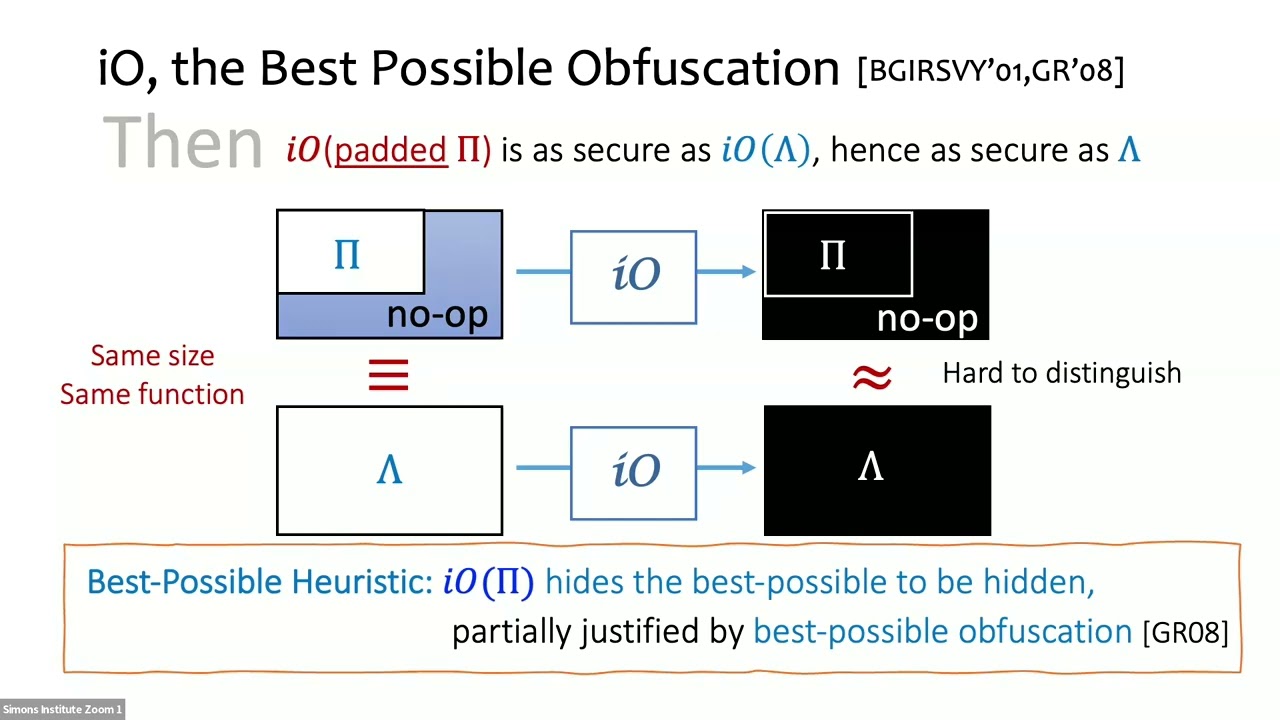
The talk is a masterful synthesis of the state of the art in indistinguishability obfuscation, delivered by one of the leading researchers in the field. Rachel Lin’s presentation is clear, well-structured, and technically accurate, making it an excellent resource for advanced students and researchers in cryptography. She successfully conveys the conceptual evolution of iO, from the initial impossibility results to the recent breakthroughs, without oversimplifying the technical details. The discussion of the ‘best possible’ heuristic and its connection to the random oracle heuristic is particularly insightful, as it provides a framework for understanding the security of iO in practice. The talk also highlights the importance of the punctured program technique, which has been instrumental in enabling applications of iO without relying on heuristics. The recent constructions based on well-studied assumptions, such as the JLS construction, are presented with sufficient detail to appreciate their significance, and the ongoing efforts to base iO on simpler lattice assumptions are appropriately contextualized. The talk does not shy away from open questions, which adds to its value as a research overview. The only minor criticism is that the talk assumes a high level of familiarity with cryptographic concepts, which may limit its accessibility to a broader audience. However, for the intended audience, this is not a drawback. Overall, this is an excellent talk that provides a comprehensive and up-to-date overview of iO, and it is highly recommended for anyone interested in the foundations of cryptography.
240 words
Title / Content Match
The title accurately reflects the content, which is an expedition through the history and recent advances in indistinguishability obfuscation.
Quality & Reliability
8/10
Talk by a leading researcher in cryptography, presenting a well-structured overview of the field with references to key works. The content is technical and assumes prior knowledge, but the presentation is clear and the claims are consistent with known literature.
Key Moments
Markers derived by PSI from the transcript: the creator did not define chapters.
- Introduction and motivation for program obfuscation
- Definition of ideal obfuscation and its power
- Impossibility of ideal obfuscation
- Introduction of indistinguishability obfuscation (iO)
- Applications of iO: public-key encryption, functional encryption, etc.
- The 'best possible' heuristic and its connection to random oracle
- Punctured program technique and its applications
- Early attempts at constructing iO and the JLS breakthrough
- Recent lattice-based constructions and open questions
Cited Sources
- Simons Institute talk page — Official page for the talk, providing abstract and related resources.
Concurring Sources
- Simons Institute talk page — The talk's abstract and related resources align with the content presented.
Contribution & Novelties
The talk provides a comprehensive and up-to-date overview of the field of indistinguishability obfuscation, synthesizing decades of research into a coherent narrative. It highlights the recent breakthrough constructions based on well-studied assumptions and the ongoing efforts to base iO on simpler lattice assumptions. The talk also offers valuable insights into the conceptual foundations of iO, such as the ‘best possible’ heuristic and its connection to the random oracle heuristic.
Pour aller plus loin :
- Indistinguishability obfuscation - Wikipedia — Provides a general overview and historical context.
- Jain, Lin, and Sahai (2021) - Indistinguishability Obfuscation from Well-Founded Assumptions — The breakthrough construction based on three well-studied assumptions.
- Lattice-based cryptography - Wikipedia — Background on lattice assumptions used in recent constructions.
119 words
Radar Profile
The radar profile shows high scores across all dimensions, indicating a talk that is rich in information, technically deep, and highly reliable. The balance between quantity and quality of information is particularly strong, making it an excellent resource for advanced audiences.
💬 No comments were provided for analysis.