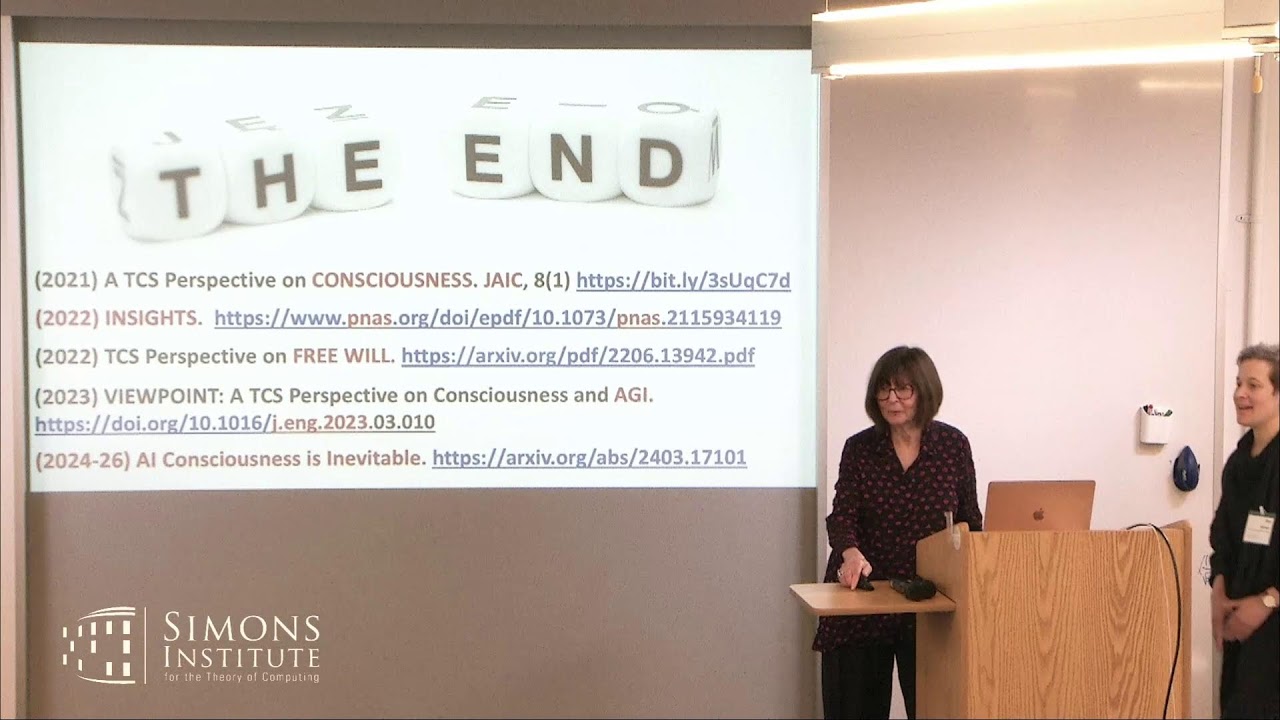
World Models and the Emergence of a “First-Person” Perspective in an AI
Keywords
Summary
180 words
Critical Evaluation
The talk provides a compelling and rigorous theoretical proposal for addressing the hard problem of consciousness from a computational perspective. Lenore Blum’s expertise in theoretical computer science lends credibility to the formal aspects of the Conscious Turing Machine (CTM). The argument is well-structured, starting with a historical grounding in Craik’s world models and Varela’s neurophenomenology, then building a formal architecture. The CTM is presented as a simple yet powerful model that integrates key features: a global workspace, competition among processors, and a self-generated multimodal language (Brainish). The emphasis on the co-evolution of Brainish and the world model is a novel contribution, suggesting that subjective experience arises from the system’s internal dynamics rather than its input-output behavior. The use of a fair competition mechanism, inspired by tennis tournaments but improved to be location-independent, is an elegant solution to avoid a central executive. The incorporation of probabilistic elements (coin toss neurons) to maintain simplicity is pragmatic and well-justified. However, the talk remains at a high level of abstraction; many details of the CTM are not fully elaborated, and the model is not empirically validated. The connection between the formal model and actual phenomenal consciousness is asserted rather than demonstrated. The talk does not address potential criticisms or alternative theories in depth. The sources cited are appropriate and authoritative (Craik, Varela, Baars), but the talk is primarily an expert opinion rather than a peer-reviewed study. The title accurately reflects the content, and the talk offers a thought-provoking perspective that could inspire future research. Overall, the talk is intellectually stimulating and scientifically grounded, but its speculative nature and lack of empirical evidence prevent it from achieving a perfect score.
275 words
Title / Content Match
The title accurately reflects the content, which focuses on world models and the emergence of a first-person perspective in AI, as discussed through the Conscious Turing Machine.
Quality & Reliability
8/10
The talk is given by a renowned computer scientist (Lenore Blum) at a prestigious institution (Simons Institute). It presents a formal theoretical model (the Conscious Turing Machine) grounded in established theories (global workspace theory, predictive processing). The argument is logically structured and references key literature (Craik, Varela). However, the model is not empirically validated and remains speculative, and the talk is an opinion/expert presentation rather than a peer-reviewed study.
Key Moments
Markers derived by PSI from the transcript: the creator did not define chapters.
- Introduction by Sherry, Lenore Blum begins talk on world models and first-person perspective.
- Blum introduces Kenneth Craik's definition of world models from 1943.
- Discussion of Francisco Varela's neurophenomenology and the hard problem of consciousness.
- Blum adapts Craik's ideas to the Conscious Turing Machine (CTM).
- Overview of the CTM architecture: global workspace, competition, and Brainish language.
- Explanation of the Up-Tree and Down-Tree, and the competition mechanism.
- Details on chunk definition and the role of auxiliary information.
- Discussion of the fairness of the competition and the use of probabilistic elements.
- Blum explains how the CTM's world model and Brainish co-evolve to give rise to subjective feelings.
- Conclusion: the CTM as a candidate for a computational model of consciousness.
Cited Sources
- Simons Institute talk page — Official page for the talk, providing context and possibly slides.
Concurring Sources
- Conscious Turing Machine (Blum & Blum, 2021) — The original paper introducing the CTM, which aligns with the talk's content.
- Global Workspace Theory (Baars, 1988) — Baars' theory is a foundational reference for the CTM's architecture.
Dissenting Sources
Contribution & Novelties
The talk proposes a novel formal framework for understanding consciousness in AI, integrating global workspace theory with a self-generated multimodal language (Brainish) and a world model. It suggests that a first-person perspective can emerge from the co-evolution of these components, offering a concrete computational architecture that could be implemented and tested. This goes beyond purely philosophical discussions by providing a testable model.
Pour aller plus loin :
- Conscious Turing Machine — Wikipedia article on the CTM, providing an overview and references.
- Global Workspace Theory — Wikipedia article on Baars’ theory, which is a key inspiration for the CTM.
- Neurophenomenology — Wikipedia article on Varela’s approach, linking subjective experience to neuroscience.
110 words
Radar Profile
The radar profile shows high scores in quantity and quality of information, with a moderate technical level and reliability. This indicates a talk that is rich in content and well-structured, but with a theoretical focus that may not be immediately accessible to all audiences. The reliability is moderate due to the speculative nature of the model.
💬 No comments were provided for analysis.