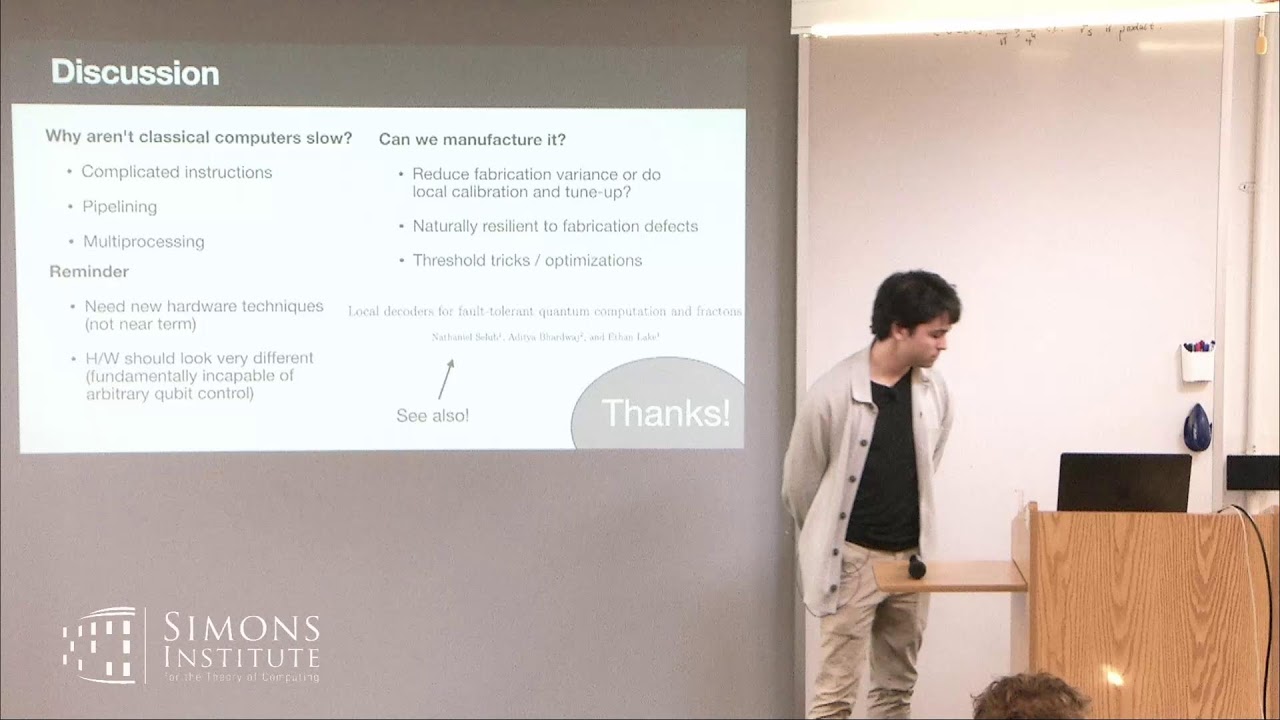
Talk by Chris Pattison (UC Berkeley)
Keywords
Summary
150 words
Critical Evaluation
The talk presents a novel and thought-provoking idea for scaling quantum computers by drastically reducing the number of control lines, which is a significant engineering bottleneck. The speaker clearly explains the motivation by comparing to classical processors, where a small number of pins control a huge number of transistors. The proposed solution, using periodic circuits and global control, is elegant and builds on existing fault-tolerant schemes. However, the talk is largely conceptual and lacks detailed technical depth; many crucial aspects are deferred to later slides or future work. The speaker acknowledges that this is futuristic and requires many hardware advances, such as identical qubits and finite gate sets, which are not yet achievable. The argumentation is coherent but relies on assumptions that may not hold in practice. The sources are not explicitly cited in the talk, but the link to the Simons Institute page provides context. Overall, the talk is valuable for inspiring new directions but is not a complete solution. The title is generic but accurate. The audience questions show engagement and highlight potential concerns, which the speaker addresses reasonably. The talk is suitable for a specialized audience in quantum computing and fault tolerance.
195 words
Title / Content Match
The title is generic but accurately reflects the content: a talk by Chris Pattison at UC Berkeley.
Quality & Reliability
8/10
Talk by a researcher at a reputable institution (UC Berkeley) presented at a workshop organized by the Simons Institute for the Theory of Computing. The content is technical and appears to be based on ongoing research, but it is not peer-reviewed and lacks detailed proofs or references in the talk itself.
Key Moments
Markers derived by PSI from the transcript: the creator did not define chapters.
- Introduction and motivation: scaling quantum computers with constant control lines.
- Comparison with classical processors: many transistors, few pins.
- Proposal to use 1D circuits and unroll them into periodic 3D structures.
- Explanation of period-3 circuit and how data flows through space.
- Discussion on global control lines and finite gate sets.
- Mention of building a quantum memory with existing 1D fault-tolerant schemes.
- Further details on the construction and challenges.
- Q&A session addressing universality and hardware requirements.
Cited Sources
- Simons Institute Talk Page — Official page for the talk, providing context and possibly slides.
Concurring Sources
- Simons Institute Talk Page — The talk is part of the Quantum Summer Cluster Final Workshop, indicating it is within the scope of current research.
Contribution & Novelties
The talk proposes a novel architecture for fault-tolerant quantum computing that reduces the number of control lines to a constant by using periodic circuits and global control. This could potentially overcome the wiring bottleneck in large-scale quantum computers. The idea of unrolling 1D circuits into 3D periodic structures is original and may inspire new hardware designs.
Pour aller plus loin :
- Fault-tolerant quantum computing — Overview of fault tolerance in quantum computing.
- Quantum error correction — Essential for fault tolerance.
- Surface code — A leading quantum error correction code.
- Quantum computing — General background.
94 words
Radar Profile
The radar profile shows high scores in technical level and information quality, reflecting the expert nature of the talk. The lower score in information quantity is due to the conceptual nature and lack of detailed proofs. Overall, the talk is strong in technical depth but may not provide comprehensive coverage.