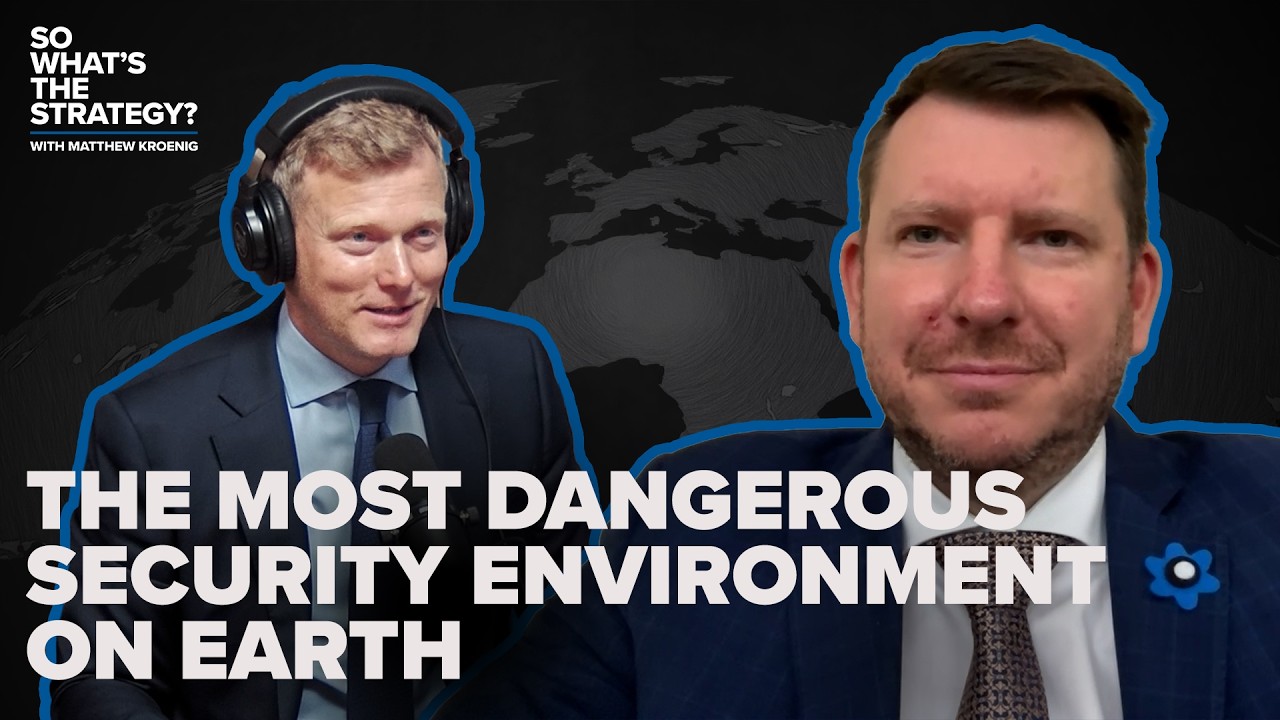
So what’s the strategy for Estonia navigating a changing security environment?
Keywords
Summary
189 words
Critical Evaluation
The video provides a compelling and insightful discussion of Estonia’s security strategy, delivered by a highly qualified official. Vseviov’s arguments are well-structured and grounded in historical experience, particularly the lessons drawn from the events of 1939 and the subsequent Soviet occupation. His emphasis on the two key lessons—’not fighting is not the safer option’ and ’never be alone again’—provides a clear framework for understanding Estonia’s approach. The discussion of Putin’s goals is particularly strong, as Vseviov draws on decades of Putin’s own statements and actions to argue that his intentions have been transparent. This analysis is persuasive and well-supported by references to specific events and policies. The video also effectively addresses the question of goals, with Vseviov articulating Estonia’s limited objectives and challenging listeners to consider the consequences of abandoning the principle of territorial integrity. The argument that helping Ukraine is not charity but a matter of European security is well-made and relevant. However, the discussion is primarily an opinion piece, and while Vseviov’s expertise is evident, the lack of formal citations or data means that some claims are not independently verifiable. The video’s strength lies in its strategic analysis and the unique perspective of a senior official from a frontline state. The title accurately reflects the content, and the discussion is accessible to a general audience while still offering depth for those familiar with the topic. Overall, the video is a valuable contribution to understanding Estonia’s security strategy and the broader geopolitical dynamics of the region.
247 words
Title / Content Match
The title accurately reflects the content, which focuses on Estonia's strategy in a changing security environment.
Quality & Reliability
8/10
The discussion features a senior Estonian official with deep expertise, providing informed perspectives on Estonia's security strategy. The content is well-argued and grounded in historical and geopolitical analysis, though it is an opinion-based discussion without formal citations or data.
Key Moments
Markers derived by PSI from the transcript: the creator did not define chapters.
- Introduction: Host Matthew Kroenig introduces the topic and guest Jonatan Vseviov.
- Vseviov describes Estonia's security environment, comparing it to Japan's handling of earthquakes.
- Vseviov discusses Estonia's history, focusing on the Molotov-Ribbentrop Pact and the lessons learned.
- Vseviov explains Estonia's integration into NATO and the EU, and its defense spending.
- Discussion on how Russia's invasions of Ukraine in 2014 and 2022 have affected Estonia's strategy.
- Vseviov analyzes Putin's goals and strategy, emphasizing his transparency and the threat to European security.
- Vseviov outlines Estonia's goals and the importance of upholding territorial integrity.
- Discussion on the need for Western resolve and the consequences of appeasement.
- Vseviov discusses the role of NATO and the importance of collective defense.
- Concluding remarks on Estonia's commitment to defense and the future of European security.
Contribution & Novelties
The video offers a unique insider perspective on Estonia’s security strategy, articulated by a senior official. It provides a clear framework of Estonia’s historical lessons and their application to current deterrence policies. The analysis of Putin’s goals is particularly insightful, drawing on his own statements and actions.
Pour aller plus loin :
- NATO — Official NATO website, relevant for understanding the alliance’s role in European security.
- The Grand Chessboard — Zbigniew Brzezinski’s book, referenced in the discussion, provides geopolitical context on Ukraine’s importance.
- Molotov-Ribbentrop Pact — Historical background on the pact that shaped Estonia’s strategic thinking.
96 words
Radar Profile
The radar profile shows high scores in quality of information and reliability, reflecting the expert's credibility and well-argued points. The quantity of information is moderate, as the discussion is focused but not exhaustive. The technical level is moderate, making it accessible to a broad audience.
💬 No comments were provided for analysis.