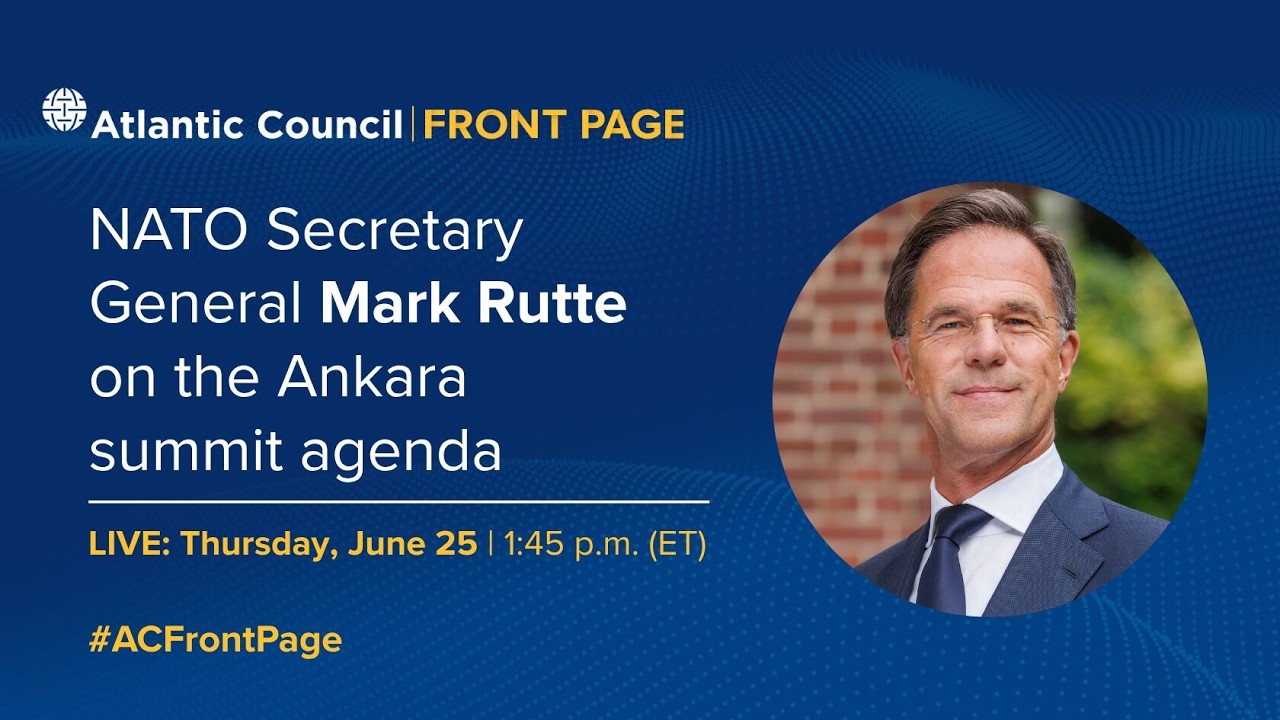
NATO Secretary General Mark Rutte on the Ankara summit agenda
Keywords
Summary
170 words
Critical Evaluation
The speech by NATO Secretary General Mark Rutte provides a comprehensive overview of the alliance’s strategic direction ahead of the Ankara summit. The content is authoritative, given his position, and aligns with official NATO communications. Rutte’s arguments are logically structured around three pillars: defense investment, industrial capacity, and support for Ukraine. He presents concrete data, such as the $1.2 trillion increase in defense spending by European allies and Canada since 2016, and the 20% rise in 2025, which lends credibility to his claims. However, the speech is essentially an opinion piece, lacking independent verification or critical analysis. Rutte attributes the surge in defense spending to President Trump’s leadership, a claim that may be contested; while Trump’s pressure likely played a role, other factors such as the war in Ukraine and shifting security perceptions also contributed. The emphasis on ‘NATO 3.0’ and the need for a ‘defense industrial revolution’ is forward-looking but somewhat vague, with limited specifics on how these goals will be achieved. The mention of specific companies and contracts suggests a strong industry-government partnership, but the potential for inefficiencies or over-reliance on private contractors is not addressed. The speech also touches on threats from Russia, China, North Korea, and Iran, but without deep analysis. Overall, the information is valuable for understanding NATO’s current priorities and rhetoric, but it should be complemented with independent sources for a balanced view. The title accurately reflects the content, and the speech is well-delivered, though it is more of a policy statement than a rigorous scientific analysis.
253 words
Title / Content Match
The title accurately reflects the content, as Rutte discusses his priorities for the upcoming Ankara summit.
Quality & Reliability
8/10
The speaker is the NATO Secretary General, providing authoritative insights into alliance strategy and defense investment. The content is consistent with official NATO positions and public data, though it is an opinion piece rather than peer-reviewed analysis.
Key Moments
Markers derived by PSI from the transcript: the creator did not define chapters.
- Introduction by Fred Kempe, President CEO of Atlantic Council
- Rutte begins speech, outlines three priorities for Ankara summit
- Discussion on defense investment, 5% GDP target, and examples of allies
- Emphasis on defense industrial revolution and need for innovation
- Commitment to Ukraine support, mention of Pillar Program and NATO-Ukraine Council
- Threat assessment: Russia, China, North Korea, Iran
- Conclusion: NATO 3.0, stronger Europe in stronger NATO
Cited Sources
- Atlantic Council — Host of the event and think tank providing analysis on transatlantic issues.
- NATO — Official NATO website, referenced implicitly as the organization's official communications.
Concurring Sources
- NATO official statements on defense spending — NATO reports on defense expenditure increases among allies.
Dissenting Sources
- Criticism of NATO spending targets
Contribution & Novelties
This video provides an authoritative statement from the NATO Secretary General on the alliance’s strategic priorities, offering insights into the upcoming Ankara summit. It highlights the concept of ‘NATO 3.0’ and the emphasis on a defense industrial revolution, which are relatively new framings. The speech also underscores the role of President Trump in catalyzing defense spending increases, a perspective that may be debated.
Pour aller plus loin :
- NATO official website — Official information on NATO policies and summits.
- Atlantic Council — Think tank analysis on transatlantic security and defense.
- Rheinmetall — Example of defense industry expansion mentioned in the speech.
- Aselsan — Turkish defense electronics company highlighted as a driver of innovation.
113 words
Radar Profile
The radar profile shows high scores in quantity and quality of information, reflecting the authoritative and data-rich nature of the speech. The technical level is moderate, suitable for a general audience, while reliability is high due to the speaker's position. Overall, the content is strong in providing strategic insights but may lack critical depth.
💬 No comments were provided for analysis.