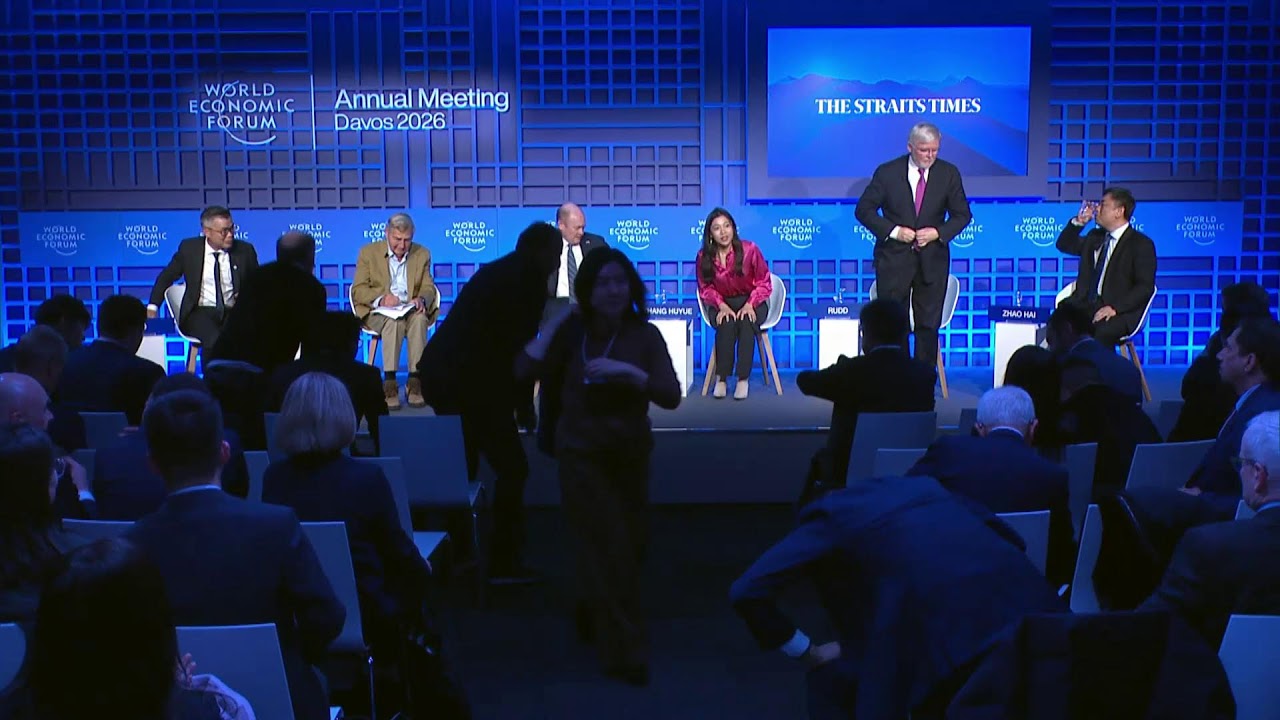
US and China: Where Will They Land? | World Economic Forum Annual Meeting 2026
Keywords
Summary
169 words
Critical Evaluation
Value of the Information & Strength of the Argument
The panel provides valuable insights into the perspectives of different stakeholders, including US political figures, Chinese scholars, and international experts. The argumentation is generally well-reasoned, with each speaker supporting their views with references to recent events and policies. However, the discussion is largely opinion-based, with limited empirical data or citations. The value lies in the diversity of viewpoints and the nuanced understanding of the challenges ahead.
Scientific Rigor, Source Quality, Title Accuracy
The video is a panel discussion, not a scientific study, so the rigor is moderate. The speakers are credible, but the content is not peer-reviewed. The title accurately reflects the content. The description provides links to the World Economic Forum’s official channels, which are reliable sources for the organization’s events. No specific academic sources are cited in the video, but the speakers reference concepts like the Thucydides Trap and policy documents.
152 words
Title / Content Match
The title accurately reflects the content, which focuses on the future trajectory of US-China relations.
Quality & Reliability
7/10
Panel of recognized experts and officials, but discussion is largely opinion-based and lacks verifiable data. The video is a debate, not a peer-reviewed analysis.
Key Moments
Markers derived by PSI from the transcript: the creator did not define chapters.
- Introduction of the panel and context of President Trump's speech.
- Graham Allison discusses the Thucydides Trap and its relevance to US-China relations.
- Senator Coons criticizes Trump's approach and emphasizes the importance of alliances.
- Zhao Hai responds to Trump's speech, highlighting misperceptions and the need for cooperation.
- Kevin Rudd outlines the three T's (tariffs, technology, Taiwan) as core issues.
- Angela Zhang discusses the challenges of reaching agreements and the incentives for stability.
- Panelists agree that tactical agreements are more likely than a comprehensive framework.
Cited Sources
- World Economic Forum — Official website of the World Economic Forum, the organizer of the event.
- World Economic Forum on LinkedIn — Official LinkedIn page of the World Economic Forum.
- World Economic Forum on YouTube — Official YouTube channel of the World Economic Forum.
- World Economic Forum on Flipboard — Official Flipboard page of the World Economic Forum.
Concurring Sources
- World Economic Forum — The official website provides additional reports and articles on US-China relations.
Contribution & Novelties
The video offers a timely and multi-perspective analysis of US-China relations, capturing the views of policymakers and scholars. It highlights the tension between competition and cooperation, and the practical challenges of managing the relationship. The discussion of the Thucydides Trap and the concept of ‘managed strategic competition’ provides a useful framework for understanding the dynamics.
Pour aller plus loin :
- Thucydides Trap — A concept popularized by Graham Allison, central to the discussion.
- US-China trade war — Background on the trade tensions mentioned.
- Taiwan status — Context for the Taiwan issue discussed.
92 words
Radar Profile
The radar profile shows moderate to high scores across the board, with a slight dip in technical level due to the non-technical nature of the discussion. The video is strong in information quantity and quality, but the reliability is moderate given the opinion-based nature.
💬 The comments are predominantly positive, with many praising the Chinese speakers and expressing support for China's stance. There is also criticism of the US approach and some negative remarks about Western panelists. Overall, the sentiment is mixed but leans positive towards China.