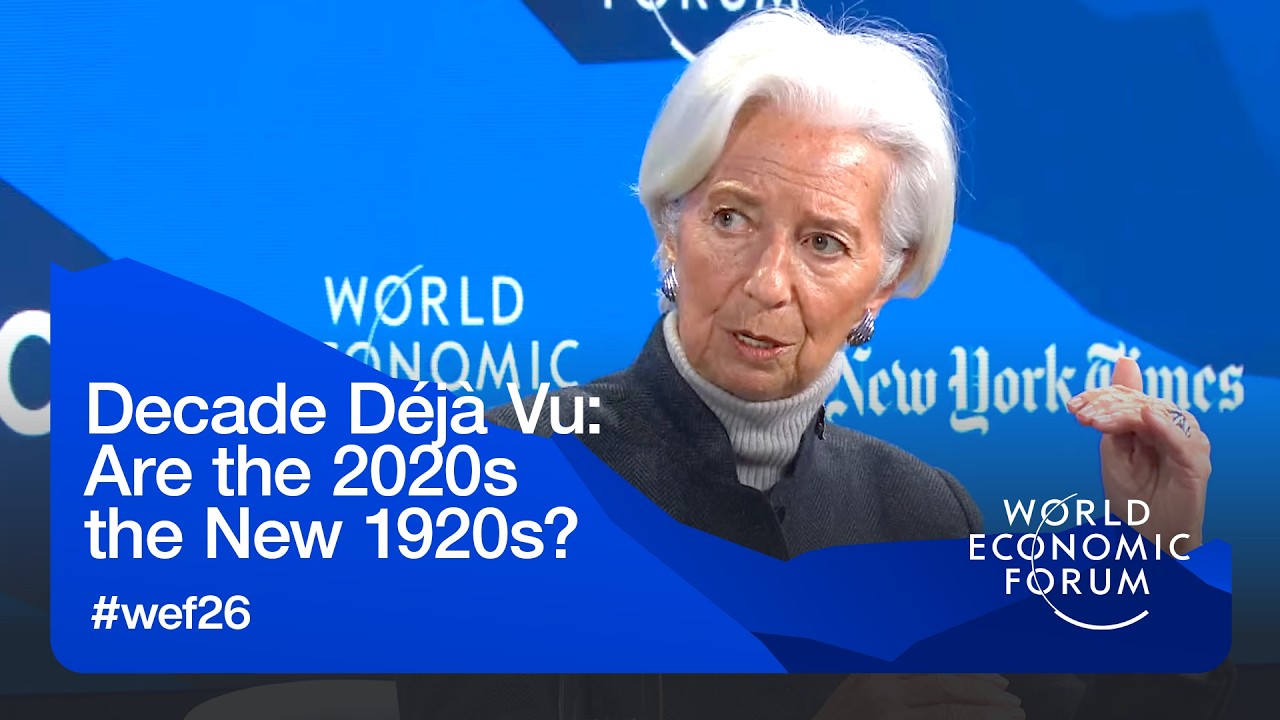
Decade Déjà Vu: Are the 2020s the New 1920s? | World Economic Forum Annual Meeting 2026
Keywords
Summary
150 words
Critical Evaluation
Value of the Information & Strength of the Argument
The discussion provides valuable insights from leading figures in finance and economics, offering diverse perspectives on the potential parallels and divergences between the 2020s and 1920s. The arguments are well-articulated, with each speaker grounding their views in historical context or current data. For instance, Lagarde cites the decline in global trade as a share of GDP in the 1920s, while Griffin points to the unprecedented scale of government spending today. The panel avoids oversimplification, acknowledging uncertainties, such as the actual productivity gains from AI. The moderation by Sorkin effectively probes the speakers, encouraging deeper analysis. However, as a debate, the arguments are not systematically evidenced, and some claims are speculative, such as the potential for AI to be a ‘savior’ for productivity. Overall, the value lies in the high-level expert opinions and the framing of key economic issues.
Scientific Rigor, Source Quality, Title Accuracy
The panel maintains a high level of rigor, with speakers referencing historical events, economic data, and their own expertise. Adam Tooze provides historical context, citing the post-WWI unipolar moment and the failure of the League of Nations. Christine Lagarde references her own 2024 speech and WTO data on trade restrictions. Larry Fink and Ken Griffin draw on their extensive experience in finance. The discussion is well-structured and stays on topic. The title accurately reflects the content, which directly addresses the question of whether the 2020s are the new 1920s. No formal citations are given, but the speakers’ credibility and the use of specific examples enhance the reliability. The description provides links to the World Economic Forum’s official channels, which are relevant for further context.
277 words
Title / Content Match
The title accurately reflects the central theme of the discussion, which directly compares the current decade to the 1920s.
Quality & Reliability
8/10
Panel of high-profile experts (Christine Lagarde, Larry Fink, Ken Griffin, Adam Tooze) provides informed perspectives on economic parallels between the 2020s and 1920s. Discussion is nuanced and grounded in historical and economic analysis, though it is a debate format with subjective viewpoints and no formal citations.
Key Moments
Markers derived by PSI from the transcript: the creator did not define chapters.
- Introduction of panel and topic by Andrew Ross Sorkin.
- Adam Tooze discusses the unipolar moment of the 1920s and the failure of political underpinnings.
- Christine Lagarde compares technological breakthroughs of the 1920s to AI, highlighting risks of fragmentation.
- Larry Fink emphasizes the need for cooperation to compete with China and the importance of AI diffusion.
- Ken Griffin identifies government overspending as the main recklessness, contrasting with the 1920s.
- Discussion on sovereign debt and the role of central banks, with Lagarde warning against fiscal dependency.
- Adam Tooze connects the current political polarization to the 1920s and the ghost of fascism.
- Debate on the effectiveness of fiscal stimulus in 2008 and COVID, with Fink and Tooze offering perspectives.
- Lagarde discusses the importance of productive vs. unproductive debt and the need for fiscal responsibility.
- Conclusion: panel reflects on the lessons from the 1920s and the uncertainties ahead.
Cited Sources
- World Economic Forum — Official website of the World Economic Forum, providing context on the organization and its annual meeting.
- World Economic Forum on Flipboard — Flipboard page of the World Economic Forum, offering curated content.
- World Economic Forum on LinkedIn — LinkedIn page of the World Economic Forum, providing professional updates.
- World Economic Forum on YouTube — YouTube channel of the World Economic Forum, hosting videos of sessions.
Concurring Sources
- World Economic Forum — The organization hosting the discussion, providing institutional context.
Contribution & Novelties
The video offers a high-level, multi-perspective analysis of the parallels between the 2020s and the 1920s, bringing together voices from central banking, finance, and academia. It provides a nuanced discussion that goes beyond simple historical analogies, highlighting both similarities (technological revolutions, financial booms) and critical differences (global nature of AI, scale of government debt). The panel’s insights on the risks of fragmentation for AI development and the importance of productive vs. unproductive debt are particularly valuable.
Pour aller plus loin :
- The Great Depression — Historical context for the end of the 1920s boom.
- Artificial intelligence — Overview of AI technology and its economic implications.
- Sovereign debt — Discussion on government debt and its economic impact.
- Productivity — Concept central to the debate on AI’s potential benefits.
127 words
Radar Profile
The radar profile shows high scores in information quantity, quality, and reliability, with a moderate technical level. This indicates a well-informed discussion that is accessible to a broad audience while still offering depth for those interested in economics and finance.
💬 Sur les 0 commentaires analysés, aucune tendance n'est disponible.