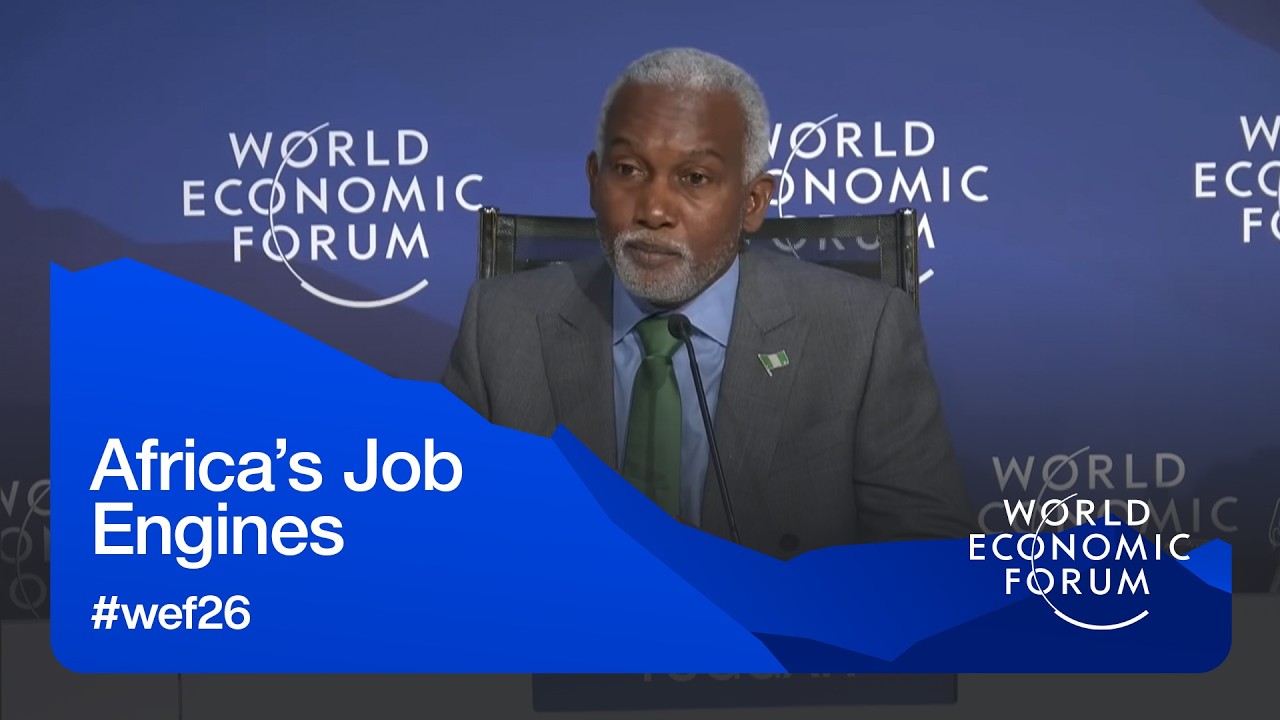
Africa’s Job Engine | World Economic Forum Annual Meeting 2026
Keywords
Summary
165 words
Critical Evaluation
Value of the Information & Strength of the Argument
The session provides valuable insights from high-level policymakers and a social enterprise leader, offering a multi-faceted view of Africa’s job creation landscape. The argumentation is largely anecdotal, relying on personal experiences and national examples rather than systematic evidence. The moderator effectively frames the urgency, but the discussion lacks deep analysis of trade-offs or potential negative consequences of proposed policies. The emphasis on social enterprises as a key driver is supported by a referenced report, but the data is not independently verified. Overall, the value lies in the diversity of perspectives and practical policy directions, though the argumentation could be strengthened with more rigorous data and critical examination.
Scientific Rigor, Source Quality, Title Accuracy
The session references the World Economic Forum’s report on social enterprises, but specific sources are not cited during the discussion. The title accurately reflects the content, focusing on Africa’s job engine. The panelists’ credentials lend authority, but the lack of detailed citations and reliance on anecdotal evidence reduce the scientific rigor. The description provides links to the WEF website and social media, but these are not direct sources for the claims made. Overall, the sources are credible but not systematically referenced, and the title-content alignment is good.
209 words
Title / Content Match
The title accurately reflects the session's focus on Africa's job creation challenges and potential solutions, though it is somewhat broad.
Quality & Reliability
7/10
The discussion features high-level government officials and a social enterprise leader, providing authoritative perspectives. However, claims are largely anecdotal and lack rigorous data verification, with some statistics cited without clear sources.
Key Moments
Markers derived by PSI from the transcript: the creator did not define chapters.
- Introduction by moderator Godfrey Mutizwa, framing the 'boom or bust' question for Africa's job market.
- Ethiopia's Finance Minister outlines three pathways for job creation: agri-food value chains, light manufacturing, and services.
- Nigeria's Foreign Affairs Minister discusses macroeconomic reforms, including currency stabilization and subsidy removal.
- Angela Oduor Lungati highlights key findings from the WEF social enterprise report, emphasizing women-led enterprises and access to finance.
- Panelists give one-minute responses on how to use AfCFTA to create jobs, with calls for simplified compliance and focus on market integration.
- Audience question from Ernest Darko on barriers faced by innovators, including tax and data regulations.
- Audience questions on youth participation in global value chains and informal economy formalization.
Cited Sources
- World Economic Forum — Official website of the World Economic Forum, hosting the session and related reports.
- WEF YouTube Channel — Official YouTube channel where the video is published.
- WEF LinkedIn — LinkedIn page of the World Economic Forum.
- WEF Flipboard — Flipboard page of the World Economic Forum.
Concurring Sources
- World Economic Forum — The WEF's official website provides context on their initiatives and reports, aligning with the session's themes.
Contribution & Novelties
The session provides a platform for high-level African policymakers to discuss job creation strategies, offering insights into national reforms and regional initiatives. It highlights the role of social enterprises as a significant but often overlooked driver of employment and GDP. The discussion underscores the need for practical implementation of AfCFTA and the importance of energy integration for trade. The novelty lies in the direct engagement between policymakers and social enterprise leaders, bridging the gap between policy and grassroots innovation.
Pour aller plus loin :
- African Continental Free Trade Area (AfCFTA) — Overview of the AfCFTA, its objectives, and implementation status.
- Social enterprise — Definition and examples of social enterprises, relevant to the report discussed.
- Ushahidi — Information about the organization led by Angela Oduor Lungati, a platform for crowdsourcing crisis information.
131 words
Radar Profile
The radar profile shows balanced scores across information quantity, quality, technical level, and reliability, indicating a well-rounded discussion. The high reliability score reflects the authoritative panel, while the moderate technical level suggests accessibility to a general audience.
💬 Sur les 0 commentaires analysés, aucune tendance n'est disponible.