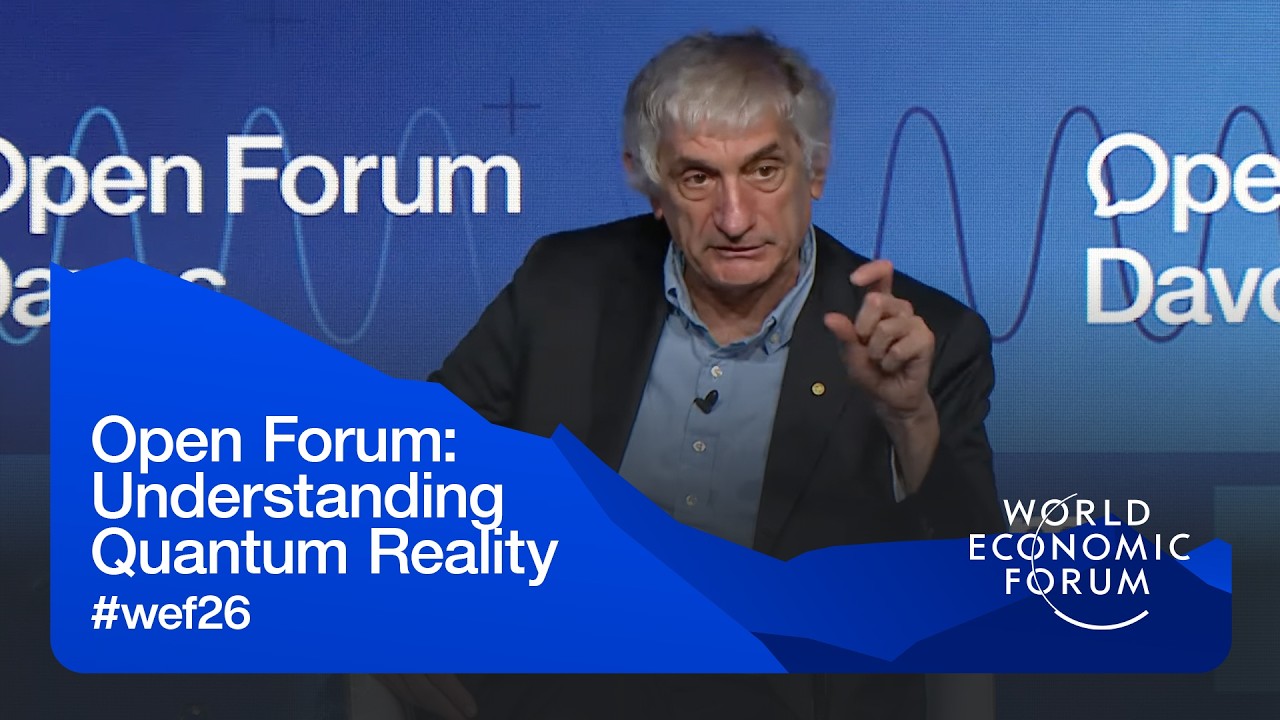
Open Forum: Understanding Quantum Reality | World Economic Forum Annual Meeting 2026
Keywords
Summary
157 words
Critical Evaluation
Value of the Information & Strength of the Argument
The panel provides valuable insights into the current state and future directions of quantum technologies. The speakers offer diverse perspectives: Martinis explains the technical foundations clearly, Budil details the role of national labs, McLaughlin presents practical applications and critiques of current AI models, Oddershede discusses strategic European investment, and Teo highlights policy and societal applications. The argumentation is generally solid, grounded in the speakers’ expertise, though some claims (e.g., about the potential of quantum computing) are presented without detailed evidence. The discussion is balanced, acknowledging both opportunities and challenges.
Scientific Rigor, Source Quality, Title Accuracy
The scientific rigor is high given the credentials of the speakers, but the discussion remains at a high level without deep technical detail. No specific sources are cited within the video; the description provides only general links to the World Economic Forum. The title accurately reflects the content, which is an open forum discussion on quantum reality. The panel’s credibility is strong, but the lack of specific references limits the ability to verify claims independently.
179 words
Title / Content Match
The title accurately reflects the content: an open forum discussion on quantum reality and its implications.
Quality & Reliability
8/10
Panel of renowned experts (Nobel laureate, national lab director, industry leaders, policy maker) providing authoritative insights. However, the discussion is high-level and lacks detailed technical depth, and no specific sources or data are cited.
Key Moments
Markers derived by PSI from the transcript: the creator did not define chapters.
- Introduction by moderator Paul Alivisatos, setting the stage for the panel.
- John Martinis explains the basics of quantum computing, superposition, and parallelism.
- Kimberly Budil discusses national laboratory efforts in quantum materials, error correction, and sensing.
- Andrew McLaughlin talks about quantum-inspired algorithms on classical hardware and critiques language models for science.
- Lene Oddershede presents the European perspective, emphasizing strategic investment and collaboration.
- Josephine Teo discusses Singapore's policy approach, focusing on port optimization and ecosystem building.
- Discussion on the importance of collaboration and the social nature of science.
- Further exploration of applications in finance and logistics, and the need for governance.
- Concluding remarks on the future of quantum technologies and the role of young people.
Cited Sources
- World Economic Forum — Official website of the World Economic Forum, hosting the event.
- World Economic Forum on YouTube — Official YouTube channel of the World Economic Forum, where the video is published.
Concurring Sources
- Quantum computing — General reference on quantum computing, consistent with the technical explanations in the video.
- Quantum sensing — Reference on quantum sensing, matching the applications discussed by Kimberly Budil.
External References
Contribution & Novelties
The video provides a high-level overview of quantum technologies from multiple perspectives, including technical, industrial, and policy angles. It highlights the importance of interdisciplinary collaboration and strategic investment. The discussion offers a unique blend of insights from a Nobel laureate, national lab director, industry leader, foundation chief, and government minister, making it valuable for understanding the broader ecosystem.
Pour aller plus loin :
- Quantum computing — Overview of quantum computing principles and history.
- Quantum sensing — Explanation of quantum sensing technologies and applications.
- Quantum error correction — Techniques for correcting errors in quantum computers.
- Niels Bohr — Background on the physicist who laid foundations of quantum mechanics.
- Lawrence Livermore National Laboratory — Official site of the national lab led by Kimberly Budil.
122 words
Radar Profile
The radar profile shows high scores in quality and reliability, reflecting the expertise of the speakers, but lower scores in technical depth and information quantity, as the discussion remains at a high level without detailed data. The overall balance suggests a reliable but introductory resource.