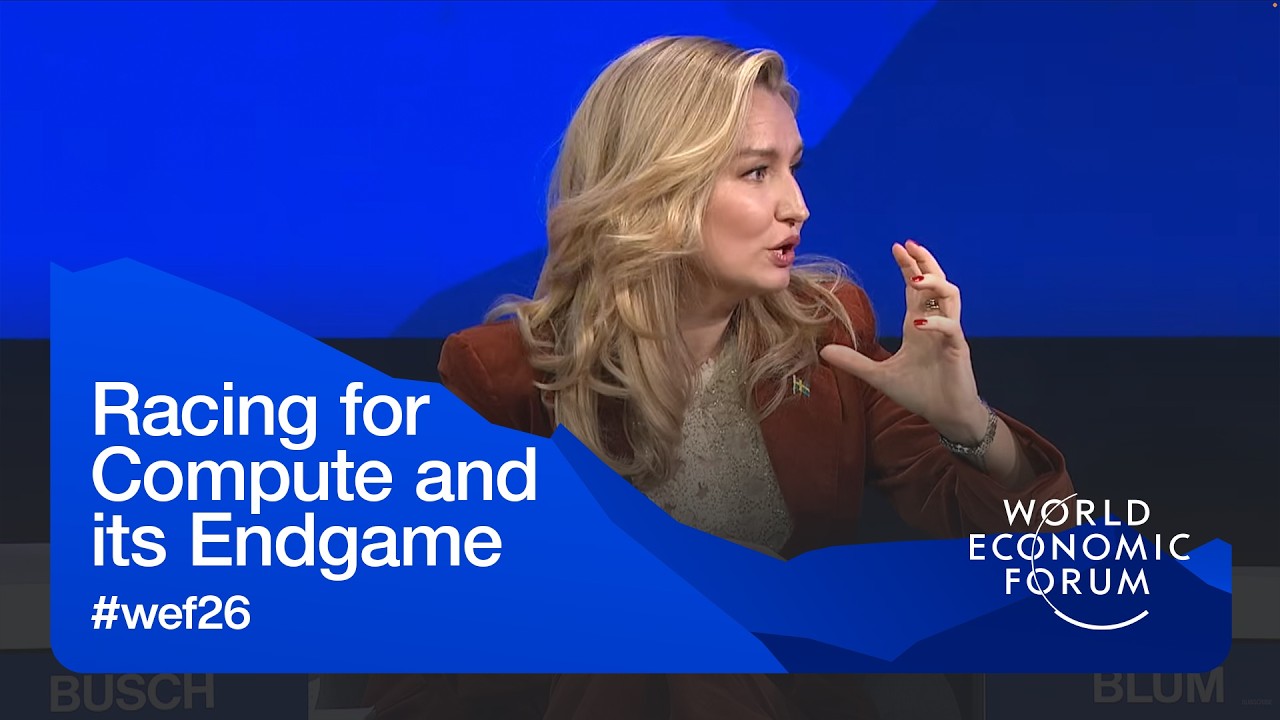
Racing for Compute and its Endgame | World Economic Forum Annual Meeting 2026
Keywords
Summary
172 words
Critical Evaluation
Value of the Information & Strength of the Argument
The value of the information lies in the diverse perspectives from industry leaders and a government official, providing insights into the practical challenges and strategies for scaling AI infrastructure sustainably. The argumentation is generally coherent, with each panelist building on the previous points. However, the discussion remains at a high level, with limited concrete data or detailed technical analysis. The moderator’s questions are insightful and help draw out key themes, but the responses often stay at the level of general principles rather than specific, verifiable claims.
Scientific Rigor, Source Quality, Title Accuracy
The scientific rigor is moderate. The panelists are credible experts, but the content is largely opinion and forward-looking statements without citations or references to specific studies. The sources cited are primarily the World Economic Forum’s own reports and social media channels, which are not scientific sources. The title accurately reflects the content, though the ’endgame’ is not clearly defined. The discussion touches on relevant topics like grid constraints, energy efficiency, and edge computing, but lacks depth in terms of evidence-based analysis. Overall, the session is more of a high-level policy and business discussion than a rigorous scientific presentation.
199 words
Title / Content Match
The title accurately reflects the discussion on the race for compute and its energy implications, though the 'endgame' is not clearly defined.
Quality & Reliability
7/10
Panel of high-level experts from industry and government, but content is largely opinion and forward-looking statements without detailed data or citations. Moderator provides context but no rigorous scientific analysis.
Key Moments
Markers derived by PSI from the transcript: the creator did not define chapters.
- Introduction by moderator VJ Vaitheeswaran, setting the stage on AI's energy challenges.
- Ebba Busch discusses the need for technology neutrality and faster permitting in Sweden.
- Olivier Blum talks about AI's role in making energy systems more intelligent and efficient.
- Rene Haas explains the potential of edge computing and the challenges of chip design for AI.
- Joshua Payne discusses Nscale's strategy of building data centers in Norway and other locations with abundant renewable energy.
- KR Sridhar likely discusses Bloom Energy's fuel cell technology and its role in providing clean power for data centers.
Cited Sources
- World Economic Forum — Mentioned as the host organization and source of reports.
- World Economic Forum on LinkedIn — LinkedIn page for the World Economic Forum.
- World Economic Forum on YouTube — YouTube channel for the World Economic Forum.
- World Economic Forum on Flipboard — Flipboard page for the World Economic Forum.
Concurring Sources
- IEA Report on Data Centres and AI — International Energy Agency report on energy consumption of data centres and AI.
Dissenting Sources
- Critique of AI's Energy Claims — Article questioning the accuracy of AI energy consumption projections.
Contribution & Novelties
The video provides a high-level overview of the energy challenges and opportunities associated with AI growth, featuring perspectives from industry leaders and a government official. It highlights the need for policy reform, technological innovation, and strategic location of data centers. The discussion on edge computing and the potential of AI to optimize energy systems offers some novel insights, though they are not deeply explored.
Pour aller plus loin :
- AI and Energy Consumption — Overview of AI’s energy footprint and related discussions.
- Data Center Energy Efficiency — Concepts and practices for reducing energy use in data centers.
- Edge Computing — Distributed computing paradigm that could reduce reliance on centralized data centers.
- Jevons Paradox — Economic concept relevant to rebound effects of efficiency improvements.
123 words
Radar Profile
The radar profile shows moderate scores across all dimensions, indicating a balanced but not exceptional presentation. The video offers a good overview of the topic but lacks deep technical detail and rigorous sourcing.
💬 No comments were provided for analysis.