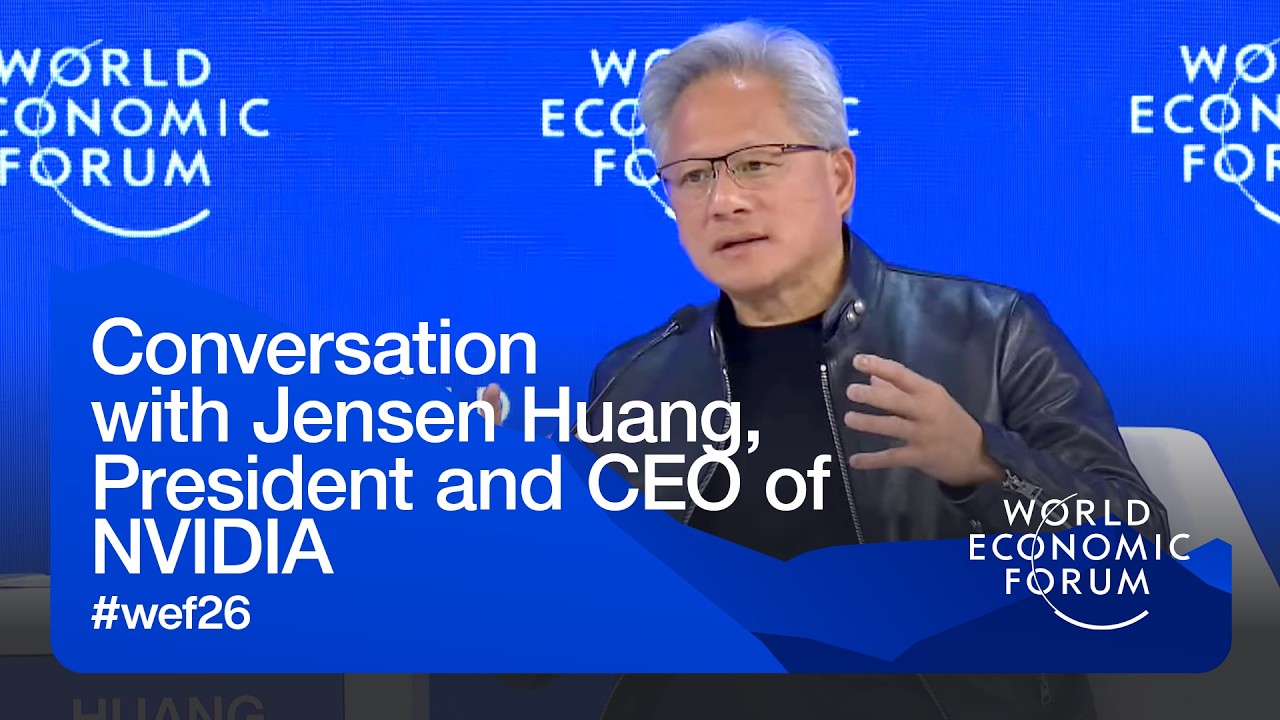
Conversation with Jensen Huang, President and CEO of NVIDIA | WEF Annual Meeting 2026
Keywords
Summary
170 words
Critical Evaluation
Value of the Information & Strength of the Argument
The value of the information lies in the insider perspective of a key industry leader on AI’s economic and societal impact. Huang provides a clear framework (five-layer cake) and concrete examples (radiology, nursing) to argue that AI will augment rather than replace human work. The argumentation is coherent and persuasive, though it relies on anecdotal evidence and optimistic projections rather than rigorous data. The discussion of open models and physical AI offers valuable insights into current technological trends.
Scientific Rigor, Source Quality, Title Accuracy
The scientific rigor is moderate: the conversation is an expert opinion, not a peer-reviewed analysis. Huang references specific companies (TSMC, Micron, Eli Lilly) and concepts (DeepSeek, Claude) but does not provide detailed citations. The title accurately reflects the content. The interview format allows for depth but lacks systematic sourcing. The audience comments are overwhelmingly positive, praising Huang’s clarity and leadership, with no significant critical analysis.
158 words
Title / Content Match
The title accurately reflects the content: a conversation with Jensen Huang at the WEF Annual Meeting.
Quality & Reliability
7/10
The conversation features a leading industry expert providing informed perspectives on AI infrastructure and economic impact. While not peer-reviewed, the arguments are coherent and grounded in observable industry trends. However, the format is an interview, not a systematic review, and some claims lack detailed evidence.
Key Moments
Markers derived by PSI from the transcript: the creator did not define chapters.
- Introduction by Larry Fink, praising Jensen Huang and NVIDIA's performance.
- Huang explains AI as a platform shift and describes the five-layer cake of AI infrastructure.
- Discussion of three major breakthroughs in AI: agentic AI, open models, and physical AI.
- Huang addresses job displacement concerns, using radiology and nursing as examples.
- Advice for developing countries to build AI infrastructure and close the technology divide.
- Opportunities for Europe in physical AI and robotics, leveraging its industrial base.
- Huang dismisses the AI bubble, citing high demand for GPUs and rising rental prices.
Cited Sources
- World Economic Forum — Official website of the organization hosting the event.
- WEF on Flipboard — WEF's Flipboard page.
- WEF on LinkedIn — WEF's LinkedIn company page.
- WEF on YouTube — WEF's YouTube channel.
Concurring Sources
- World Economic Forum — The event itself, aligning with the discussion on global economic impact.
Contribution & Novelties
The interview provides a high-level industry perspective on AI’s economic impact, emphasizing infrastructure buildout and the concept of ‘purpose vs. task’ for job impact. It offers a clear framework for understanding AI layers and highlights recent breakthroughs like open models and physical AI.
Pour aller plus loin :
- Agentic AI — Overview of autonomous AI systems.
- Physical AI — AI interacting with the physical world.
- DeepSeek — Open reasoning model mentioned in the interview.
- Radiology and AI — Context on AI in medical imaging.
84 words
Radar Profile
The radar profile shows high scores in information quantity and quality, with moderate technical depth and reliability. This reflects a balanced, informative interview that is accessible but not deeply technical, and relies on expert opinion rather than empirical evidence.
💬 Très positif. Sur les 30 commentaires analysés, la grande majorité exprime une admiration pour la clarté et la vision de Jensen Huang, avec des éloges sur sa capacité à expliquer l'IA simplement.