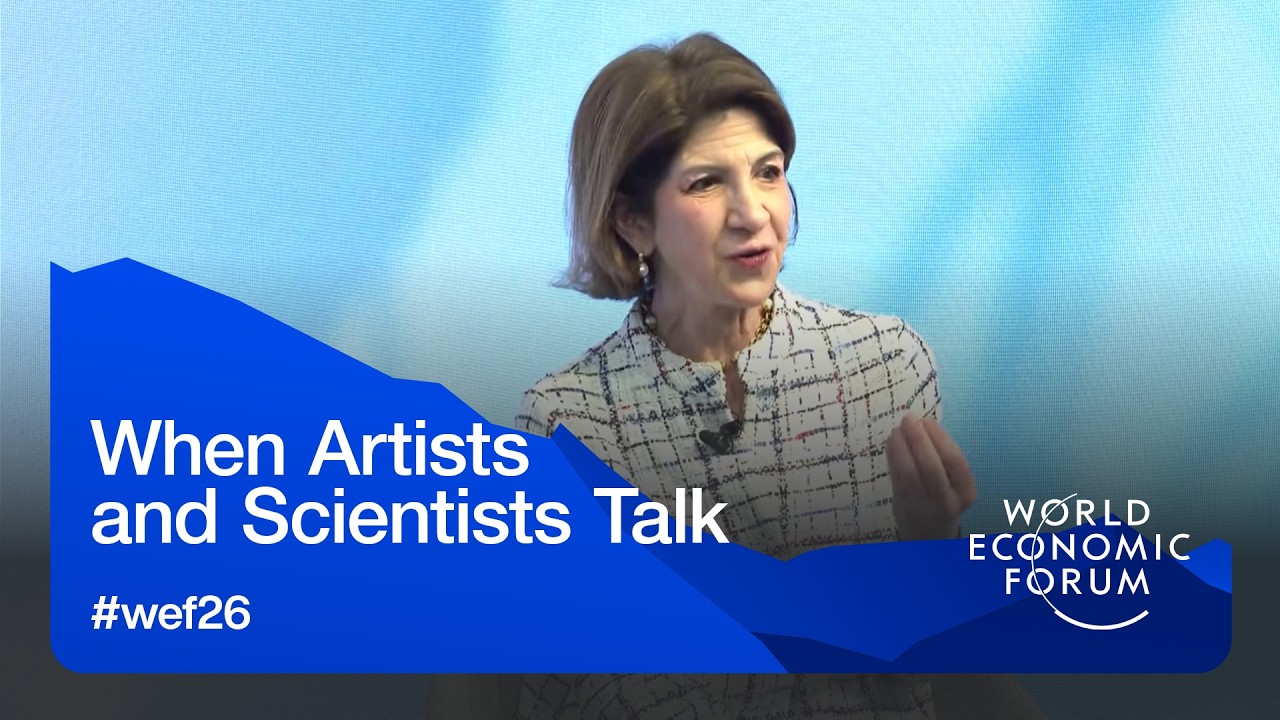
When Artists and Scientists Talk | World Economic Forum Annual Meeting 2026
Keywords
Summary
141 words
Critical Evaluation
Value of the Information & Strength of the Argument
The value of the information lies in the diverse perspectives of the panelists, who provide concrete examples of how art and science can inform each other. Fabiola Gianotti draws parallels between the simplicity underlying complexity in physics and music, citing the three fundamental particles and seven notes. Thijs Biersteker describes his collaborative process with scientists, using data to create emotionally engaging installations that translate complex data into visceral experiences. Nomzamo Mbatha emphasizes the role of language and storytelling in making science relatable, while Caroline Lustenberger highlights the importance of art for mental well-being and science communication. The argumentation is coherent and persuasive, though it relies heavily on anecdotal evidence and personal opinions rather than systematic analysis. The panelists effectively make the case for interdisciplinary collaboration, but the discussion remains at a high level without delving into specific methodologies or outcomes.
Scientific Rigor, Source Quality, Title Accuracy
The scientific rigor is moderate; the discussion is not a formal scientific presentation but a panel of experts sharing perspectives. The speakers are credible, with Fabiola Gianotti’s tenure at CERN lending authority to her remarks. However, no specific studies or data are cited, and the claims are largely qualitative. The title accurately reflects the content, and the discussion stays on topic. The panel is well-moderated, and the speakers’ credentials are established. The lack of formal citations is typical for such panel discussions, but it limits the ability to verify specific claims. Overall, the content is reliable in its general assertions about the value of art-science collaboration, but it lacks the depth of a peer-reviewed source.
270 words
Title / Content Match
The title accurately reflects the content: a panel discussion on the collaboration between artists and scientists.
Quality & Reliability
8/10
Panel discussion featuring credible scientists and artists, with high-level institutional backing (WEF). The content is largely anecdotal and opinion-based, but speakers are authoritative in their fields. No specific scientific claims are made that require verification, and the discussion is well-moderated.
Key Moments
Markers derived by PSI from the transcript: the creator did not define chapters.
- Introduction of panelists by moderator Priyamvada Natarajan.
- Caroline Lustenberger discusses how art can make complex science understandable and its role in mental health.
- Thijs Biersteker explains how artists help scientists communicate emotionally, using his installation as an example.
- Fabiola Gianotti draws parallels between physics and music, emphasizing simplicity and beauty.
- Nomzamo Mbatha discusses the role of language and storytelling in translating science.
- Panelists discuss the impact of interdisciplinary storytelling on society and trust.
- Discussion on how art can accelerate scientific creativity and innovation.
- Panelists share views on integrating arts and sciences in education.
- Nomzamo Mbatha highlights societal bias against arts education.
- Closing remarks on the need for interdisciplinary approaches to global challenges.
Cited Sources
- World Economic Forum — Official website of the World Economic Forum, the organization hosting the panel.
- World Economic Forum on LinkedIn — LinkedIn page of the World Economic Forum, providing additional context on the organization.
- World Economic Forum on YouTube — YouTube channel of the World Economic Forum, where the video is published.
- World Economic Forum on Flipboard — Flipboard page of the World Economic Forum, offering curated content.
Concurring Sources
- World Economic Forum — The organization hosting the panel, aligning with its mission to foster public-private cooperation and interdisciplinary dialogue.
Contribution & Novelties
This panel provides a unique platform for direct dialogue between prominent artists and scientists, offering personal insights into the value of cross-disciplinary collaboration. The discussion highlights concrete examples, such as Thijs Biersteker’s data-driven installations and Fabiola Gianotti’s reflections on the aesthetic principles in physics, which are not commonly explored in mainstream media. The emphasis on the role of beauty and emotion in scientific discovery adds a nuanced perspective to the typical science communication discourse.
Pour aller plus loin :
- Art and Science: A Symbiotic Relationship — Overview of the historical and contemporary intersections between art and science.
- Science Communication — Discusses the importance of making science accessible to the public, a key theme in the panel.
- Interdisciplinarity — Explores the concept of combining knowledge from different disciplines, central to the discussion.
- CERN — The European Organization for Nuclear Research, where Fabiola Gianotti served as Director General, providing context for her remarks.
151 words
Radar Profile
The radar profile shows high scores in quality of information and global reliability, reflecting the credibility of the speakers and the coherent discussion. The quantity of information is moderate, as the panel is more conversational than data-dense. The technical level is low, making the content accessible to a general audience. Overall, the profile indicates a reliable and engaging discussion suitable for those interested in the intersection of art and science.
💬 No comments were provided for analysis.