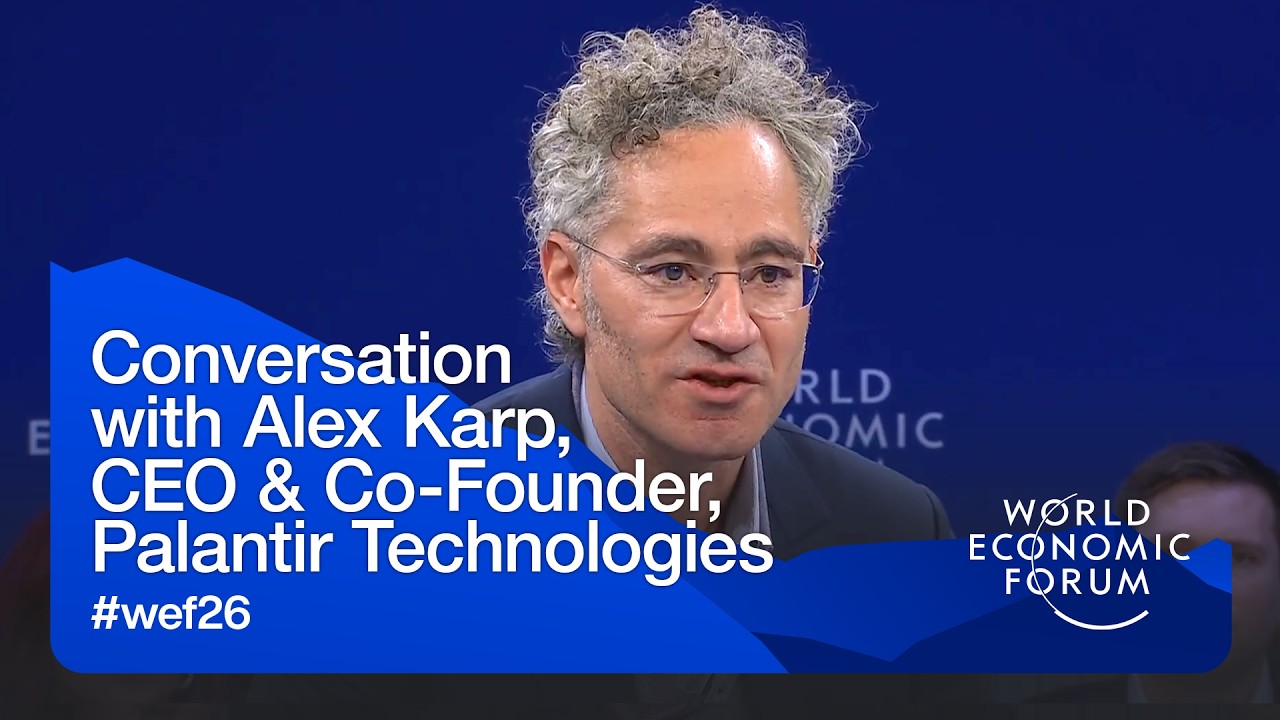
Conversation with Alex Karp, CEO and Co-Founder, Palantir Technologies | WEF Annual Meeting 2026
Keywords
Summary
162 words
Critical Evaluation
Value of the Information & Strength of the Argument
The value of the information lies in Karp’s unique perspective as a CEO at the intersection of AI, defense, and business. He provides concrete examples from battlefield operations, illustrating how AI must adapt to chaotic environments. His argument that AI can expose organizational inefficiencies and that off-the-shelf LLMs are insufficient is compelling. However, the discussion is largely anecdotal and promotional, lacking empirical data or rigorous analysis. The argumentation is coherent but relies heavily on Karp’s authority rather than evidence.
Scientific Rigor, Source Quality, Title Accuracy
The scientific rigor is moderate; the conversation is an expert opinion without citations to studies or data. The sources are limited to the WEF’s official channels, which are not academic. The title accurately reflects the content, but the discussion is more of a high-level dialogue than a detailed technical analysis. The lack of critical questioning and the promotional tone reduce the overall rigor.
157 words
Title / Content Match
The title accurately reflects the content: a conversation with Alex Karp at the WEF Annual Meeting 2026.
Quality & Reliability
7/10
The conversation features a leading industry figure discussing AI applications in defense and business. While insightful, it is largely anecdotal and promotional, lacking rigorous scientific evidence or data. The interviewer's questions are soft, and the discussion remains at a high level without deep technical detail.
Key Moments
Markers derived by PSI from the transcript: the creator did not define chapters.
- Introduction of Alex Karp by Larry Fink, highlighting Palantir's 73% compounded return.
- Karp discusses the historical link between military and industrial development.
- Karp explains the challenges of deploying AI in battlefield conditions, using Ukraine as an example.
- Karp talks about the translation of defense AI to commercial sectors, like insurance and healthcare.
- Discussion on AI adoption lag and the need for ontology layers.
- Karp addresses the impact of AI on jobs, emphasizing vocational training and aptitude.
- Karp discusses the future of AI in developed and developing economies.
Cited Sources
- World Economic Forum — Official website of the World Economic Forum, hosting the event.
- WEF on Flipboard — WEF's Flipboard page for curated content.
- WEF on LinkedIn — WEF's LinkedIn company page.
- WEF on YouTube — WEF's YouTube channel where the video is published.
Concurring Sources
- World Economic Forum — The event and platform for the discussion.
Contribution & Novelties
The video offers a rare, high-level perspective from a leading AI defense contractor on how AI is applied in real-world, high-stakes environments. Karp’s emphasis on the ‘ground truth’ of battlefield conditions and the need for ontology layers provides a nuanced view beyond typical AI hype. The discussion on aptitude and vocational training adds a fresh angle to the AI and jobs debate.
Pour aller plus loin :
- Ontology (information science) — Relevant to Karp’s emphasis on ontology layers for AI orchestration.
- Artificial intelligence in government — Discusses AI applications in public sector, including defense.
- Palantir Technologies — Background on the company and its products.
104 words
Radar Profile
The radar profile shows moderate scores across all dimensions, with a slight dip in technical level. This indicates a balanced but not deeply technical discussion, suitable for a general audience interested in AI's strategic implications.
💬 Négatif. Sur les 30 commentaires analysés, une majorité exprime du scepticisme ou des critiques envers Palantir et le contenu de l'interview, certains allant jusqu'à qualifier le discours de vide ou de promotionnel.