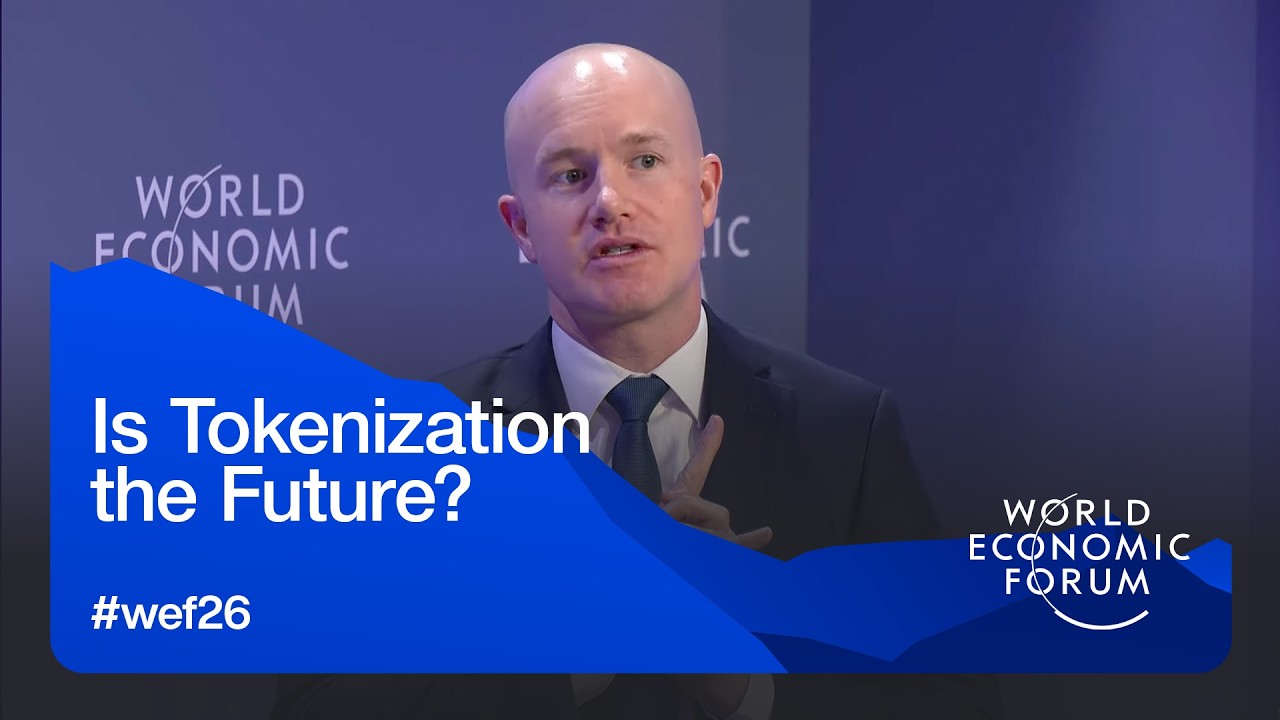
Is Tokenization the Future? | World Economic Forum Annual Meeting 2026
Keywords
Summary
192 words
Critical Evaluation
Value of the Information & Strength of the Argument
The panel provides valuable insights from multiple perspectives: central banking, traditional finance, and crypto industry. The arguments are generally well-articulated, with speakers supporting their positions with examples and references to ongoing initiatives. However, the discussion is largely opinion-based, with limited empirical evidence. The debate format allows for direct engagement, but some points are oversimplified. The value lies in the diversity of viewpoints and the high-level expertise of the speakers.
Scientific Rigor, Source Quality, Title Accuracy
The discussion is scientifically rigorous in the sense that it involves experts with deep knowledge, but it is not a formal scientific presentation. Sources are not explicitly cited, but references are made to projects like Project Europa, MiCA, and GENIUS Act. The title accurately reflects the content. The panel is well-moderated, and the conversation stays on topic. However, the lack of concrete data and the reliance on anecdotal evidence reduce the overall scientific rigor.
158 words
Title / Content Match
The title accurately reflects the central topic of the panel discussion on tokenization and its future in global finance.
Quality & Reliability
7/10
Panel of high-level experts from central banking, traditional finance, and crypto industry, providing diverse perspectives. However, the discussion is largely opinion-based and lacks empirical data or rigorous analysis. Some claims are unverifiable and the debate format may oversimplify complex issues.
Key Moments
Markers derived by PSI from the transcript: the creator did not define chapters.
- Introduction of the panel and topic by Karen Tso.
- François Villeroy de Galhau discusses the benefits and threats of tokenization, mentioning the digital euro and wholesale CBDC.
- Valérie Urbain talks about Euroclear's initiatives and the potential for financial inclusion.
- Bill Winters expresses confidence in the digital future of transactions and discusses regulatory challenges.
- Brian Armstrong argues for democratization of investment and introduces the concept of a 'Bitcoin standard'.
- Brad Garlinghouse highlights the growth of stablecoins and the need for bridges between traditional and decentralized finance.
- Debate on trust, sovereignty, and the role of central banks.
- Discussion on stablecoin regulation and the Clarity Act.
- Exchange on whether the digital euro should pay interest.
- Closing remarks and summary.
Cited Sources
- World Economic Forum — Official website of the World Economic Forum, hosting the event.
- World Economic Forum on Flipboard — WEF's Flipboard page for curated content.
- World Economic Forum on LinkedIn — WEF's LinkedIn page.
- World Economic Forum on YouTube — WEF's YouTube channel where the video is hosted.
Concurring Sources
- World Economic Forum — The event is hosted by WEF, and the discussion aligns with their agenda on technology and finance.
Contribution & Novelties
The panel provides a high-level overview of the current state and future prospects of tokenization, bringing together perspectives from central banks, traditional finance, and crypto industry. It highlights the growing momentum of stablecoins and the potential for tokenization to democratize investment. The discussion also touches on regulatory developments and the debate over the ‘Bitcoin standard’.
Pour aller plus loin :
- Tokenization (asset tokenization) — Overview of asset tokenization concepts.
- Stablecoin — Explanation of stablecoins and their role.
- Central bank digital currency — Information on CBDCs, including the digital euro.
89 words
Radar Profile
The radar chart shows a balanced profile with high scores in quantity and quality of information, moderate technical level, and good reliability. The discussion is informative but not deeply technical, and the reliability is supported by the expertise of the speakers.
💬 Très positif. Sur les 30 commentaires analysés, la grande majorité exprime un soutien enthousiaste à Brian Armstrong et à la vision crypto, avec des critiques envers les banques centrales et les institutions traditionnelles.