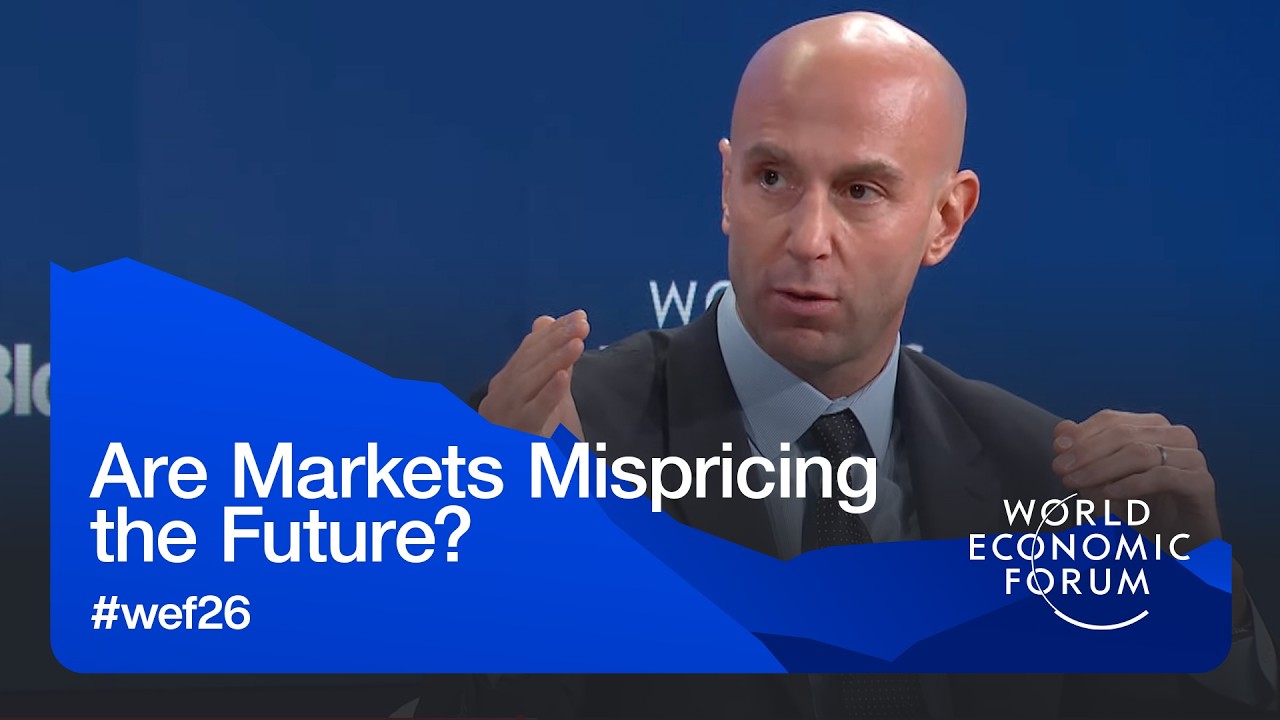
Are Markets Mispricing the Future? | World Economic Forum Annual Meeting 2026
Keywords
Summary
160 words
Critical Evaluation
Value of the Information & Strength of the Argument
The value of the information lies in the diverse perspectives of senior financial and economic leaders, providing insights into current market dynamics and the potential impact of AI and geopolitics. The argumentation is generally solid, with panelists building on each other’s points and offering reasoned counterarguments. For instance, Gopinath’s emphasis on the structural break in global trust is compelling, while Vince’s distinction between token manufacturers, the ecosystem, and users offers a nuanced framework. However, the discussion is largely opinion-based, with few concrete data points or citations, and some arguments rely on hypothetical scenarios (e.g., OpenAI going bust). The panelists acknowledge uncertainty, which adds credibility, but the lack of rigorous evidence weakens the overall argumentation.
Scientific Rigor, Source Quality, Title Accuracy
The scientific rigor is moderate: the panelists are credible experts, but they do not cite specific studies or data sources, and the discussion is forward-looking and speculative. The title accurately reflects the content, focusing on market mispricing. The description provides links to the World Economic Forum’s official channels, but no direct references to the claims made. The adequacy between title and content is high, as the panel directly addresses the question of mispricing. However, the lack of verifiable sources and the reliance on anecdotal evidence (e.g., specific IPOs, market moves) reduce the overall rigor.
223 words
Title / Content Match
The title accurately reflects the central question of the panel discussion on market valuations and future risks.
Quality & Reliability
7/10
Panel of high-level experts (IMF, UBS, HKEX, BlackRock) providing informed opinions and analysis, but no formal citations or data sources are provided, and the discussion is forward-looking and speculative.
Key Moments
Markers derived by PSI from the transcript: the creator did not define chapters.
- Jonathan Ferro introduces the panel and the central question of market mispricing.
- Gita Gopinath argues that everything has changed for the global economy, citing breakdown in trust and policy chaos.
- Robin Vince discusses the fuel for the economy from AI spending and fiscal stimulus, and the market's difficulty pricing tail risks.
- Sergio Ermotti warns against rationalizing excesses and notes the lack of alternatives to the dollar.
- Bonnie Chan highlights the rebound in Hong Kong IPOs and the underweighting of China, suggesting mispricing in Asia.
- Mark Benedetti emphasizes the long-term AI tailwind and the importance of infrastructure investment.
- Discussion on the potential for productivity gains and the risk of a bubble in AI-related assets.
- Robin Vince splits the AI value chain into three constituencies: token manufacturers, ecosystem, and users.
- Sergio Ermotti discusses the importance of timing and the historical pattern of overestimating short-term impact.
- Mark Benedetti concludes with the importance of diversification and the continued attractiveness of the US market.
Cited Sources
- World Economic Forum — Official website of the World Economic Forum, where the panel discussion took place.
- World Economic Forum on LinkedIn — LinkedIn page of the World Economic Forum, providing additional context on the organization.
- World Economic Forum on YouTube — YouTube channel of the World Economic Forum, where the video is hosted.
- World Economic Forum on Flipboard — Flipboard page of the World Economic Forum, offering curated content.
Concurring Sources
- IMF World Economic Outlook — The IMF's flagship publication provides global economic forecasts, which align with Gita Gopinath's role as IMF First Deputy Managing Director.
Contribution & Novelties
The panel provides a timely and high-level discussion on market valuations amid AI-driven optimism and geopolitical uncertainty. The main novelty is the synthesis of perspectives from key financial leaders, offering a nuanced view that neither fully dismisses nor embraces the bubble narrative. The discussion highlights the disconnect between short-term market pricing and long-term technological potential, and introduces the concept of three constituencies in the AI value chain (token manufacturers, ecosystem, users) as a framework for analysis.
Pour aller plus loin :
- Artificial intelligence — Overview of AI, its history, and applications.
- Productivity — Economic concept of productivity, relevant to the discussion on AI’s impact.
- Market bubble — Definition and historical examples of market bubbles.
- Geopolitics — Study of the effects of geography on international politics and relations.
127 words
Radar Profile
The radar chart shows a balanced profile with moderate scores across all dimensions. The highest score is in 'quantite_information' (7), reflecting the breadth of topics covered, while 'fiabilite_globale' (6) is slightly lower due to the speculative nature of the discussion. The overall profile suggests a well-rounded but not deeply rigorous analysis, typical of a high-level panel debate.
💬 No comments were provided for analysis.