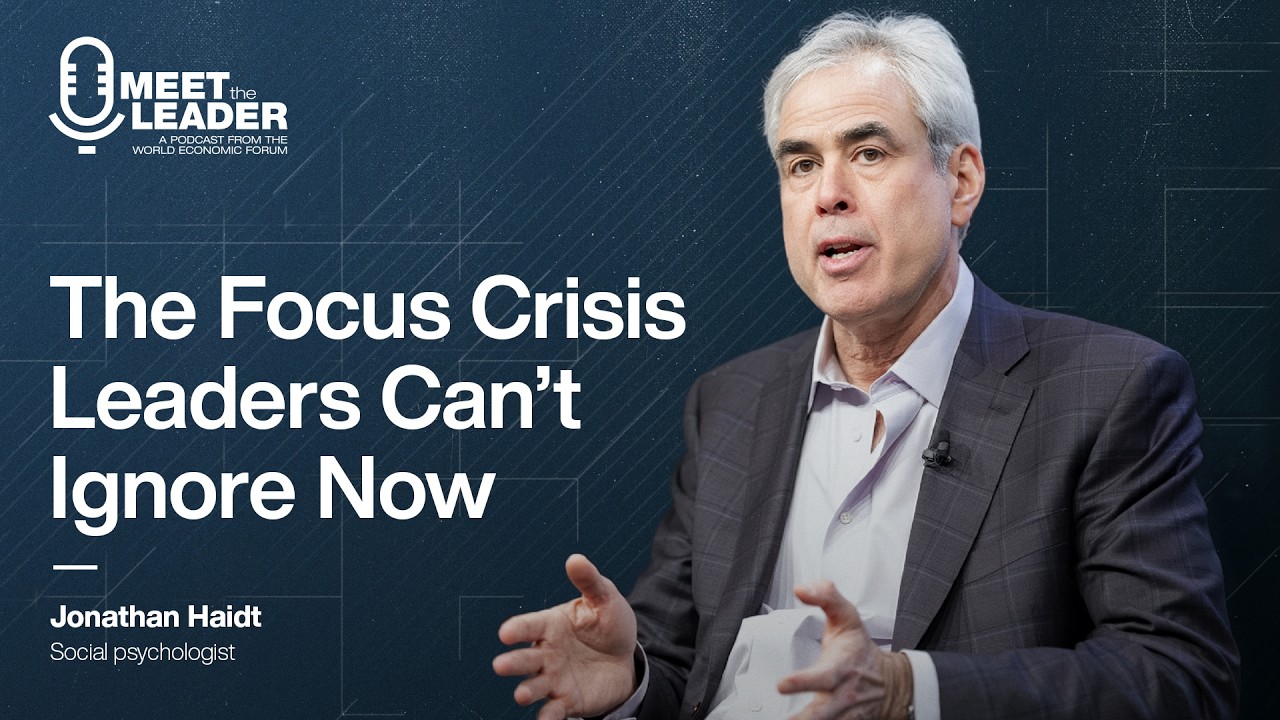
Attention Crisis: How leaders can fix focus and happiness in an AI Era -psychologist Jonathan Haidt
Keywords
Summary
142 words
Critical Evaluation
Value of the Information & Strength of the Argument
The value of the information is high, as it synthesizes research from social psychology and presents a coherent argument about the dangers of technology on well-being. Haidt’s argumentation is solid, drawing on his own research and books, but it is largely opinion and advocacy rather than presenting new empirical data. He effectively connects the dots between social media, AI, and the decline in mental health and attention, but some claims are anecdotal or based on his own interpretations. The argument is persuasive and well-structured, but it lacks counterarguments or alternative perspectives.
Scientific Rigor, Source Quality, Title Accuracy
The scientific rigor is moderate to high. Haidt is a reputable researcher, and his claims are based on his published work and general trends. However, the video is an interview, not a peer-reviewed presentation, so the evidence is not systematically presented. The sources cited are his own books and websites, which are credible but not independent. The title accurately reflects the content, and the interview stays on topic. No comments were provided for analysis.
180 words
Title / Content Match
The title accurately reflects the content, which focuses on the attention crisis and its impact on happiness and leadership in the AI era.
Quality & Reliability
8/10
The speaker is a recognized expert in social psychology with a strong publication record. The content is based on his research and books, but it is largely opinion and advocacy rather than presenting new empirical data. The claims are plausible and supported by references to his own work and general trends, but not all are backed by specific citations in the video.
Key Moments
Markers derived by PSI from the transcript: the creator did not define chapters.
- Introduction of Jonathan Haidt and the topic of happiness in the AI era.
- Haidt explains his background and research on moral psychology and the impact of social media on Gen Z.
- Discussion on how AI could 'crack' happiness by undermining meaningful work, relationships, and purpose.
- Haidt critiques the idea that material prosperity and UBI will bring happiness, citing the adaptation principle.
- He emphasizes the importance of relationships and warns that AI will isolate individuals.
- Call for government accountability and regulation of social media and AI companies.
- Discussion on the impact of technology on adults' attention and focus.
- Introduction of the Constructive Dialogue Institute and its mission to improve civil discourse.
- Practical advice for improving digital habits, such as removing addictive apps and starting the day intentionally.
- Haidt shares resources for further information, including his books and websites.
Cited Sources
- The Anxious Generation — Book referenced as central hub for information.
- The Righteous Mind — Book referenced for moral psychology.
- The Happiness Hypothesis — Book referenced for happiness research.
- Constructive Dialogue Institute — Organization co-founded by Haidt for civil discourse.
- Jonathan Haidt's website — Personal website with more information.
- Transcript of this episode — Official transcript of the interview.
Concurring Sources
- The Anxious Generation — Haidt's own book, which aligns with the video's arguments.
- The Righteous Mind — Haidt's earlier work on moral psychology, supporting his views on polarization.
External References
Contribution & Novelties
This interview provides a compelling synthesis of Haidt’s research on the attention crisis and its implications for happiness and leadership. It offers a clear framework for understanding how AI and social media undermine the foundations of well-being, and it proposes actionable solutions for individuals and society. The emphasis on the need for accountability and the protection of childhood is particularly timely.
Pour aller plus loin :
- The Anxious Generation — Book that details the impact of smartphones and social media on youth mental health.
- The Righteous Mind — Explores moral psychology and political polarization.
- The Happiness Hypothesis — Examines ancient wisdom and modern psychology on happiness.
- Constructive Dialogue Institute — Offers resources for improving civil discourse.
- Let Grow — Organization promoting childhood independence and resilience.
125 words
Radar Profile
The radar profile shows high scores in information quantity, quality, and reliability, with a slightly lower technical level. This indicates that the content is rich and credible but not highly technical, making it accessible to a broad audience.