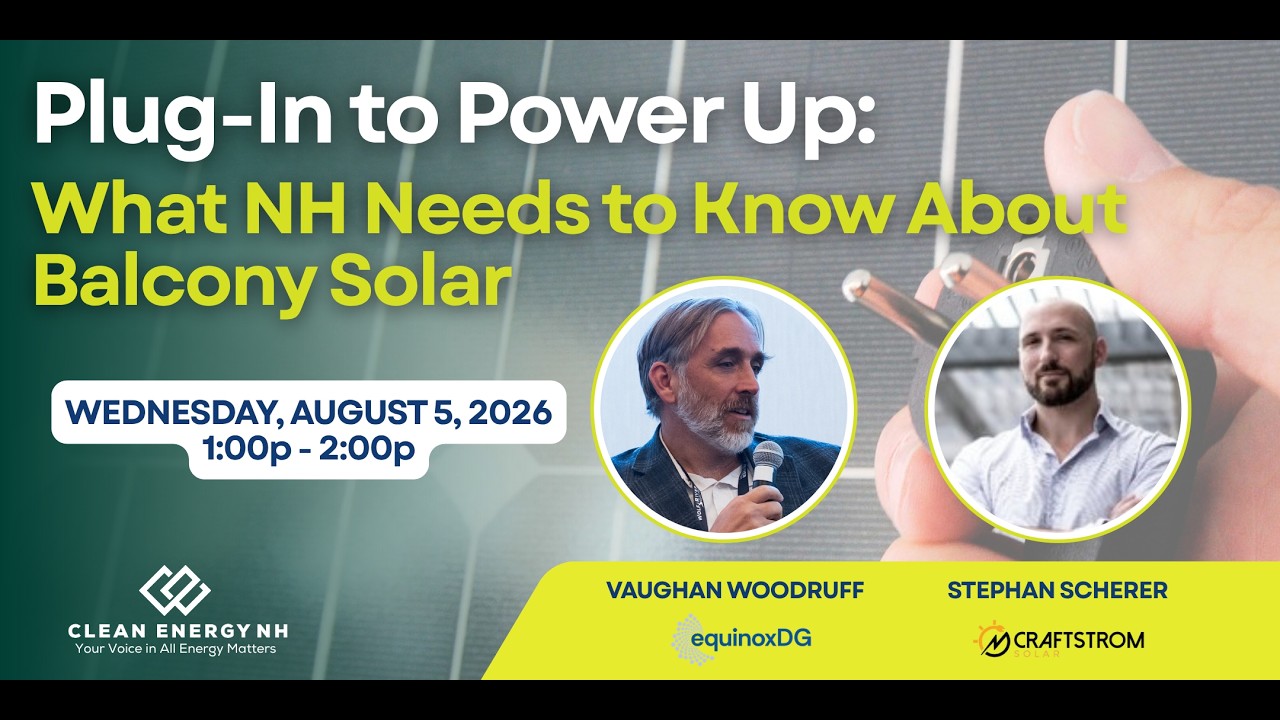
Plug-In to Power Up: What NH Needs to Know About Balcony Solar
Keywords
Summary
197 words
Critical Evaluation
Value of the Information & Strength of the Argument
The webinar offers substantial value by demystifying a relatively new technology and providing concrete, actionable information. It clearly explains how plug-in solar works, its benefits (cost savings, accessibility for renters), and its limitations (not a backup power source, cannot offset entire bill). The argumentation is solid, grounded in technical explanations of electrical systems and safety standards. The speakers effectively address common concerns, such as safety and grid impact, by referencing specific standards (NEC, UL 3700) and explaining the rationale behind them. The discussion of breaker masking and the need for power meters is particularly valuable, as it highlights a nuanced safety issue that is often overlooked. The presentation is balanced, acknowledging both the potential and the current limitations of the technology.
Scientific Rigor, Source Quality, Title Accuracy
The webinar demonstrates strong scientific rigor by referencing specific technical standards (NEC, UL 3700, UL 1741, UL 3141) and legislative details (SB540). The speakers are directly involved in the industry, lending credibility. However, the presentation is largely based on expert opinion and experience rather than peer-reviewed studies, and some claims (e.g., safety statistics) are not directly cited. The title accurately reflects the content, focusing on what New Hampshire residents need to know about balcony solar. The webinar is well-structured and provides clear, trustworthy information, though it is inherently promotional for the technology and the organization.
231 words
Title / Content Match
The title accurately reflects the content: a webinar focused on plug-in solar in New Hampshire, covering technology, safety, and policy.
Quality & Reliability
8/10
The webinar features two experts directly involved in the technology and policy, provides specific technical details (e.g., NEC requirements, UL standards), and references official standards and legislation. However, it is a promotional/educational webinar by an advocacy organization, and some claims (e.g., safety statistics) are presented without direct citations.
Key Moments
Markers derived by PSI from the transcript: the creator did not define chapters.
- Introduction and overview of Clean Energy NH
- Background on Senate Bill 540 and legislative process
- Stefan Scherer explains plug-in solar technology and components
- Discussion of safety: breaker masking, power meters, and NEC requirements
- Overview of UL standards, including UL 3700 and inverter shutdown times
- Q&A session addressing audience questions on cost, installation, and safety
Cited Sources
- Senate Bill 540 (New Hampshire) — Mentioned as the legislation creating a legal pathway for plug-in solar in New Hampshire.
- UL 3700 Standard — Discussed as the new safety standard for plug-in solar systems.
- National Electrical Code (NEC) — Referenced as the basis for electrical safety requirements.
Concurring Sources
- Plug-in solar (Wikipedia) — Provides general information on plug-in solar, including its popularity in Germany and safety considerations.
- UL 3700 Standard — Official description of the UL 3700 standard, which aligns with the webinar's discussion.
Contribution & Novelties
This webinar provides a timely and detailed overview of plug-in solar technology specifically tailored to New Hampshire, addressing both technical and policy aspects. It clarifies the safety considerations and the role of new standards like UL 3700, which are not widely understood. The discussion of breaker masking and the need for power meters is particularly insightful, offering practical guidance for consumers and installers.
Pour aller plus loin :
- Plug-in solar (Wikipedia) — Provides general background on the technology and its global adoption.
- UL 3700 Standard — Official information on the new safety standard.
- National Electrical Code — The code that governs electrical installations in the US.
106 words
Radar Profile
The radar profile shows high scores in information quantity, quality, and reliability, with a slightly lower technical level. This indicates a well-balanced webinar that is both informative and credible, though it may not delve into the most advanced technical details.
💬 No comments were provided for analysis.