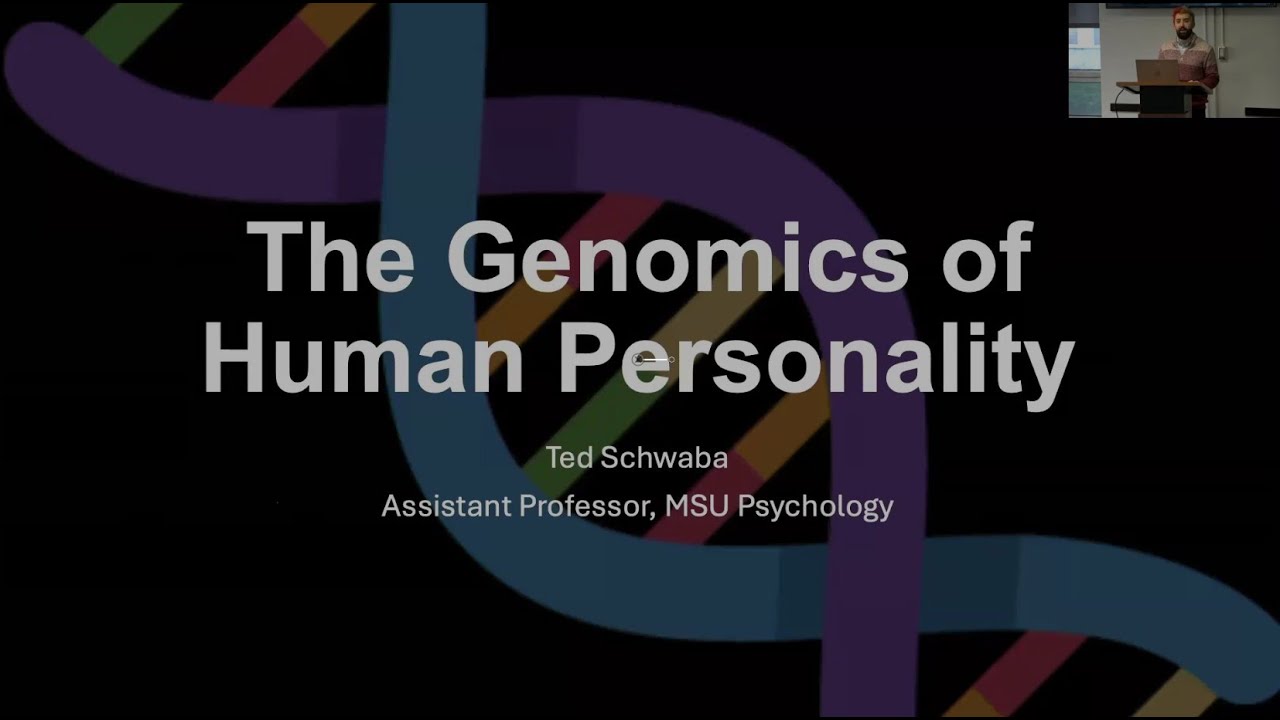
Seminar SERIES - Ted Schwaba, PhD
Keywords
Summary
142 words
Critical Evaluation
Value of the Information & Strength of the Argument
The talk provides substantial value by presenting the largest GWAS of personality to date, significantly advancing the field. The argumentation is solid, with clear explanations of methodology and results. The speaker effectively demonstrates the importance of sample size and measurement reliability in genetic studies. The discussion of genetic correlations across groups and the potential cultural moderation of agreeableness is insightful. The presentation is well-structured, moving from background to methods, results, and implications.
Scientific Rigor, Source Quality, Title Accuracy
The scientific rigor is high, with a large consortium, pre-print, and journal submission. The speaker cites previous work and explains limitations. The title is generic but the content is accurately described in the description. The talk does not include a formal reference list, but the pre-print is mentioned. The adequacy between title and content is acceptable, though the title could be more specific.
150 words
Title / Content Match
The title is generic ('Seminar SERIES') but the content is clearly about the genomics of human personality, as indicated in the description.
Quality & Reliability
8/10
The talk presents forthcoming results from a large international consortium (46 samples, 1.14 million participants) with a pre-print on bioRxiv and an invited revision at Nature. The methodology is rigorous, with clear descriptions of GWAS, heritability estimation, and genetic correlations. However, as a seminar, it lacks full peer review and detailed methodological appendices.
Key Moments
Markers derived by PSI from the transcript: the creator did not define chapters.
- Introduction and overview of the talk
- Introduction to the Big Five personality traits
- Background on heritability and twin studies
- Description of the Genomics of Personality Consortium and sample
- Explanation of GWAS methodology and results for extraversion
- Results for other Big Five traits and polygenicity
- SNP-based heritability estimates and measurement reliability
- Biological characterization and gene expression enrichment
- Genetic correlations across groups and informant reports
- Polygenic indices and prediction in independent samples
Cited Sources
- Pre-print on bioRxiv — Mentioned as a pre-print of the study results
Concurring Sources
- Previous GWAS of personality — The talk references earlier studies with smaller sample sizes that found few associations.
Dissenting Sources
- Candidate gene studies — The talk argues against candidate gene approaches that expected large effect sizes, which have not been replicated.
Contribution & Novelties
This study provides the largest GWAS of personality to date, with 1.14 million participants, identifying hundreds of genetic associations for each Big Five trait. It offers new insights into the polygenic architecture of personality, heritability estimates, and genetic correlations across groups. The findings challenge previous candidate gene approaches and highlight the importance of sample size and measurement reliability.
Pour aller plus loin :
- Genome-wide association study — Overview of GWAS methodology.
- Big Five personality traits — Background on the trait model.
- Heritability — Explanation of heritability concepts.
87 words
Radar Profile
The radar profile shows high scores in information quantity, quality, and technical level, with a slightly lower but still strong reliability score. This indicates a well-rounded, informative, and credible presentation.
💬 No comments were provided for analysis.