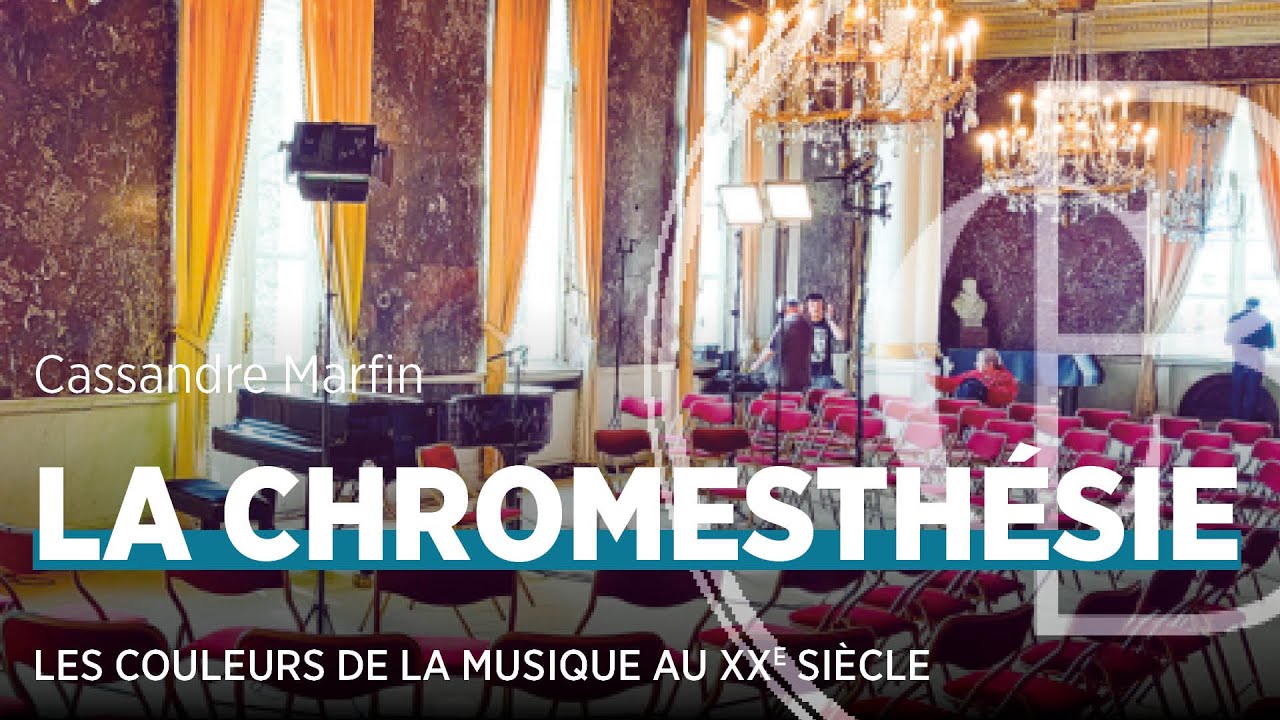
La chromesthésie : les couleurs de la musique au XXe siècle (conférence-concert)
Keywords
Summary
129 words
Critical Evaluation
Value of the Information & Strength of the Argument
The lecture provides valuable insights into the historical and cultural dimensions of color, particularly blue, and its influence on musical composition. The argumentation is well-structured, moving from general color theory to specific examples of composers and their synesthetic experiences. The inclusion of musical performances and the interview with Messiaen strengthens the argument by providing direct evidence. However, the scientific explanation of synesthesia is somewhat superficial, and the distinction between associative and projective chromesthesia could be more detailed. The speaker’s personal artistic project adds a unique perspective but may introduce a subjective bias.
Scientific Rigor, Source Quality, Title Accuracy
The lecture demonstrates a good level of scientific rigor in its historical and cultural references, citing scholars like Michel Pastoureau and Goethe. The sources mentioned in the description (Académie royale de Belgique, Cassandre Marfin’s website) are relevant and credible. However, the neurological aspects of synesthesia are not supported by specific scientific studies, and the claims about brain interconnectivity are oversimplified. The title accurately reflects the content, focusing on chromesthesia in 20th-century music. The lecture is well-organized and the musical examples effectively illustrate the concepts discussed.
192 words
Title / Content Match
The title accurately reflects the content, which focuses on chromesthesia and its influence on 20th-century composers, illustrated with musical performances.
Quality & Reliability
7/10
The lecture is based on historical and scientific references (Newton, Goethe, Pastoureau) and includes testimonies from composers (Messiaen). However, the scientific claims about synesthesia are presented in a simplified manner and lack rigorous citations. The artistic and historical content is well-documented, but the neurological aspects are not deeply explored.
Key Moments
Markers derived by PSI from the transcript: the creator did not define chapters.
- Introduction by Jean-Luc Fafchamps, presenting Cassandre Marfin and the theme of the lecture.
- Discussion on the history of color, from Newton's prism to Goethe's theory, and the cultural symbolism of colors.
- Exploration of the color blue, its pigments, and its rise in popularity from the Middle Ages to modern times.
- Introduction to synesthesia and chromesthesia, with definitions and examples of associative and projective forms.
- Discussion of composers like Kandinsky, Schoenberg, and Messiaen, and their use of color in music.
- Musical performance illustrating the connection between sound and color, with commentary on the pieces.
- Interview excerpt with Olivier Messiaen about his synesthetic experiences and the influence of stained glass windows.
- Conclusion and final thoughts on the project 'Jusqu'à la nuit' and the importance of color in music.
Cited Sources
- Académie royale de Belgique - Collège Belgique — Official page of the Collège Belgique where the lecture was given.
- Cassandre Marfin - Official Website — Website of the pianist, providing information about her projects and recordings.
- Collège Belgique 2025 Playlist — YouTube playlist containing other lectures from the Collège Belgique 2025 series.
Concurring Sources
- Synesthesia - Wikipedia — Provides general information on synesthesia, supporting the lecture's definitions.
- Olivier Messiaen - Wikipedia — Confirms Messiaen's synesthetic experiences and his use of color in music.
Dissenting Sources
- No discordant sources found — The lecture's claims are generally consistent with established knowledge, though some scientific simplifications are noted.
Contribution & Novelties
This lecture-concert offers a unique interdisciplinary perspective on chromesthesia, combining musicology, art history, and personal artistic practice. It highlights the influence of color on 20th-century composers, with a focus on the color blue, and presents original musical interpretations. The inclusion of an interview with Messiaen provides rare primary source material. The project ‘Jusqu’à la nuit’ offers a novel artistic exploration of color in music.
Pour aller plus loin :
- Synesthesia - Wikipedia — Overview of synesthesia, including chromesthesia.
- Olivier Messiaen - Wikipedia — Biography and discussion of his synesthetic experiences.
- Michel Pastoureau - Wikipedia — Historian specializing in the history of colors.
- Goethe’s Theory of Colours - Wikipedia — Goethe’s work on color perception.
114 words
Radar Profile
The radar profile shows high scores in quantity of information and quality, reflecting the rich historical and musical content. The technical level is moderate, suitable for a general audience. The global reliability is good, but the scientific aspects could be more rigorous. Overall, the lecture is well-balanced, with strengths in cultural and historical context.
💬 No comments were provided for analysis.