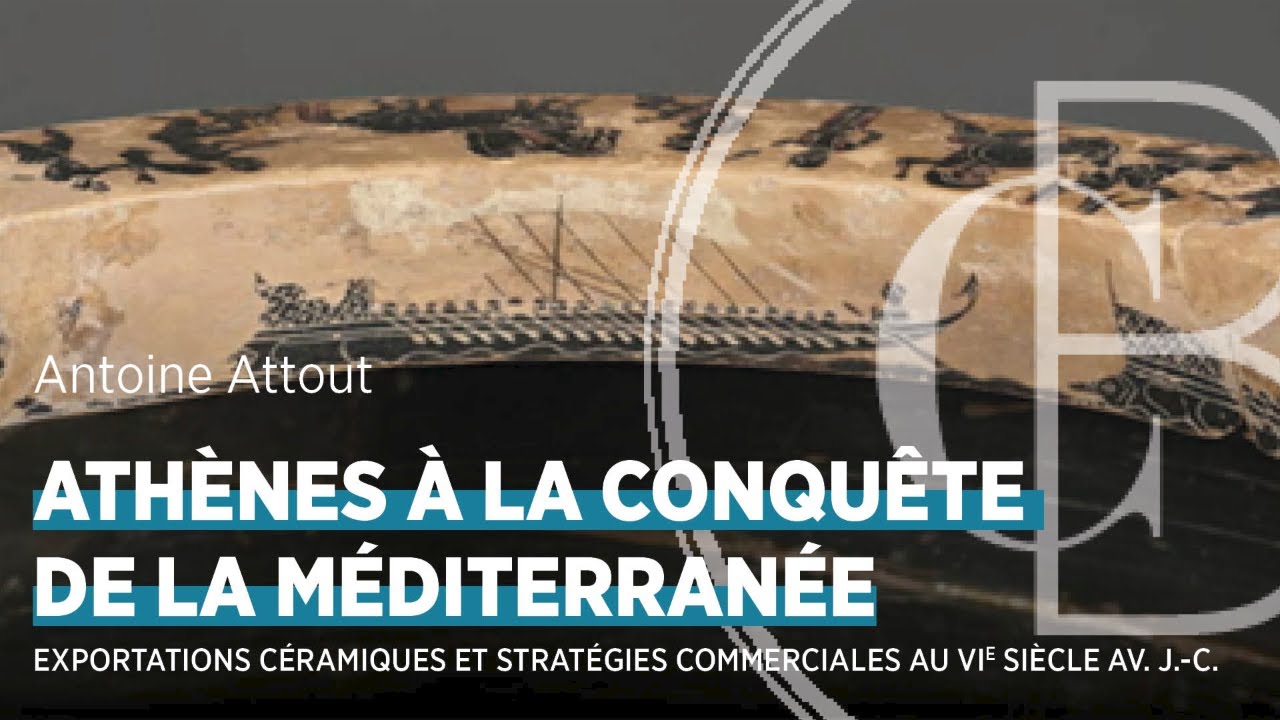
Athènes à la conquête de la Méditerranée : le commerce de céramiques au VIe siècle av. J.-C.
Keywords
Summary
209 words
Critical Evaluation
Value of the Information & Strength of the Argument
The lecture offers valuable insights into ancient economic strategies, demonstrating how archaeological evidence can reveal sophisticated market adaptation. Attout’s argumentation is solid, systematically presenting case studies and supporting them with distribution data and comparisons with other regional productions. He acknowledges uncertainties, such as the chronology of Ionian amphorae, and offers reasoned interpretations. The value lies in its contribution to understanding ancient trade networks and the agency of producers in responding to consumer preferences.
Scientific Rigor, Source Quality, Title Accuracy
The lecture demonstrates scientific rigor through its methodological approach, clear presentation of evidence, and cautious interpretation. Attout, as a specialist, bases his arguments on his doctoral research and archaeological data. However, the video does not provide explicit citations or references to specific studies, which limits the verifiability of his claims. The title accurately reflects the content, focusing on Athenian ceramic exports and commercial strategies. The lecture is well-structured and maintains a high standard of scholarly discourse.
164 words
Title / Content Match
The title accurately reflects the content, which focuses on Athenian ceramic exports and commercial strategies in the 6th century BCE.
Quality & Reliability
8/10
The lecture is delivered by a PhD in archaeology, based on his doctoral research, and presents a rigorous archaeological analysis with clear methodological explanations. The argumentation is well-structured and supported by specific case studies and distribution data. However, the lack of detailed citations in the video itself and the reliance on the speaker's own interpretations slightly reduce the score.
Key Moments
Markers derived by PSI from the transcript: the creator did not define chapters.
- Introduction by Didier Viviers presenting Antoine Attout's background.
- Overview of the Mediterranean world in the 6th century BCE: fragmented but interconnected.
- Discussion of Athens' rise as a ceramic exporter.
- Case study 1: Nikosthenic amphorae and their Etruscan inspiration.
- Case study 2: Standard type neck-amphorae and Ionian influences.
- Analysis of distribution patterns and the role of intermediaries.
- Conclusion and final remarks.
Cited Sources
- Académie royale de Belgique - Collège Belgique — Official page of the Collège Belgique, where the lecture was given.
Concurring Sources
- Académie royale de Belgique - Collège Belgique — Official page of the Collège Belgique, where the lecture was given.
Contribution & Novelties
This lecture provides a detailed analysis of how Athenian potters adapted their products to foreign markets, specifically the Etruscan and Ionian influences on ceramic forms. It contributes to the understanding of ancient trade networks and consumer-driven production. The speaker’s doctoral research offers new insights into the complexity of these adaptations.
Pour aller plus loin :
- Nikosthenic amphora — Overview of this specific type of amphora.
- Bucchero — Etruscan black pottery that influenced Athenian shapes.
- Fikellura pottery — Ionian pottery style mentioned in the lecture.
- Corpus Vasorum Antiquorum — International project for publishing ancient ceramics, relevant to the speaker’s work.
99 words
Radar Profile
The radar profile shows high scores in information quantity, quality, and reliability, with a slightly lower technical level, indicating a lecture that is rich in content and well-supported but accessible to a general audience.
💬 No comments were provided for analysis.