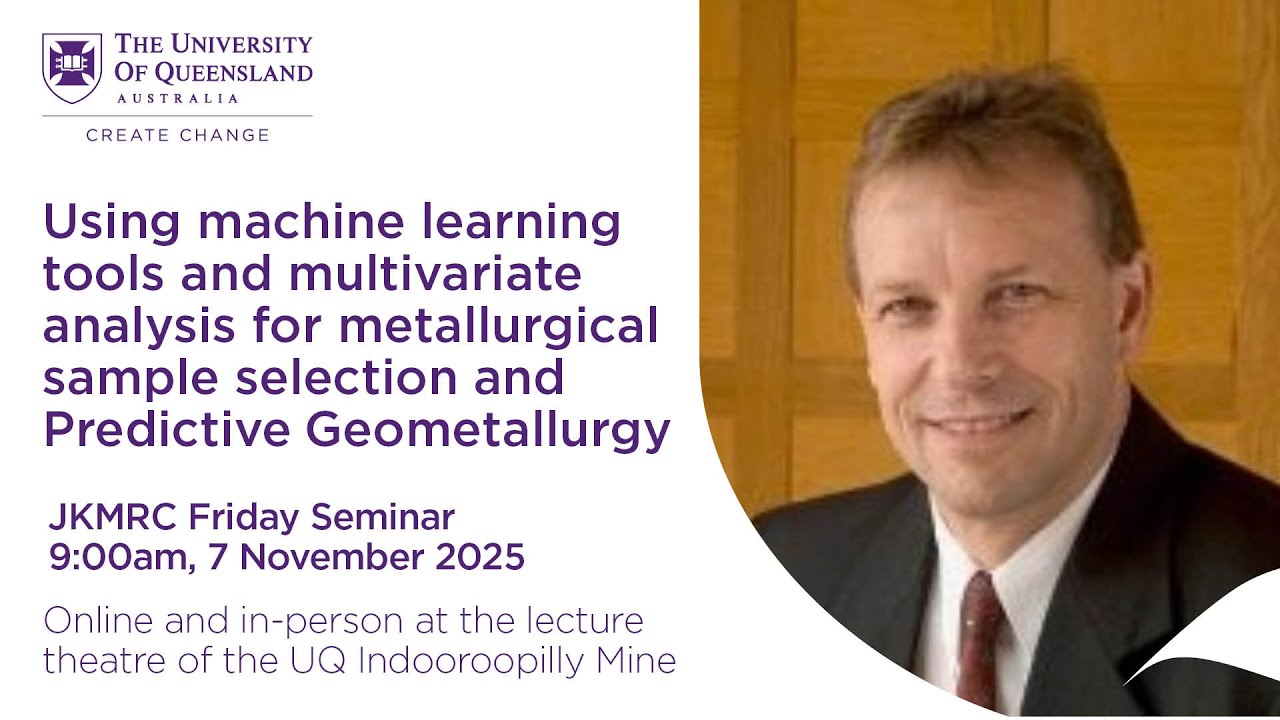
JKMRC Friday Seminar 2025: Using machine learning for sample selection and Predictive Geometallurgy
Keywords
Summary
133 words
Critical Evaluation
Value of the Information & Strength of the Argument
The presentation provides valuable insights into practical applications of machine learning in geometallurgy, a field where such methods are increasingly relevant. The argumentation is coherent and grounded in real-world examples, demonstrating the effectiveness of UMAP and k-means in sample selection. The speaker clearly explains the benefits of using multivariate analysis to overcome the limitations of traditional 1-3D visualization. The discussion on determining sample numbers using predictive models is particularly valuable, as it offers a quantitative approach to risk reduction. However, the presentation lacks rigorous statistical validation or comparison with alternative methods, and the argumentation relies heavily on anecdotal evidence from the speaker’s experience.
Scientific Rigor, Source Quality, Title Accuracy
The presentation is scientifically rigorous in its methodology, but it does not cite specific academic sources or publications. The speaker mentions the use of established algorithms (UMAP, k-means, cubist models) but does not provide references. The title accurately reflects the content, and the talk is well-structured. The lack of formal citations is a limitation, but the speaker’s expertise and the practical examples lend credibility. The presentation does not include any advertising or sponsored content.
192 words
Title / Content Match
The title accurately reflects the content, which focuses on using machine learning for sample selection and predictive geometallurgy.
Quality & Reliability
8/10
Presentation by a PhD-trained chemist with extensive industry experience, describing practical applications of machine learning in geometallurgy. Methods are well-established (UMAP, k-means, cubist models) and the talk includes concrete examples. However, no peer-reviewed sources are cited, and the presentation is largely based on the speaker's professional experience.
Key Moments
Markers derived by PSI from the transcript: the creator did not define chapters.
- Introduction to the seminar and speaker bio.
- Overview of the challenge: sparse metallurgical data vs. abundant geological data.
- Introduction to the AMC team and their expertise.
- Explanation of the multivariate approach and the use of UMAP and k-means.
- Example from a porphyry copper project: UMAP projection and grouping.
- Visualizing sulfide mineral grades on UMAP to guide sample selection.
- Using UMAP to assess coverage of metallurgical samples and suggest additional samples.
- Discussion on the number of samples needed and the use of predictive models.
- Introduction to probabilistic graphical models for data augmentation.
- Conclusion and Q&A session.
Contribution & Novelties
The presentation offers a practical framework for integrating machine learning into geometallurgical sample selection, emphasizing the use of UMAP and k-means clustering to handle high-dimensional geological data. It provides a clear methodology for ensuring representativity and for using predictive models to quantify risk and determine sample numbers. The talk also highlights the importance of combining data-driven approaches with subject matter expertise.
Pour aller plus loin :
- UMAP: Uniform Manifold Approximation and Projection for Dimension Reduction — Foundational paper on UMAP, a key method discussed.
- K-means clustering — Overview of the clustering algorithm used for grouping samples.
- Cubist models — Description of the rule-based regression model used for predictive modeling.
109 words
Radar Profile
The radar profile shows a balanced performance across all dimensions, with slightly higher scores in information quantity and quality, reflecting the speaker's expertise and the practical examples provided. The technical level is moderate, making the content accessible to a broad audience.