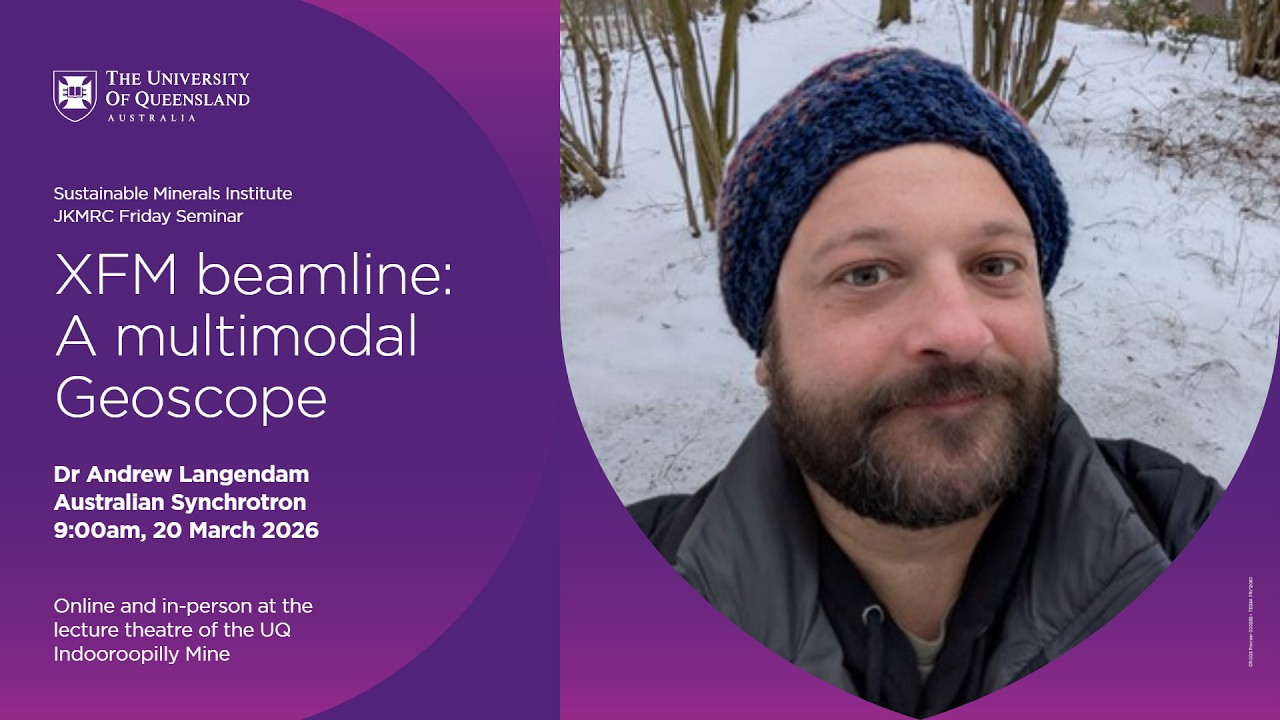
JKMRC Friday Seminar 2026: The XFM beamline – A multimodal Geoscope
Keywords
Summary
109 words
Critical Evaluation
Value of the Information & Strength of the Argument
The presentation provides valuable insights into the capabilities of the XFM beamline, highlighting its unique ability to combine multiple X-ray techniques for comprehensive geochemical analysis. The argumentation is solid, grounded in the speaker’s direct experience and illustrated with concrete case studies. The emphasis on multimodal data collection is well-supported, demonstrating how combining fluorescence with diffraction and other methods enhances geological interpretation. The speaker also addresses practical considerations, such as sample preparation and beamtime application, adding practical value.
Scientific Rigor, Source Quality, Title Accuracy
The scientific rigor is high, as the speaker is a domain expert and references a peer-reviewed paper on the beamline. The sources cited are primarily institutional (SMI webinars, YouTube channel) and the talk itself is a primary source. The title accurately reflects the content, focusing on the XFM beamline as a multimodal geoscope. No comments were provided for analysis.
151 words
Title / Content Match
The title accurately reflects the content, which focuses on the XFM beamline as a multimodal tool for geoscience applications.
Quality & Reliability
8/10
The speaker is a beamline scientist at the Australian Synchrotron, providing detailed technical information about the XFM beamline's capabilities, techniques, and applications. The content is based on his professional expertise and includes specific examples and references to peer-reviewed work. However, as a seminar presentation, it lacks formal peer review and some claims are anecdotal.
Key Moments
Markers derived by PSI from the transcript: the creator did not define chapters.
- Introduction to the Australian Synchrotron and its facilities.
- Explanation of synchrotron radiation and how it is produced.
- Overview of the XFM beamline's optical setup and capabilities.
- Discussion of X-ray fluorescence mapping and its applications.
- Case study: meteorite weathering and element mapping.
- Case study: hydrothermal silica deposits and biosignatures.
- Case study: mine tailings and element mobility.
- Techniques: XANES, microdiffraction, and other correlated methods.
- Practical advice for applying for beamtime.
- Q&A session and closing remarks.
Cited Sources
- SMI Webinars — Link to past webinars from the Sustainable Minerals Institute.
- SMI YouTube Channel — YouTube channel hosting previous seminars.
Concurring Sources
- XFM beamline paper — The speaker references a peer-reviewed paper on the XFM beamline, but no URL is provided.
Contribution & Novelties
The seminar provides a comprehensive overview of the XFM beamline’s multimodal capabilities, emphasizing the integration of multiple X-ray techniques for geoscience research. It highlights the beamline’s unique ability to combine fluorescence mapping with diffraction, XANES, and other methods, offering a holistic approach to sample characterization. The speaker’s practical insights into beamtime application and data collection strategies add value for potential users.
Pour aller plus loin :
- X-ray fluorescence — Overview of the fundamental technique.
- Synchrotron light source — Explanation of how synchrotrons produce intense X-rays.
- X-ray absorption near edge structure — Details on XANES, a technique mentioned in the talk.
100 words
Radar Profile
The radar profile shows high scores across all dimensions, indicating a technically detailed and reliable presentation. The balance between information quantity, quality, and technical depth is strong, with a slight emphasis on practical application.