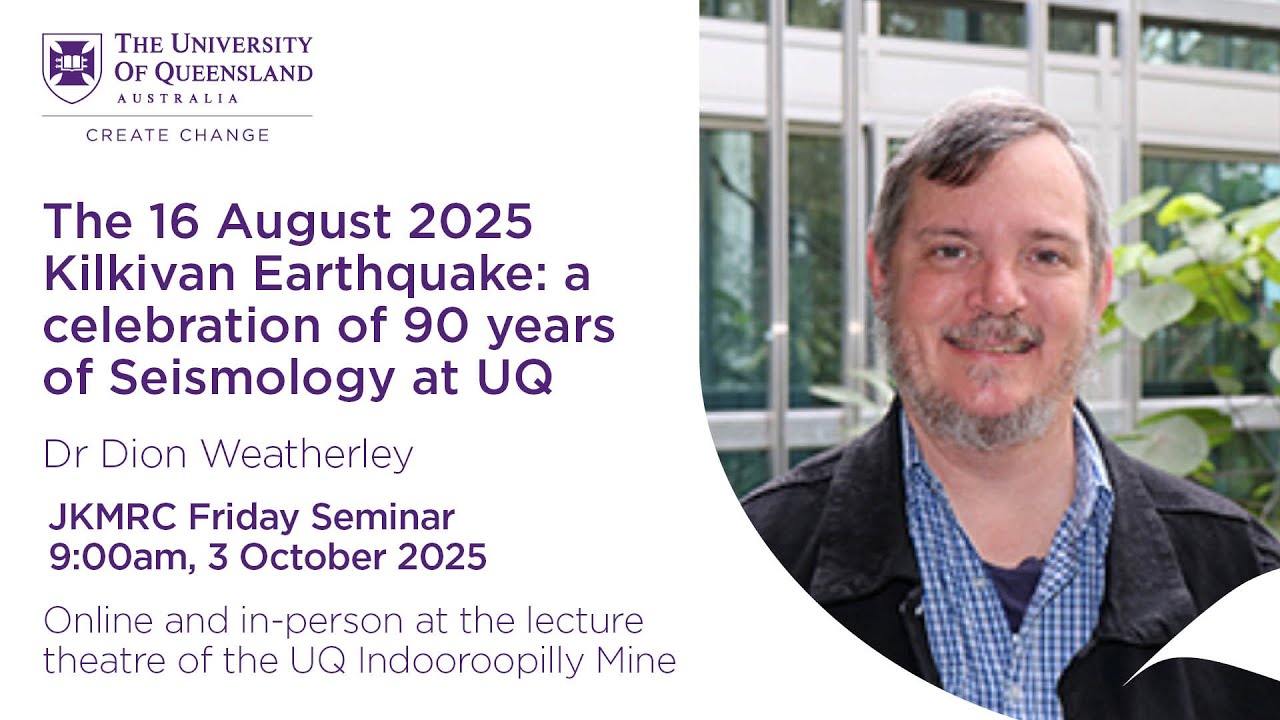
JKMRC Friday Seminar 2025: The 16 August 2025 Kilkivan Earthquake / 90 years of Seismology at UQ
Keywords
Summary
148 words
Critical Evaluation
Value of the Information & Strength of the Argument
The presentation offers valuable insights into a significant seismic event, combining personal experience with scientific data. Weatherley’s argumentation is solid, grounded in seismological principles and real-time data. He effectively explains complex concepts like stress changes and aftershock patterns using accessible analogies and examples. The value is enhanced by his unique perspective as a seismologist directly involved in monitoring the event.
Scientific Rigor, Source Quality, Title Accuracy
The presentation demonstrates scientific rigor, with references to established laws (Omori’s law) and stress models. Weatherley cites data from Geoscience Australia and the Australian National Seismic Network. The title accurately reflects the content, covering both the earthquake and the historical context. The seminar is an expert opinion based on professional experience and real data, though not a peer-reviewed study.
134 words
Title / Content Match
The title accurately reflects the content, which covers both the Kilkivan earthquake and the history of seismology at UQ.
Quality & Reliability
8/10
The speaker is a chief seismologist with direct involvement in the event, providing authoritative insights. The presentation is based on real data and established scientific principles, though it is a seminar rather than a peer-reviewed study.
Key Moments
Markers derived by PSI from the transcript: the creator did not define chapters.
- Introduction and acknowledgment of traditional owners
- Overview of the Kilkivan earthquake and personal experience
- Felt reports and intensity mapping
- Instrumental recording and seismic network
- Aftershock sequence and stress changes
- Why earthquakes occur in Australia
- Australian stress map and notable earthquakes
- Earthquake hazard mitigation in Australia
- History of seismology at UQ
- Conclusion and Q&A
Cited Sources
- SMI Webinars — List of past webinars from the Sustainable Minerals Institute
- SMI YouTube Channel — Previous seminars uploaded to YouTube
Concurring Sources
- Geoscience Australia - Earthquakes — Official source for earthquake data and monitoring in Australia
Contribution & Novelties
The seminar provides a unique case study of a significant intraplate earthquake in Australia, offering real-time data and analysis. It also highlights the importance of citizen science through felt reports and the role of modern technology in earthquake alerts. The historical perspective on 90 years of seismology at UQ adds value.
Pour aller plus loin :
- Intraplate earthquake — Explains earthquakes away from plate boundaries.
- Omori’s law — Empirical relation for aftershock decay.
- Australian National Seismic Network — Monitoring network operated by Geoscience Australia.
84 words
Radar Profile
The radar profile shows high scores in quantity and quality of information, reflecting the speaker's expertise and the detailed data presented. The technical level is moderate, making it accessible to a general audience while still informative. Overall, the presentation is reliable and well-rounded.
💬 No comments were provided for analysis.