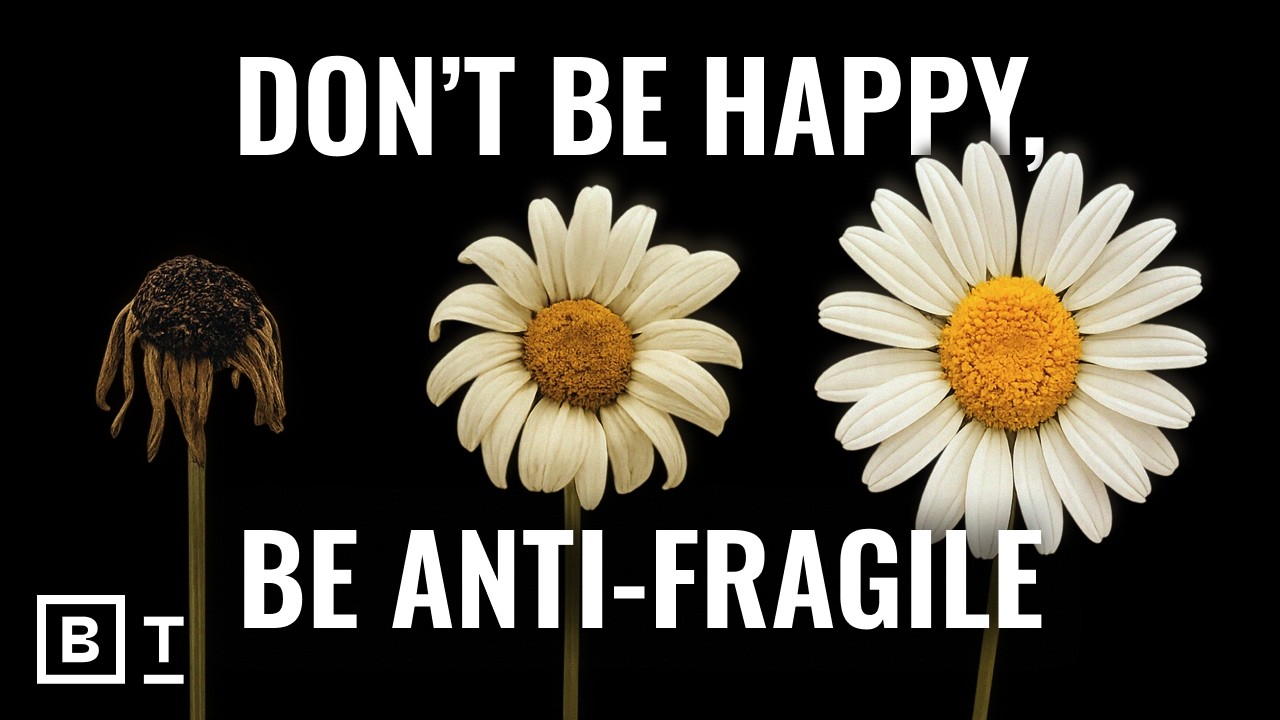
Don't chase happiness. Become antifragile | Tal Ben-Shahar: Full Interview
Keywords
Summary
168 words
Critical Evaluation
The interview provides a compelling and accessible overview of key concepts in positive psychology, particularly the SPIRE model and the notion of antifragility. Ben-Shahar’s arguments are well-structured and grounded in established research, such as the work of Iris Mauss on the paradox of valuing happiness, Amy Wrzesniewski on work orientations, and Nassim Taleb on antifragility. He effectively communicates complex ideas in a relatable manner, using personal anecdotes and clear analogies, such as the sunlight and prism metaphor. However, the discussion is largely opinion-driven, and while he references research, he does not provide specific citations or data, which limits the ability to verify claims. The interview could benefit from a more critical examination of the limitations of the SPIRE model and the generalizability of the findings. Additionally, the focus on individual agency may overlook systemic and societal factors that influence well-being, as some commenters noted. Despite these limitations, the content is valuable for its practical insights and its emphasis on resilience and growth, making it a worthwhile resource for those interested in well-being.
172 words
Title / Content Match
The title accurately reflects the core message of the interview: shifting focus from directly pursuing happiness to building resilience and meaning through the SPIRE model.
Quality & Reliability
8/10
The interview is based on established psychological research (e.g., post-traumatic growth, SPIRE model) and the speaker is a recognized expert in positive psychology. However, it is primarily an opinion-driven discussion with limited presentation of empirical evidence, and some claims are presented without detailed citations.
Chapters
- Happiness studies
- The paradox of chasing happiness
- Two questions about happiness
- The science of happiness in difficult times
- Why isn’t there a field that studies happiness?
- What is anti-fragility?
- PTSD vs PTG
- SPIRE: the 5 dimensions of well-being
- Why not include financial wellness in SPIRE?
- Exercising your spirit, body, and mind
- 3 archetypes of work
- Physical wellbeing and the mind-body connection
- 3 levels of recovery
- Time off and wellness
- Curiosity and engaging deeply with others
- The importance of relational and emotional health
- The #1 condition to increase anti-fragility: The quality of our relationships
- Generosity in connections
- Sustainable generosity
- Is the pursuit of happiness selfish?
- The 2 kinds of people who do not experience difficult emotions
- The importance of gratitude
- Gratitude and growth
- Learning to fail
Cited Sources
- Big Think Membership — Mentioned in the video description as a way to access exclusive content and support Big Think.
- Tal Ben-Shahar's Class: Building Your Antifragile Systems: The SPIRE Model — Referenced in the description as a full class by the speaker on the SPIRE model.
- Big Think Plus — Linked in the description as a platform for business learning.
- Full Interview Series: Anti-Fragile Happiness — Linked in the description as the series page for this interview.
- Big Think Media Substack — Linked in the description as a newsletter subscription.
- Up Next: Antifragility: How to use suffering to get stronger — Referenced in the description as a related video on antifragility.
Concurring Sources
- Post-traumatic growth - Wikipedia — Supports the concept of PTG discussed in the interview.
- Antifragility - Wikipedia — Provides background on the concept of antifragility introduced by Nassim Taleb.
- Positive psychology - Wikipedia — Contextualizes the field of positive psychology that Ben-Shahar draws upon.
Dissenting Sources
- Comment on structural constraints — Some viewers noted that the interview overlooks societal and structural factors that impact well-being, such as housing, healthcare, and economic inequality.
Contribution & Novelties
The interview offers a comprehensive synthesis of positive psychology concepts, presenting the SPIRE model as a practical framework for well-being. It integrates the idea of antifragility, popularized by Nassim Taleb, into the context of personal development, emphasizing post-traumatic growth. The discussion on the paradox of pursuing happiness and the indirect approach through SPIRE elements provides a novel perspective for a general audience.
Pour aller plus loin :
- Post-traumatic growth - Wikipedia — Provides an overview of the concept and research on PTG.
- Antifragility - Wikipedia — Explains Taleb’s concept of antifragility and its applications.
- Positive psychology - Wikipedia — Background on the field that studies well-being and happiness.
- Viktor Frankl - Wikipedia — His work on meaning and logotherapy is directly relevant to the discussion of meaning in life.
- Iris Mauss - Wikipedia — Her research on the paradox of valuing happiness is cited in the interview.
147 words
Radar Profile
The radar profile shows high scores in quantity and quality of information, reflecting the depth and relevance of the content. The technical level is moderate, making it accessible to a broad audience. The overall reliability is strong, supported by the speaker's expertise and the alignment with established psychological research.
💬 Positif. Sur les 30 commentaires analysés, la majorité exprime une appréciation pour la profondeur et la clarté des idées, bien que certains soulèvent des préoccupations concernant le manque de prise en compte des contraintes structurelles.