Mapping the Microbiome-Gut-Brain Axis
Keywords
Summary
191 words
Critical Evaluation
Value of the Information & Strength of the Argument
The presentation provides valuable insights into the microbiome-gut-brain axis, supported by a strong body of research from the speaker’s group and others. The argumentation is solid, with careful attention to confounding factors such as diet and medication, and acknowledgment of limitations like cross-sectional designs and low explained variance. The speaker emphasizes the importance of functional analysis over taxonomic composition, and the need for strain-level resolution to understand transmission. The discussion of potential clinical applications, such as FMT and probiotics, is balanced and evidence-based, noting the early stage of these interventions.
Scientific Rigor, Source Quality, Title Accuracy
The speaker demonstrates scientific rigor by referencing published studies, including meta-analyses, and by transparently discussing methodological challenges. She acknowledges the limitations of case-control designs and the need for prospective cohorts. The title accurately reflects the content, which focuses on mapping the microbiome-gut-brain axis. The presentation is well-structured and supported by data from large cohorts and collaborative efforts.
162 words
Title / Content Match
The title accurately reflects the content, which focuses on mapping the microbiome-gut-brain axis across neuropsychiatric and neurodegenerative conditions.
Quality & Reliability
8/10
Presentation by a recognized researcher in microbiome research, based on published studies and meta-analyses, with transparent discussion of limitations and open questions.
Key Moments
Markers derived by PSI from the transcript: the creator did not define chapters.
- Introduction to the microbiome and its relevance to the exposome.
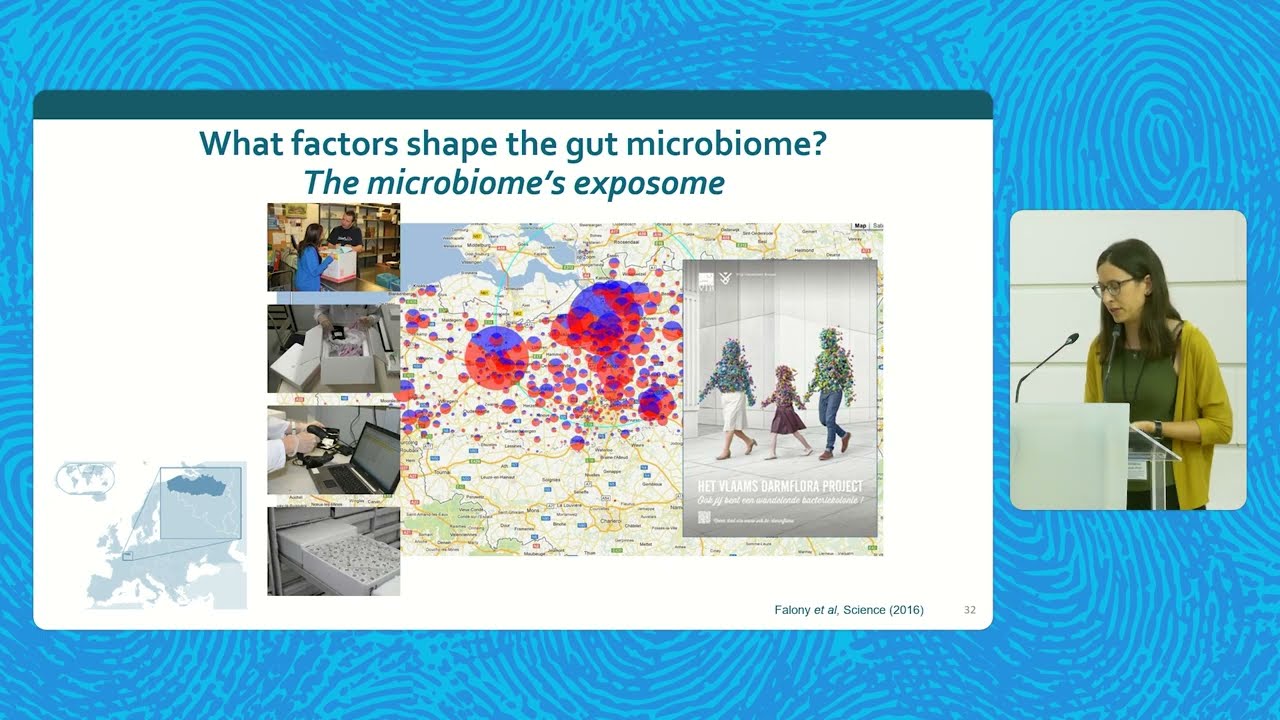
- Description of the Flemish Gut Flora project and initial findings on microbiome composition.
- Associations between microbial genera and mental health, including butyrate producers.
- Introduction of the gut-brain modules tool for assessing neuroactive potential.
- Expansion of the tool to include bile acids and sex hormones.
- Discussion of strain-level transmission from mothers and other caregivers.
- Application to autism spectrum disorder and reduced strain sharing.
Cited Sources
- Flemish Gut Flora Project — Population-level cohort study on gut microbiome composition.
- Lifelines cohort — Dutch cohort used for replication of findings.
- Simons Foundation — Source of data for autism spectrum disorder study.
Concurring Sources
- Valles-Colomer et al. 2019 — Original study on the neuroactive potential of the gut microbiome.
- Valles-Colomer et al. 2023 — Study on mother-to-infant strain transmission.
Contribution & Novelties
The presentation highlights the development of a computational tool to assess the neuroactive potential of the gut microbiome, which is a novel approach to understanding the microbiome-gut-brain axis. It also provides insights into strain-level transmission dynamics, including the role of fathers and other caregivers, and the potential for horizontal transmission. The emphasis on functional analysis over taxonomic composition is a valuable contribution to the field.
Pour aller plus loin :
- Gut-brain axis — Overview of the bidirectional communication between the gut and the brain.
- Metagenomics — Technique used to study microbial communities directly from environmental samples.
- Short-chain fatty acids — Key metabolites produced by gut bacteria, implicated in host health.
110 words
Radar Profile
The radar profile shows high scores in information quantity, quality, and reliability, with a slightly lower technical level, indicating a presentation that is comprehensive and reliable but may require some background knowledge to fully appreciate.
💬 No comments provided.