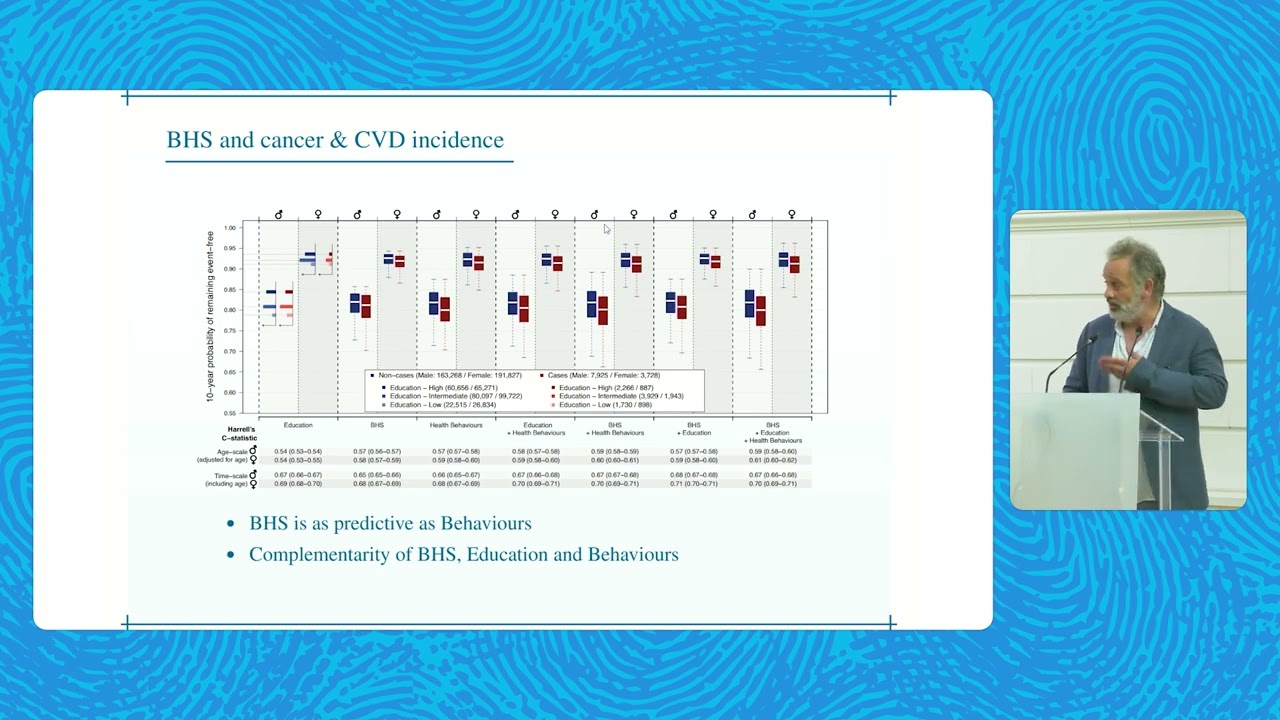
Exposome Analytics: Overview and Perspectives
Keywords
Summary
158 words
Critical Evaluation
Value of the Information & Strength of the Argument
The presentation provides valuable insights into the methodological toolkit for exposome research, emphasizing the importance of moving beyond single-exposure models to integrative approaches. The speaker argues for the utility of stability selection and sparse networks in handling high-dimensional correlated data, and supports his claims with examples from published studies. The argumentation is coherent and grounded in practical experience, though the talk is more of an overview than a deep dive into specific methods.
Scientific Rigor, Source Quality, Title Accuracy
The speaker is a professor at Imperial College London with extensive publications in the field. He references several of his own studies and the EXPANSE project, and mentions a review on mediation methods published in the Exposome journal. The title accurately reflects the content, and the presentation is scientifically rigorous, though it does not provide detailed citations for all claims. The talk is part of a symposium on exposome and brain health, and the speaker acknowledges the preliminary nature of some results.
170 words
Title / Content Match
The title accurately reflects the content: a comprehensive overview of exposome analytics methods and perspectives.
Quality & Reliability
8/10
Presentation by a recognized expert in computational epidemiology, based on published research and methodological developments. The talk is a high-level overview without detailed methodological exposition, but the described methods are established in the literature. The speaker clearly distinguishes preliminary results from published work.
Key Moments
Markers derived by PSI from the transcript: the creator did not define chapters.
- Introduction and overview of exposome analytics
- Conceptual framework: exposures, embodiment, health
- Four key aims: complexity reduction, feature selection, data integration, mediation
- Complexity reduction: allostatic load score in UK Biobank
- Clustering exposure profiles in UK Biobank and Europe
- Feature selection: stability selection approach
- Application to CAD prediction with biomarkers and PRS
- Data integration: sparse network models for multi-omics
- Example: smoking-related methylation and gene expression network
- Application to lung cancer with three omics
- Mediation analysis: direct and indirect effects on CVD and COPD
- Causal discovery with deep learning (TABU) on UK Biobank
- Future directions: high-dimensional clustering, interactions, longitudinal data
- Resources: R packages and short course
Cited Sources
- Exposome journal — Mentioned as the journal where a review on mediation methods was published.
- UK Biobank — Used as the main data source for several examples.
- EXPANSE project — The project under which much of the presented work was conducted.
Concurring Sources
- Exposome journal — The journal where the speaker published a review on mediation methods, aligning with the talk's content.
- UK Biobank — The data source for many examples, consistent with the speaker's use of this resource.
Contribution & Novelties
The talk provides a comprehensive overview of the methodological landscape in exposome analytics, highlighting the importance of integrative approaches and reproducibility. It showcases the application of stability selection and sparse network models to multi-omics data, which are relatively novel in the field. The speaker also discusses the use of deep learning for causal discovery, a cutting-edge area.
Pour aller plus loin :
- Stability selection — A resampling-based method for feature selection that improves reproducibility.
- Allostatic load — A concept used to summarize physiological wear and tear from chronic stress.
- Mediation analysis — Statistical methods to decompose total effects into direct and indirect effects.
103 words
Radar Profile
The radar profile shows high scores in information quantity and quality, reflecting the speaker's expertise and the breadth of methods covered. The technical level is moderate, suitable for a specialized audience. The overall reliability is high, given the speaker's credentials and the published nature of much of the work.
💬 No comments were provided for analysis.