Multidomain Approaches to Prevent Cognitive Decline
Keywords
Summary
146 words
Critical Evaluation
Value of the Information & Strength of the Argument
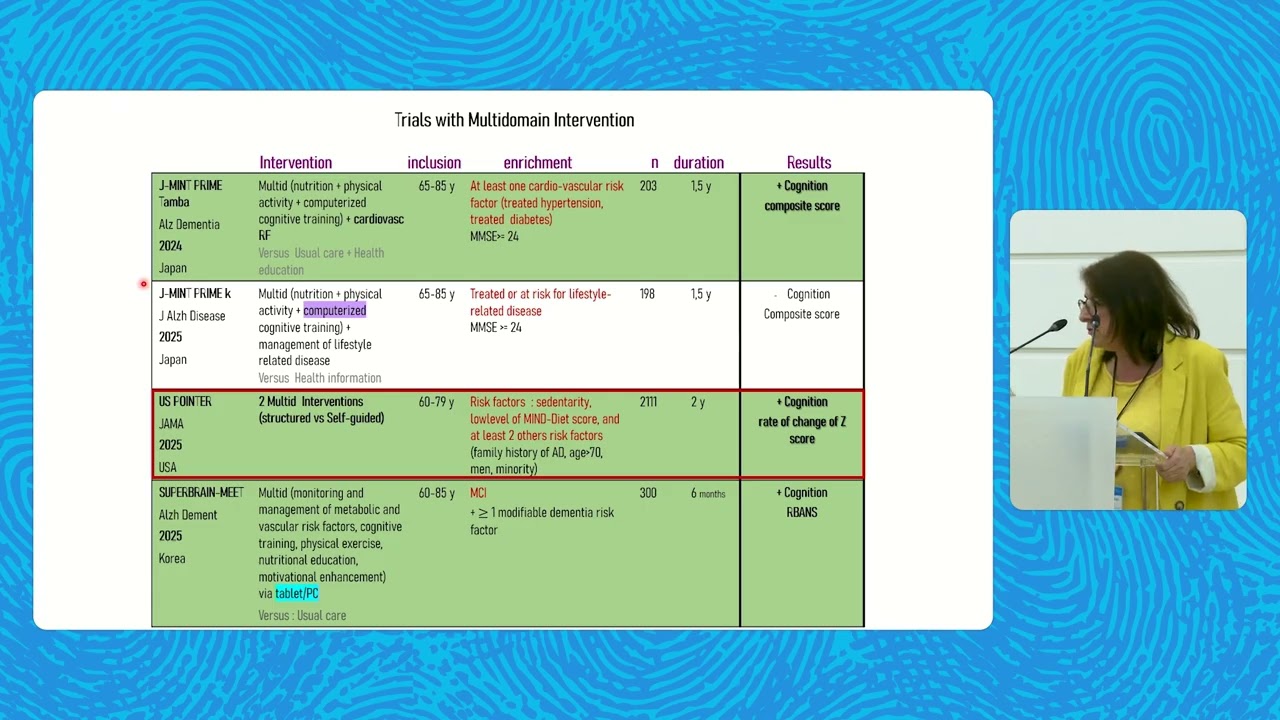
The presentation provides valuable insights into the complexity of multidomain prevention trials. The speaker systematically reviews major trials, highlighting both positive and negative results, and discusses methodological challenges such as population selection, adherence, and the need for long-term follow-up. The argumentation is well-structured and evidence-based, drawing on the speaker’s extensive experience. She acknowledges potential biases and limitations, such as the difficulty of maintaining behavior change and the possibility of practice effects. The discussion of future directions, including the use of biomarkers and biological age, is forward-looking and relevant.
Scientific Rigor, Source Quality, Title Accuracy
The presentation demonstrates scientific rigor by referencing specific trials (e.g., FINGER, preDIVA, SMART) and discussing their designs and outcomes. The speaker mentions a systematic review of 29 trials, indicating a comprehensive approach. The title accurately reflects the content. The speaker discloses her involvement in large trials, which is transparent. The talk is part of a symposium on exposomics and brain health, and the description lists funding sources, adding credibility. No specific sources are cited in the video, but the description provides context and funding information.
188 words
Title / Content Match
The title accurately reflects the content, which focuses on multidomain interventions to prevent cognitive decline.
Quality & Reliability
8/10
Presentation by a leading expert in dementia prevention trials, based on a systematic review of 29 randomized controlled trials and personal experience. The speaker discloses potential bias and discusses methodological challenges. The content is consistent with current scientific literature, though it reflects the author's perspective.
Key Moments
Markers derived by PSI from the transcript: the creator did not define chapters.
- Introduction and disclosure of involvement in large clinical trials.
- Discussion of why most preventive trials are negative.
- Overview of 29 multidomain trials and key positive trials like FINGER.
- Challenges in recruitment and adherence, including findings from the MAPT trial.
- Discussion of future directions: larger trials, biomarkers, and surrogates.
- Q&A session on trial design and implementation.
Cited Sources
- FINGER trial — Referenced as a landmark multidomain trial with positive results.
- preDIVA study — Mentioned as a negative trial with over 3,000 participants.
- SMART trial — Discussed as a personalized intervention with positive results.
- Maintain Your Brain study — Online intervention trial with positive cognitive outcomes.
- APPLE-Tree trial — Online trial with low intensity that missed primary endpoint.
Concurring Sources
- Lancet Commission on dementia prevention — Supports the importance of modifiable risk factors.
- FINGER trial publication — Positive results align with the speaker's emphasis on multidomain interventions.
Dissenting Sources
- preDIVA study — Negative result despite large sample and long follow-up, contrasting with positive trials.
Contribution & Novelties
The presentation synthesizes current evidence on multidomain prevention trials, highlighting the heterogeneity in design and outcomes. It offers a critical perspective on methodological challenges, such as participant selection and adherence, and suggests future directions including the use of blood biomarkers and biological age. The speaker’s emphasis on the need for political support for implementation adds a unique dimension.
Pour aller plus loin :
- FINGER trial — Landmark trial showing cognitive benefits of multidomain intervention.
- Lancet Commission on dementia prevention — Overview of modifiable risk factors.
- Exposome and brain health — Relevant to the symposium theme.
95 words
Radar Profile
The radar profile shows high scores in information quantity, quality, and technical level, with a slightly lower but still strong reliability score. This indicates a comprehensive and credible presentation with a high level of expertise.
💬 No comments were provided for analysis.