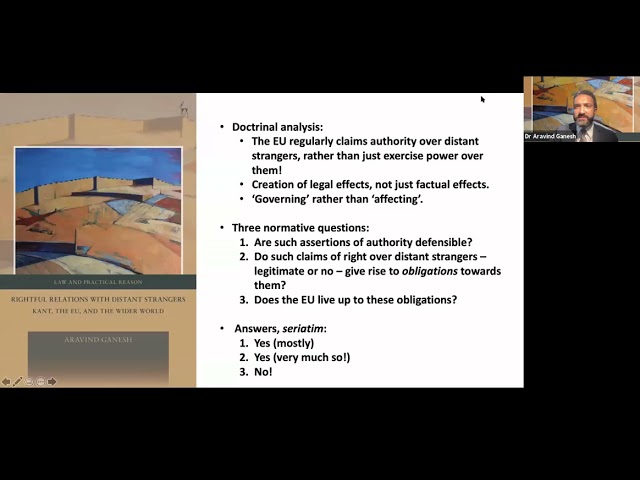
Rightful Relations with Distant Strangers: Kant, the EU, and the Wider World
Keywords
Summary
166 words
Critical Evaluation
Value of the Information & Strength of the Argument
The lecture provides a sophisticated and original philosophical argument, grounded in Kant’s legal philosophy, which is often overlooked in EU law scholarship. Ganesh’s distinction between harm and wrong is compelling and well-illustrated with examples. He effectively critiques the public goods approach by showing that it cannot justify coercive authority over non-consenting individuals. The argumentation is rigorous and logically structured, though it assumes familiarity with Kantian concepts and legal theory.
Scientific Rigor, Source Quality, Title Accuracy
The lecture is based on a peer-reviewed book published by Hart Publishing, which lends credibility. Ganesh references specific legal cases (e.g., Shrimp-Turtle) and theoretical works (e.g., Benvenisti, Reinhardt) to support his arguments. The title accurately reflects the content, focusing on the EU’s relations with distant strangers through a Kantian lens. The discussion with Prof. Mattias Kumm adds depth and critical perspective.
145 words
Title / Content Match
The title accurately reflects the content: the lecture focuses on the philosophical and legal relations between the EU and non-members, using Kant's philosophy of right.
Quality & Reliability
8/10
The lecture is based on a peer-reviewed academic book published by Hart Publishing, with a rigorous philosophical framework grounded in Kant's Doctrine of Right. The speaker is a legal scholar with relevant expertise, and the discussant is a prominent professor. The argumentation is structured and references specific legal cases and theoretical works.
Key Moments
Markers derived by PSI from the transcript: the creator did not define chapters.
- Introduction and welcome by the host, introducing Dr Aravind Ganesh and Prof. Mattias Kumm.
- Ganesh begins his presentation, outlining the book's thesis on rightful relations with distant strangers.
- Discussion of the EU's extraterritorial measures, including the emissions trading directive and the Shrimp-Turtle case.
- Critique of the public goods approach, arguing that harm is not the only basis for wrongfulness.
- Introduction of Kant's innate right to independence and its implications for legal relations.
- Explanation of the three forms of private law: property, contract, and fiduciary relations.
- Application of the theory to the EU, arguing that it often fails to meet its obligations of accountability.
- Conclusion and beginning of discussion with Prof. Mattias Kumm.
Cited Sources
- Rightful Relations with Distant Strangers: Kant, the EU, and the Wider World — The book being presented, published by Hart Publishing.
- Sovereignty as Trusteeship for Humanity — Referenced as a key work by Eyal Benvenisti on fiduciary obligations.
- The Free Sea — Grotius's work cited in the context of the torch example.
Concurring Sources
- Sovereignty as Trusteeship for Humanity — Benvenisti's work aligns with the fiduciary approach discussed.
- The Law of Peoples — Rawls's work on international justice, which shares concerns about global justice.
Dissenting Sources
- Global Public Goods and Extraterritorial Jurisdiction — Some scholars argue that providing global public goods can justify extraterritorial jurisdiction, which Ganesh critiques.
Contribution & Novelties
The lecture offers a novel application of Kant’s Doctrine of Right to EU external relations, moving beyond the usual focus on Perpetual Peace. It provides a rigorous philosophical framework for evaluating extraterritorial jurisdiction, distinguishing between harm and wrong, and emphasizing the importance of independence. This approach challenges existing justifications based on global public goods and offers a more principled basis for assessing the legitimacy of EU actions.
Pour aller plus loin :
- Kant’s Doctrine of Right — Stanford Encyclopedia of Philosophy entry on Kant’s social and political philosophy.
- Extraterritorial Jurisdiction — Overview of the concept in international law.
- Fiduciary Principle in Public Law — General concept of fiduciary relationships, relevant to the argument.
113 words
Radar Profile
The radar profile shows high scores in quality and technical level, indicating a rigorous and specialized lecture. The lower score in quantity of information reflects the focused nature of the presentation, while the overall fiability is high due to the academic context.