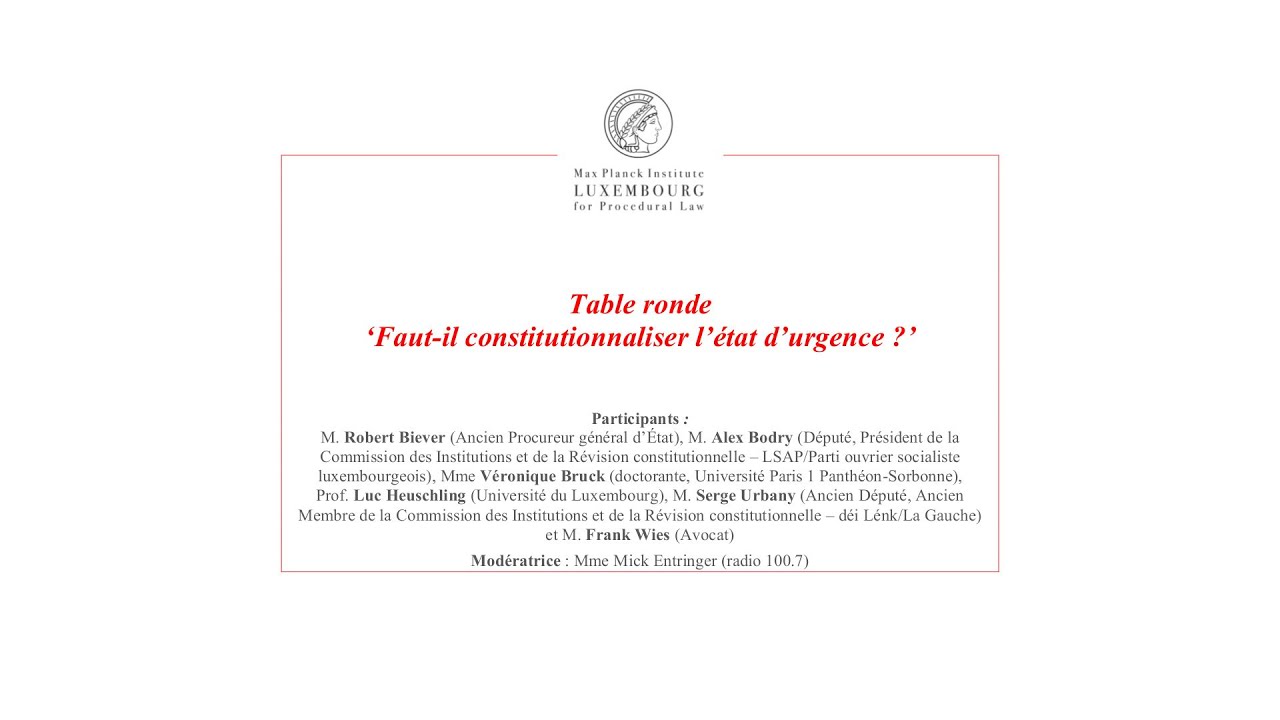
L’état d’urgence, rempart ou menace pour l’État de droit ? - Séquence Débat
Keywords
Summary
174 words
Critical Evaluation
Value of the Information & Strength of the Argument
The video provides valuable insights into the constitutional debate on the state of emergency in Luxembourg. The arguments are well-structured and grounded in legal and political reasoning. Alex Bodry presents a pragmatic case for constitutionalizing emergency powers, citing the need for rapid response to crises. Serge Urbany and Véronique Bruck offer critical perspectives, emphasizing the risks of executive overreach and the symbolic downgrading of fundamental rights. Robert Biever underscores the importance of proportionality and judicial control. Luc Heuschling contributes a nuanced analysis of the need for graded responses. The debate is balanced, with each participant given equal time to present their views, and the moderation facilitates a constructive exchange. The arguments are supported by references to constitutional texts, international human rights instruments, and historical precedents.
Scientific Rigor, Source Quality, Title Accuracy
The scientific rigor is high, as the debate features legal scholars and practitioners with expertise in constitutional law. The sources cited include the Luxembourg Constitution, the European Convention on Human Rights, and the International Covenant on Civil and Political Rights, which are relevant and authoritative. The title accurately reflects the content, which is a debate on the state of emergency and the rule of law. The video is an academic event organized by a reputable institution, the Max Planck Institute Luxembourg, ensuring a high level of credibility. The discussion is well-moderated and follows a structured format, with each speaker given time to present their arguments. The comments section is not provided, so no analysis of public reception is possible.
259 words
Title / Content Match
The title accurately reflects the content, which is a debate on whether the state of emergency is a safeguard or a threat to the rule of law.
Quality & Reliability
8/10
The video is a recorded academic conference-debate organized by the Max Planck Institute Luxembourg, featuring legal scholars, practitioners, and politicians. The discussion is structured, with multiple expert perspectives, and references to constitutional texts and legal frameworks. The content is reliable and well-argued, though it is a debate rather than a peer-reviewed study.
Key Moments
Markers derived by PSI from the transcript: the creator did not define chapters.
- Introduction by moderator Mick Entringer, presenting the panel and the topic.
- Alex Bodry explains the rationale for the constitutional revision, linking it to the Paris attacks and ongoing constitutional reform.
- Serge Urbany criticizes the proposal, arguing that it grants excessive powers to the executive and introduces the notion of 'ordre public'.
- Robert Biever discusses the need for proportionality and judicial oversight, referencing international human rights law.
- Luc Heuschling argues for a graded approach to exceptional situations, emphasizing the need for effective and proportionate responses.
- Véronique Bruck presents her critical view, arguing that the constitutionalization is unnecessary and dangerous.
- Frank Wies shares his perspective on the implications for human rights and the rule of law.
- Open discussion and questions from the audience.
Cited Sources
- Event page: L’état d’urgence, rempart ou menace pour l’État de droit ? — Official description and program of the conference-debate.
Concurring Sources
- European Convention on Human Rights — Article 15 allows derogations from certain rights in times of war or public emergency, subject to conditions.
- International Covenant on Civil and Political Rights — Article 4 permits derogations in times of public emergency, with safeguards.
Dissenting Sources
- Luxembourg Constitution (Article 32(4)) — The current provision limits the state of emergency to international crises, which the debate argues is too narrow or too broad depending on perspective.
Contribution & Novelties
The video contributes to the public debate on the constitutionalization of the state of emergency in Luxembourg, offering a multi-perspective analysis from legal scholars, practitioners, and politicians. It provides a comprehensive overview of the arguments for and against, highlighting the tensions between security and liberty. The debate is particularly relevant in the context of post-2015 terrorist attacks in Europe. It underscores the importance of procedural safeguards and proportionality in emergency legislation.
Pour aller plus loin :
- State of emergency — Provides general background on the concept and its legal implications.
- Rule of law — Discusses the principle of rule of law and its relationship with emergency powers.
- European Convention on Human Rights — Relevant for Article 15 on derogations in times of emergency.
123 words
Radar Profile
The radar profile shows high scores in quantity and quality of information, reflecting the rich content and expert contributions. The technical level is moderately high, indicating a specialized audience. The overall reliability is strong, given the institutional context and the expertise of the speakers.