Panel 2: Collective Redress
Keywords
Summary
163 words
Critical Evaluation
Value of the Information & Strength of the Argument
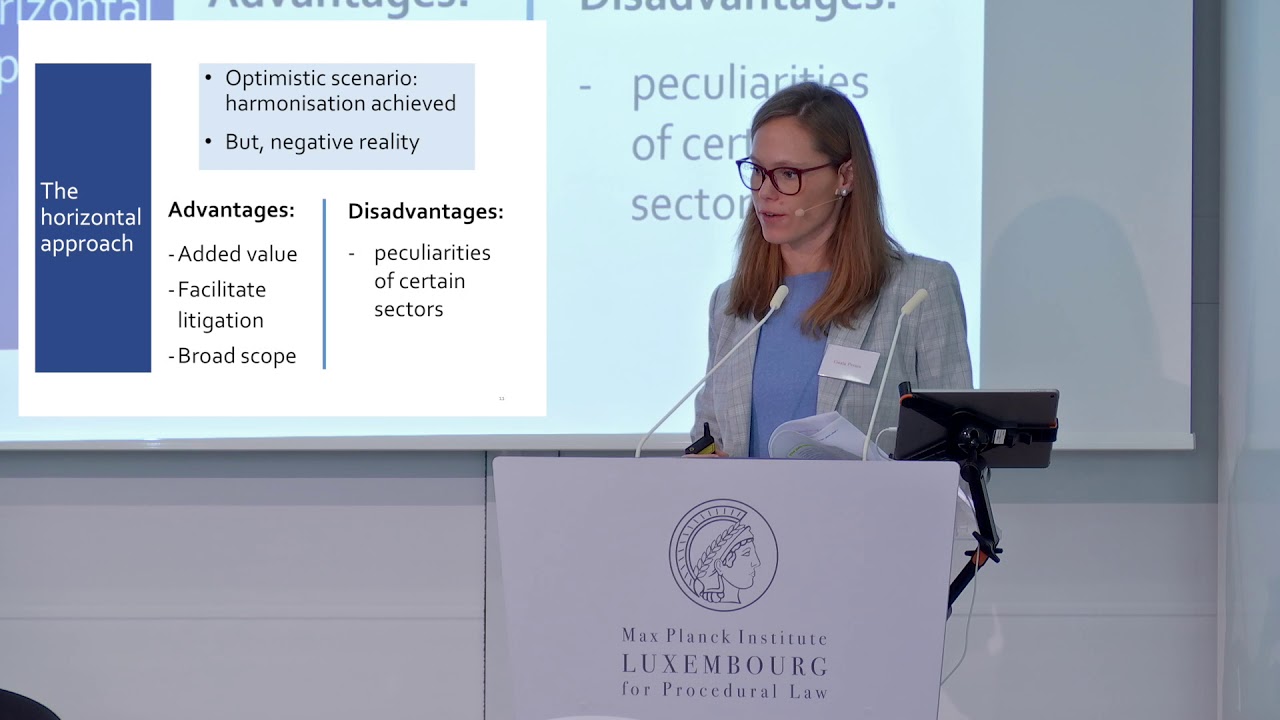
The video provides valuable insights into the complexities of collective redress in the EU, offering a detailed analysis of legal instruments and case law. The argumentation is solid, grounded in legal texts and judicial decisions. The speaker effectively contrasts horizontal and sectoral approaches, highlighting their strengths and weaknesses. The discussants add depth by examining practical implications and potential reforms. The panel’s critical assessment of the Brussels I Regulation’s applicability to collective actions is well-reasoned, supported by references to specific cases and legislative proposals.
Scientific Rigor, Source Quality, Title Accuracy
The scientific rigor is high, with references to EU regulations, directives, and Court of Justice case law. The sources cited are authoritative, including the European Commission’s 2013 Recommendation and 2018 proposal, as well as the GDPR. The title accurately reflects the content, which is a focused panel discussion on collective redress. The discussion is well-structured and maintains a high level of legal analysis.
161 words
Title / Content Match
The title accurately reflects the content, which is a panel discussion on collective redress mechanisms in the EU.
Quality & Reliability
8/10
The video features academic experts discussing legal frameworks, with references to EU legislation and case law. The content is well-structured and grounded in legal analysis, though it is a panel discussion rather than a peer-reviewed study.
Key Moments
Markers derived by PSI from the transcript: the creator did not define chapters.
- Introduction by Chair Michal Bobek, setting the stage for the panel.
- Cinzia Peraro begins her presentation on cross-border collective redress.
- Discussion of the definition and context of collective redress in the EU.
- Analysis of horizontal vs sectoral approaches.
- Examination of the 2013 Recommendation and its limited impact.
- Discussion of sectoral legislation, including antitrust and consumer directives.
- Focus on cross-border jurisdictional issues and the Brussels I Regulation.
- Case law on assignment of claims and GDPR Article 80.
- Stephanie Law's commentary on the 2018 proposal and cross-border dimensions.
- Janek Nowak discusses recognition and enforcement issues.
- Conclusions and open discussion on future developments.
Cited Sources
- Commission Recommendation of 11 June 2013 on common principles for injunctive and compensatory collective redress mechanisms — Referenced as the horizontal approach framework.
- Proposal for a Directive on representative actions for the protection of the collective interests of consumers — Discussed as the latest sectoral initiative.
- Regulation (EU) No 1215/2012 (Brussels I Recast) — Central to the jurisdictional analysis.
- GDPR Article 80 — Mentioned as an extension of representative actions in data protection.
- Case C-498/16 (Schrems II) — Referenced in the discussion on judicial legislation and coherence.
Concurring Sources
- Study on Collective Redress in the Member States (2007) — Referenced as background on national systems.
Contribution & Novelties
The panel provides a comprehensive analysis of the current state of collective redress in the EU, highlighting the tension between horizontal and sectoral approaches. It offers a critical evaluation of the Brussels I Regulation’s applicability to collective actions, suggesting that it is not fit for purpose. The discussion brings to light the need for legislative intervention and the potential for extending existing rules to other areas like employment.
Pour aller plus loin :
- Collective Redress in the EU — Overview of collective redress mechanisms.
- Brussels I Regulation — Background on the EU jurisdiction regulation.
- European Commission’s New Deal for Consumers — Context of the 2018 proposal.
106 words
Radar Profile
The radar profile shows high scores in information quantity and quality, reflecting the depth of legal analysis. The technical level is moderate, indicating accessibility to a legal audience. Overall, the panel is reliable and well-sourced.