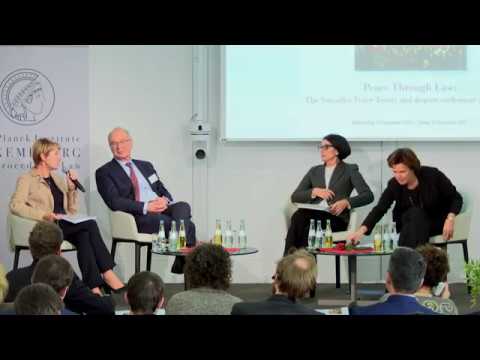
Round table: The dispute settlement system from a contemporary perspective
Keywords
Summary
167 words
Critical Evaluation
Value of the Information & Strength of the Argument
The value of the information is high, as it provides expert insights into the historical development and contemporary challenges of international dispute settlement. The panelists offer well-reasoned arguments, drawing on their extensive experience and knowledge. They critically assess the strengths and weaknesses of various mechanisms, such as the ICJ, the WTO Appellate Body, and mass claims commissions. The argumentation is solid, with panelists engaging in a nuanced debate about the role of politics, the composition of courts, and the universality of the European model. They also highlight the importance of regional approaches and the need for adequate resources. The discussion is balanced, acknowledging both successes and failures, and avoids oversimplification.
Scientific Rigor, Source Quality, Title Accuracy
The scientific rigor is evident in the panelists’ references to historical events, legal instruments, and specific cases. They cite examples such as the Hague Conferences, the Versailles Treaty, the UN Compensation Commission, and the Iran-United States Claims Tribunal. However, the discussion is based on expert opinion rather than formal citations, and no specific sources are mentioned in the video description. The title accurately reflects the content, and the panelists adhere to the topic throughout. The adequacy between title and content is strong, as the discussion consistently addresses the dispute settlement system from a contemporary perspective, building on the legacy of the Versailles Treaty.
228 words
Title / Content Match
The title accurately reflects the content: a round table discussion on the dispute settlement system from a contemporary perspective, focusing on the legacy of the Versailles Treaty and current challenges.
Quality & Reliability
8/10
The round table features distinguished legal scholars and judges with extensive expertise in international dispute settlement. The discussion is well-informed, referencing historical and contemporary examples, and provides nuanced perspectives. However, it is a debate format with no formal citations or peer-reviewed sources, and the views are expert opinions rather than empirical findings.
Key Moments
Markers derived by PSI from the transcript: the creator did not define chapters.
- Introduction by Prof. Hélène Ruiz Fabri, framing the round table on the dispute settlement system from a contemporary perspective.
- Prof. Laurence Boisson de Chazournes discusses the legacy of the Versailles Treaty, highlighting the establishment of the Permanent Court of International Justice and its influence on the ICJ.
- Prof. Photini Pazartzis reflects on the achievements of the PCIJ and the importance of looking back to understand current international courts.
- Judge Bruno Simma comments on the composition of courts and the political dynamics, referencing the Iran-United States Claims Tribunal.
- Discussion on the fragility of judicial institutions, including the crisis of the WTO Appellate Body and the Inter-American system.
- Debate on the universality of the European model of dispute settlement and the role of regional courts.
- Prof. Hans Van Houtte shares insights on mass claims commissions and the importance of functional mechanisms.
- Discussion on the independence of judges and the impact of re-election on judicial decision-making.
- Panelists consider the role of advisory opinions and the relationship between the ICJ and political organs.
- Concluding remarks by Prof. Burkhard Hess, summarizing the key themes and future challenges.
Contribution & Novelties
The round table provides a contemporary perspective on the dispute settlement system, emphasizing the historical legacy of the Versailles Treaty and its relevance to current challenges. It offers expert insights into the fragility of international courts, the role of politics, and the need for sustainable funding. The discussion highlights the importance of regional mechanisms and the universality of the European model, while also acknowledging alternative views. The panelists’ diverse backgrounds and experiences enrich the analysis, making it a valuable resource for understanding the evolution and future of international dispute settlement.
Pour aller plus loin :
- Permanent Court of International Justice — Historical context and significance.
- International Court of Justice — Official website with information on its role and functions.
- WTO Appellate Body — Overview of the crisis and its implications.
- Iran-United States Claims Tribunal — Example of a mass claims commission.
- United Nations Compensation Commission — Details on the UNCC and its operations.
153 words
Radar Profile
The radar profile shows high scores in quantity and quality of information, reflecting the depth and expertise of the panelists. The technical level is also high, indicating a sophisticated discussion suitable for an informed audience. The overall reliability is strong, though the debate format and lack of formal citations slightly reduce the score. The profile suggests a well-rounded and credible discussion.