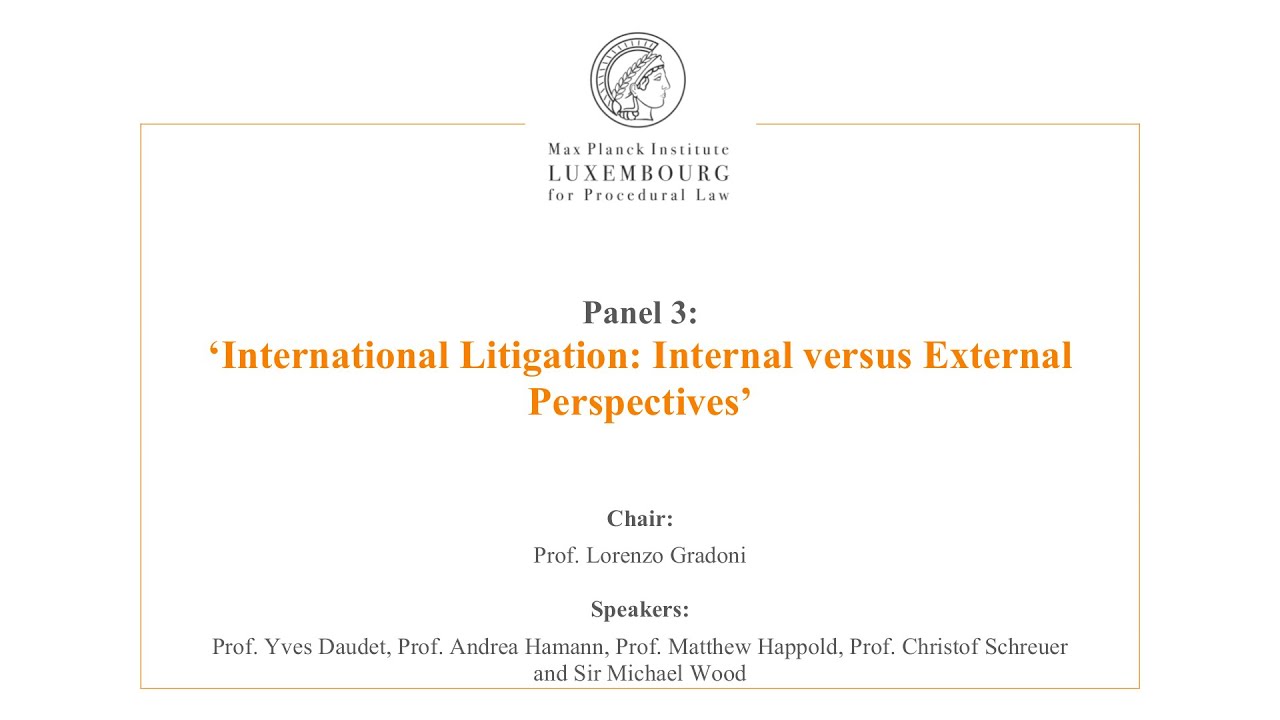
International Law and Litigation - 3 - Internal versus External Perspectives
Keywords
Summary
164 words
Critical Evaluation
Value of the Information & Strength of the Argument
The value of the information is high, as the panel brings together leading experts with practical experience in international courts and tribunals. The arguments are well-founded, drawing on concrete examples such as the ICJ’s working methods, dissenting opinions, and the public debate on investment arbitration. The discussion is nuanced, acknowledging the complexity of the insider/outsider distinction and the various criteria that can be applied. The panelists engage critically with each other’s points, providing a rich and balanced analysis.
Scientific Rigor, Source Quality, Title Accuracy
The scientific rigor is evident in the panelists’ expertise and their references to specific cases, institutional practices, and scholarly debates. The sources cited are primarily the panelists’ own experiences and well-known legal doctrines, rather than external publications. The title accurately reflects the content, as the entire panel is dedicated to exploring the internal/external dichotomy. The discussion is well-structured and stays on topic.
155 words
Title / Content Match
The title accurately reflects the panel's focus on internal versus external perspectives in international litigation, as the discussion consistently addresses this dichotomy.
Quality & Reliability
8/10
The video features a panel of distinguished international law scholars and practitioners, including professors and a former ICJ judge, discussing theoretical and practical aspects of international litigation. The discussion is grounded in legal expertise and institutional experience, though it is a debate format with subjective viewpoints rather than a peer-reviewed study.
Key Moments
Markers derived by PSI from the transcript: the creator did not define chapters.
- Introduction by Lorenzo Gradoni, framing the panel's theme and questions.
- Yves Daudet discusses the internal perspective of a judge, focusing on solving the case and the role of dissenting opinions.
- Andrea Hamann analyzes the insider/outsider distinction based on different criteria, suggesting a focus on visibility.
- Matthew Happold contrasts judges' and academics' perspectives, highlighting the collective nature of judicial decision-making.
- Christof Schreuer discusses the external perspective on investment arbitration, addressing criticisms and the role of NGOs.
- Sir Michael Wood provides further insights on the internal/external dichotomy and the role of international law.
- Open discussion with the audience, addressing questions on the legitimacy and reform of international litigation.
Cited Sources
- Max Planck Institute Luxembourg - International Law and Litigation — Official conference page with details on the event and panelists.
Concurring Sources
- Max Planck Institute Luxembourg — Institutional website providing context on the research department and its activities.
Contribution & Novelties
The panel provides a nuanced exploration of the internal/external dichotomy in international litigation, moving beyond a simple binary to consider multiple criteria and blurred boundaries. It offers practical insights from judges and practitioners, highlighting the importance of visibility and the role of academics. The discussion on investment arbitration’s external critics adds a contemporary dimension.
Pour aller plus loin :
- International Court of Justice — Official site for understanding the ICJ’s role and procedures.
- Investor-State Dispute Settlement (ISDS) — Overview of ISDS and its controversies.
- Max Planck Institute Luxembourg — Research institute focusing on procedural law, including international litigation.
98 words
Radar Profile
The radar profile shows high scores in quantity and quality of information, reflecting the rich discussion and expert contributions. The technical level is moderately high, suitable for an academic audience. The overall reliability is strong due to the panelists' credentials.