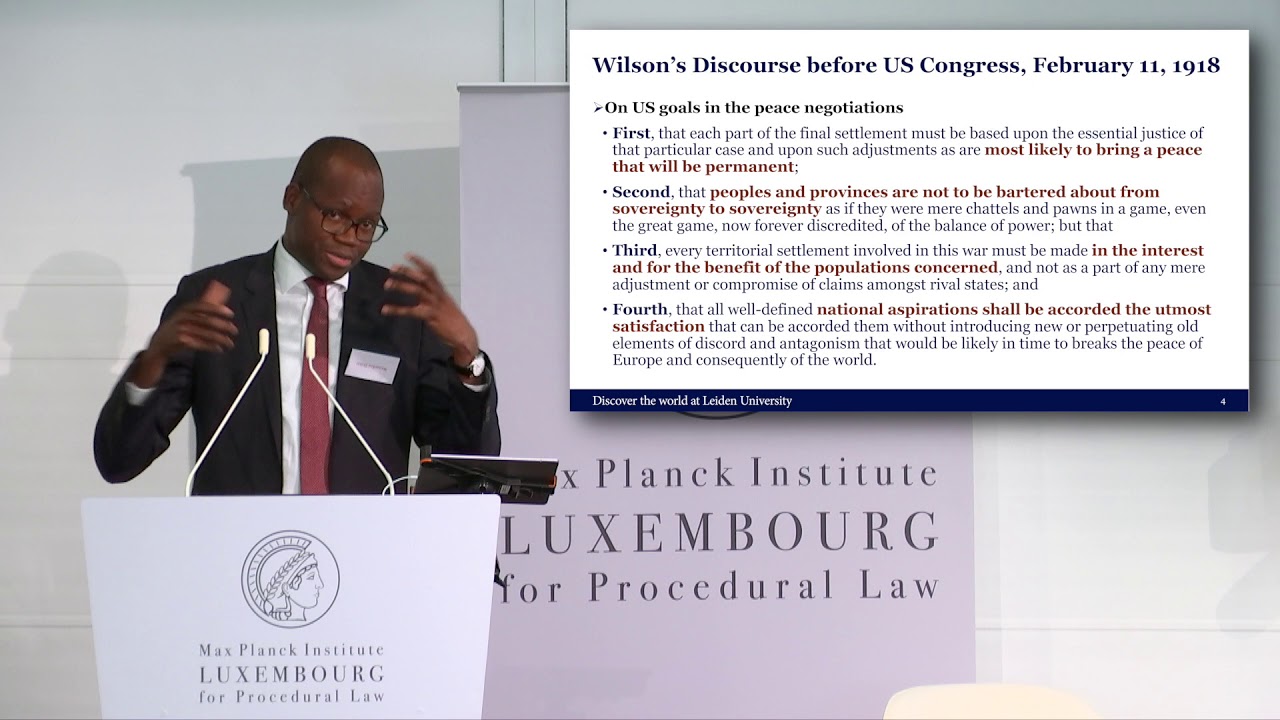
Panel II: The political termination of the war
Keywords
Summary
122 words
Critical Evaluation
Value of the Information & Strength of the Argument
The value of the information is high, offering a nuanced historical and legal analysis of the mandate system. Hébié’s argument that the system was both novel and a continuation of realpolitik is well-supported with specific examples (e.g., Sykes-Picot, Balfour Declaration). Wilde’s conceptualization of ‘foreign territorial administration’ provides a useful framework for understanding diverse practices. The argumentation is solid, grounded in legal texts and historical context, though some points are presented as interpretations rather than definitive conclusions.
Scientific Rigor, Source Quality, Title Accuracy
The speakers demonstrate rigorous scholarship, referencing primary sources such as the Versailles Treaty, the League of Nations Covenant, and the UN Charter. They also engage with secondary literature, though specific citations are not always given. The title accurately reflects the content, focusing on the political termination of war. The discussion is well-structured and maintains a high level of academic rigor.
151 words
Title / Content Match
The title accurately reflects the panel's focus on the political dimensions of ending war, particularly through the mandate system and trusteeship.
Quality & Reliability
8/10
The panel features two established academics in international law (Mamadou Hébié and Ralph Wilde) presenting nuanced historical analysis grounded in legal scholarship. The content is well-structured, references primary sources (Versailles Treaty, League of Nations Covenant), and demonstrates critical evaluation. Minor limitations include lack of visual aids and the inherent interpretive nature of historical analysis.
Key Moments
Markers derived by PSI from the transcript: the creator did not define chapters.
- Introduction of speakers and topic by chair Valérie Rosoux.
- Hébié begins his talk on the mandate system, focusing on Wilson's ideals.
- Hébié discusses the departure from conquest as a title to sovereignty.
- Hébié explains the categories of mandates (A, B, C) and the civilizing mission.
- Hébié concludes with the legacy of the mandate system, including the Stimson Declaration.
- Wilde begins his talk on Versailles as a landmark in trusteeship and internationalisation.
- Wilde discusses the four types of foreign territorial administration and their commonalities.
- Wilde analyzes the principles of trusteeship and self-determination in Versailles.
- Discussion begins, with questions from the audience.
Cited Sources
- Versailles Treaty — Referenced as the primary document establishing the mandate system and other provisions.
- League of Nations Covenant — Article 22 of the Covenant is discussed in relation to mandates.
- Fourteen Points — Wilson's Fourteen Points are referenced as the ideological basis for the mandate system.
- Sykes-Picot Agreement — Mentioned as an example of pre-war realpolitik that influenced mandate boundaries.
- Balfour Declaration — Referenced as a commitment that shaped the Palestine mandate.
- UN Charter — Mentioned in relation to the trusteeship system and non-self-governing territories.
- UN General Assembly Resolution 1514 (XV) — Referenced as the Declaration on Decolonization that rejected the civilizing mission.
Concurring Sources
- The Mandate System: Origins, Principles, Application — A UNHCR document providing historical context on mandates.
- International Law and the Administration of Occupied Territories — ICRC overview of occupation law, which relates to Wilde's discussion.
Dissenting Sources
- The Mandate System: A Critical Assessment — Some scholars argue that the mandate system was primarily a tool for maintaining colonial control, downplaying its innovative aspects. This perspective is not fully addressed in the panel.
Contribution & Novelties
The panel provides a nuanced reassessment of the mandate system, highlighting its dual nature as both a new departure and a continuation of imperial practices. Hébié’s focus on the legal innovation of ’no conquest title’ and Wilde’s broader framework of ‘foreign territorial administration’ offer fresh perspectives. The discussion also illuminates the origins of international supervision and human rights mechanisms.
Pour aller plus loin :
- Mandate system — Overview of the mandate system.
- Trusteeship Council — The UN body that succeeded the mandates system.
- Self-determination — Key principle discussed in the panel.
- Standard of civilization — Concept underlying the civilizing mission.
- International territorial administration — Wilde’s framework, though not a standard term, related to UN administrations.
115 words
Radar Profile
The radar profile shows high scores in information quantity and quality, reflecting the dense historical and legal content. The technical level is moderate, indicating accessibility to a general audience with some background. Overall reliability is high due to the academic credentials of the speakers.
💬 No comments were provided for analysis.