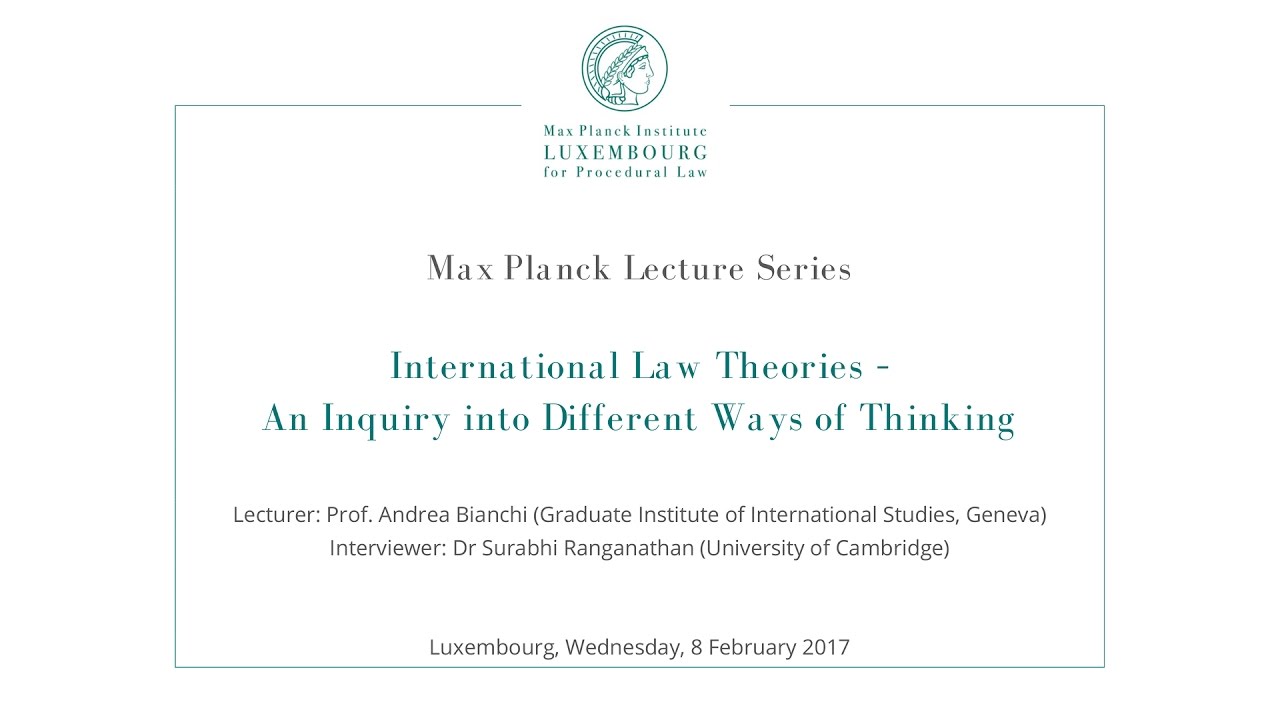
International Law Theories: An Inquiry Into Different Ways of Thinking
Keywords
Summary
145 words
Critical Evaluation
Value of the Information & Strength of the Argument
The video provides valuable insights into the landscape of international law theories, offering a nuanced perspective on how different schools of thought can be understood and engaged with. Bianchi’s argumentation is thoughtful and reflexive, as he draws on his own intellectual journey and experiences. He effectively conveys the idea that theory is not merely an academic exercise but a means to understand the assumptions underlying legal practice. The discussion is well-structured, with Bianchi responding to questions with depth and clarity. While the content is primarily based on his personal views, it is grounded in extensive knowledge of the field and offers a compelling case for embracing theoretical diversity.
Scientific Rigor, Source Quality, Title Accuracy
The video is a scholarly discussion, and the speaker demonstrates rigor in his analysis, referencing various schools of thought and their critiques. The sources cited are primarily the book itself and the speaker’s own academic work. The title accurately reflects the content, which is an inquiry into different ways of thinking about international law. The discussion is not heavily sourced with external references, but it is clear that the speaker is well-versed in the literature. The adequacy between title and content is strong, as the video indeed explores multiple theoretical perspectives.
214 words
Title / Content Match
The title accurately reflects the content, which is a discussion of various international law theories and ways of thinking.
Quality & Reliability
8/10
The video features a distinguished professor of international law discussing his own book, providing expert opinion and insights. The content is well-structured and reflects deep knowledge, but it is not peer-reviewed or empirically verified.
Key Moments
Markers derived by PSI from the transcript: the creator did not define chapters.
- Introduction of the speakers and the event structure.
- Discussion on the book's purpose to broaden the curriculum of the 'invisible college'.
- Bianchi explains his choice to write the book in his own voice rather than commissioning chapters.
- Discussion on the difficulty of categorizing oneself within a particular theoretical school.
- Bianchi discusses his forays into different theoretical approaches and the attempts to co-opt him.
- Exploration of the resonances and differences between various schools of thought.
- Discussion on the relationship between theory and practice in international law.
- Bianchi emphasizes the importance of curiosity and reflexivity in legal scholarship.
Cited Sources
- Max Planck Institute Luxembourg - Event page — Official event page providing details about the lecture and the book.
Concurring Sources
- International Law Theories: An Inquiry into Different Ways of Thinking (book) — The book discussed in the video, providing a comprehensive overview of various theories.
Contribution & Novelties
The video offers a unique perspective on international law theories, as it is an interview with the author of a comprehensive book on the subject. Bianchi’s approach of writing the book in his own voice provides a personal and reflexive account of various theoretical schools, which is not commonly found in edited volumes. He emphasizes the importance of curiosity and the freedom to draw from different approaches without being confined to a single school. This contributes to a more nuanced understanding of the field.
Pour aller plus loin :
- International Legal Theory — Overview of the field and its various approaches.
- Critical Legal Studies — A movement that challenges traditional legal doctrines, relevant to the discussion.
- New Haven School — A policy-oriented approach to international law, mentioned in the video.
130 words
Radar Profile
The radar profile shows high scores in quantity and quality of information, reflecting the depth and breadth of the discussion. The technical level is also high, indicating that the content is aimed at an audience with some familiarity with legal theory. The overall reliability is strong, given the expertise of the speaker.