Panel III: The Role of Water Agreements and Institutions
Keywords
Summary
107 words
Critical Evaluation
Value of the Information & Strength of the Argument
The panel provides valuable insights into the design and implementation of water treaties, combining empirical analysis with practical legal experience. Fishhendler’s data-driven approach offers a nuanced understanding of how uncertainty is managed, while Levine’s case studies illustrate the PCA’s evolving role. The argumentation is solid, grounded in both academic research and real-world examples, though some points could benefit from deeper exploration.
Scientific Rigor, Source Quality, Title Accuracy
The panel demonstrates scientific rigor through the use of empirical data and reference to specific treaties and cases. However, the transcript lacks explicit citations, and the sources are not systematically listed. The title accurately reflects the content, and the discussion is coherent and well-structured.
120 words
Title / Content Match
The title accurately reflects the panel's focus on the role of water agreements and institutions in resolving transboundary freshwater disputes.
Quality & Reliability
8/10
The panel features established experts in international water law and dispute resolution, providing a high-level academic discussion. The content is based on empirical research and practical experience, but lacks formal peer review and specific citations in the transcript.
Key Moments
Markers derived by PSI from the transcript: the creator did not define chapters.
- Introduction by Prof. Alan Boyle setting the context for the panel.
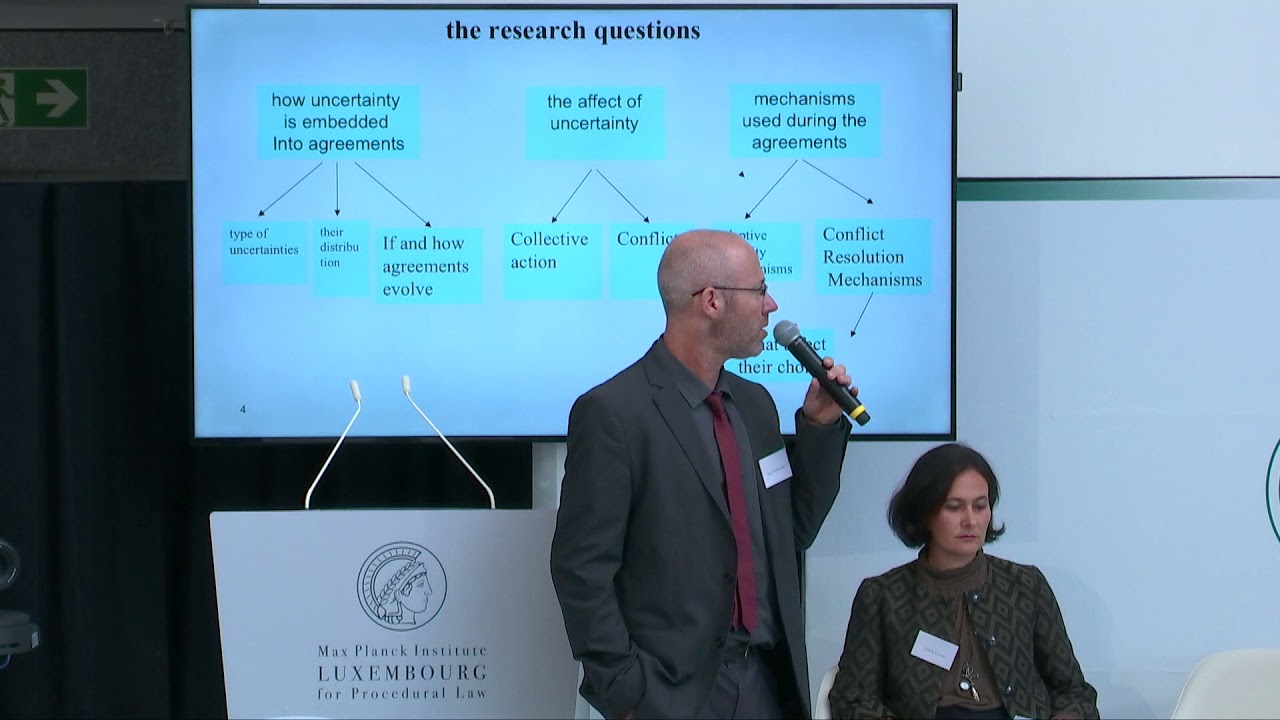
- Prof. Itay Fishhendler begins his presentation on accommodating uncertainty in water treaty design.
- Fishhendler discusses the typology of mechanisms for dealing with uncertainty.
- Fishhendler presents empirical findings on the prevalence of different mechanisms.
- Fishhendler concludes with lessons learned and open questions.
- Ms. Judith Levine begins her talk on the Permanent Court of Arbitration's role.
- Levine reviews historical and recent PCA cases involving water disputes.
- Levine discusses the evolving role of the PCA and its institutional structure.
- Prof. Laurence Boisson de Chazournes and Dr. Komlan Sangbana present on legal frameworks and cooperation.
- Q&A session and concluding remarks.
Cited Sources
- International Conference: A Bridge over Troubled Waters — Conference page providing more information about the event and panel.
Concurring Sources
- UN Watercourses Convention — The 1997 UN Convention, which aligns with the panel's discussion on legal frameworks for transboundary water cooperation.
Contribution & Novelties
The panel contributes original empirical research on water treaty design, offering a systematic analysis of mechanisms for accommodating uncertainty. It also provides practical insights into the role of arbitration institutions. The discussion highlights the importance of institutional cooperation and the need for coherent legal interpretation.
Pour aller plus loin :
- UN Watercourses Convention — The 1997 UN Convention on the Law of the Non-Navigational Uses of International Watercourses, a key legal framework.
- Permanent Court of Arbitration — Official website of the PCA, with details on its role and cases.
- Helsinki Rules — The 1966 Helsinki Rules on the Uses of the Waters of International Rivers, a foundational document in international water law.
112 words
Radar Profile
The radar profile shows high scores in information quantity, quality, and technical level, indicating a dense and expert-level discussion. The overall reliability is strong, though the lack of explicit citations slightly lowers the score.