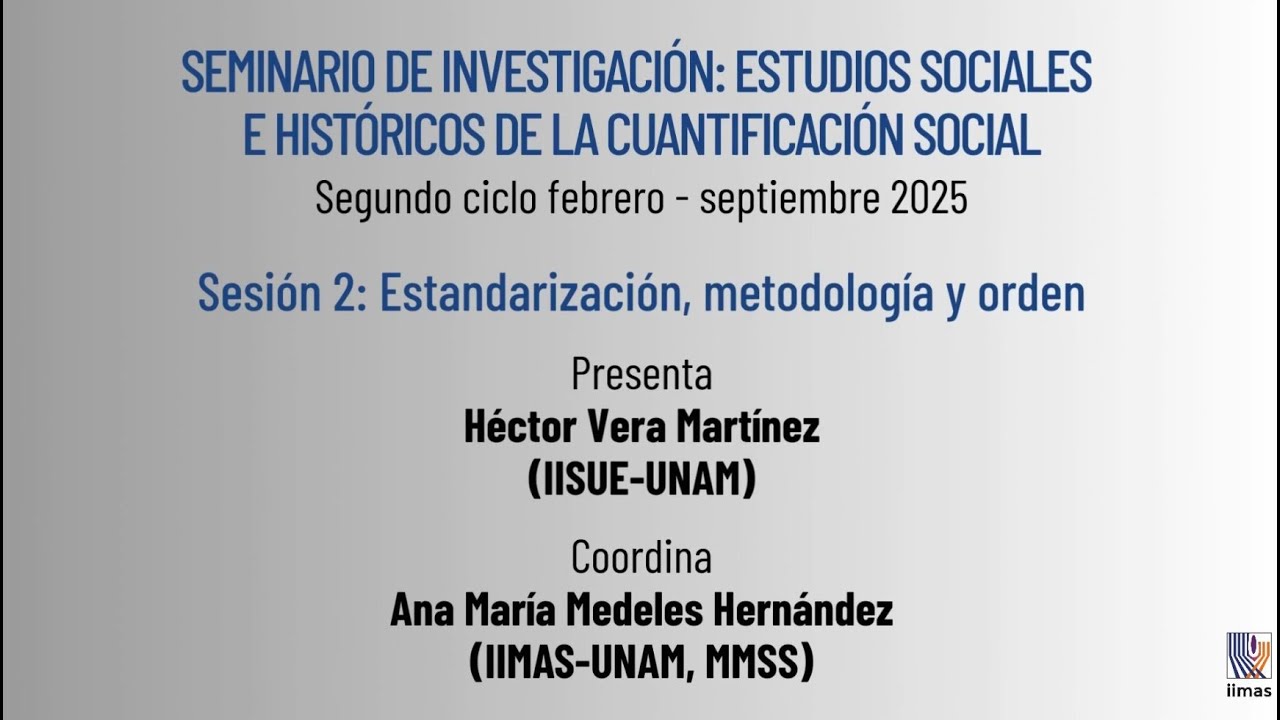
Seminario de inv., Estudios sociales e históricos de la cuantificación social 2o ciclo 2025 sesión 2
Keywords
Summary
198 words
Critical Evaluation
Value of the Information & Strength of the Argument
The presentation offers valuable insights into the history and sociology of measurement, challenging common assumptions about the metric system’s spread. Vera’s argument that state coercion, rather than capitalism, is the primary driver of metrication is well-supported with historical examples, such as the late adoption by capitalist nations like the US and UK, and early adoption by the Soviet Union. He effectively uses comparative case studies (Mexico vs. US) to illustrate the factors that facilitate or hinder metrication. The argumentation is coherent and logically structured, though it relies heavily on his own research and may not fully engage with counterarguments. The discussion of pre-metric systems’ variability and their impact on trade and governance is particularly compelling, providing a clear rationale for standardization. Overall, the value lies in its interdisciplinary approach, bridging history, sociology, and political science.
Scientific Rigor, Source Quality, Title Accuracy
The presentation demonstrates strong scientific rigor, drawing on the speaker’s extensive research and publications. Vera references his own books and articles, as well as the work of James C. Scott, providing a solid foundation. However, specific citations are not provided during the talk, and the audience is expected to be familiar with the literature. The title accurately reflects the content, which is a seminar on social and historical studies of quantification, focusing on standardization and metrology. The session is part of a series, and the title appropriately indicates the session number and topic. No comments were provided, so no analysis of public reception is possible.
255 words
Title / Content Match
The title accurately describes the content: a seminar session on social and historical studies of quantification, focusing on standardization and metrology.
Quality & Reliability
8/10
The speaker is a recognized researcher in sociology and historical studies of quantification, with a solid publication record. The presentation is based on his own research and published works, providing a high level of expertise. However, as a seminar presentation, it lacks peer review and detailed citations, and some claims are presented without direct evidence.
Key Moments
Markers derived by PSI from the transcript: the creator did not define chapters.
- Introduction and welcome by the moderator, introducing Dr. Héctor Vera and the seminar topic.
- Vera begins his presentation, outlining his research areas and the global history of the metric system.
- Discussion of the global diffusion of the metric system, with maps showing adoption over time.
- Explanation of the role of state coercion in metrication, contrasting with capitalism as a driver.
- Analysis of the US failure to adopt the metric system, comparing with successful cases like Mexico.
- Discussion of pre-metric systems' variability and their impact on trade and governance.
- Vera elaborates on the concept of 'legibility' and state power, referencing James C. Scott.
- Q&A session begins, with questions from the audience on specific points.
- Further discussion on the role of education and knowledge distribution in metrication.
- Concluding remarks and thanks, with mention of upcoming publications.
Cited Sources
- El peso del kilo: Historia de la métrica decimal en México — Vera's book on the history of the metric system in Mexico, mentioned as a previous publication.
- Jarick Nation (upcoming book on US non-adoption) — Vera's forthcoming book on why the US did not adopt the metric system, to be published in May.
- Seeing Like a State — James C. Scott's work on state legibility, referenced by Vera to explain state motivations for standardization.
Concurring Sources
- Seeing Like a State — Vera's argument aligns with Scott's thesis that states seek to make societies legible through standardization.
Dissenting Sources
- The Metric System: A History of Its Adoption and Use — Some economic historians argue that market forces, not state coercion, were the primary drivers of metrication, a view Vera explicitly challenges.
Contribution & Novelties
This presentation offers a novel perspective on the history of the metric system, emphasizing the role of state coercion over economic factors. Vera’s comparative analysis of Mexico and the US provides new insights into the conditions necessary for successful metrication. The discussion of pre-metric systems’ variability and their implications for trade and governance adds depth to the understanding of standardization. The upcoming book on the US case promises to fill a gap in the literature.
Pour aller plus loin :
- Metric system — Overview of the metric system’s history and adoption.
- Metrology — The science of measurement and its social implications.
- James C. Scott — Anthropologist whose work on state legibility is central to Vera’s argument.
- International System of Units (SI) — The modern form of the metric system, relevant to current standardization efforts.
134 words
Radar Profile
The radar profile shows high scores in quantity and quality of information, reflecting the depth and expertise of the presentation. The technical level is also high, indicating a specialized audience. The overall reliability is strong, given the speaker's credentials and the use of historical evidence. The profile suggests a well-rounded, authoritative seminar.