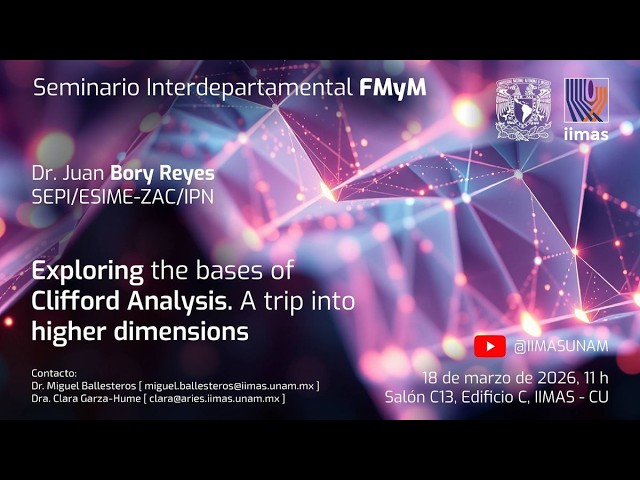
Exploring the bases of Clifford Analysis. A trip into higher dimensions
Keywords
Summary
195 words
Critical Evaluation
Value of the Information & Strength of the Argument
The lecture provides valuable historical and conceptual insights into Clifford analysis, connecting it to classical complex analysis and highlighting its role in unifying various mathematical structures. The speaker’s argumentation is coherent and well-structured, building from the basics of complex analysis to higher-dimensional generalizations. He effectively demonstrates the natural progression of ideas and the importance of the Cauchy-Riemann operator in factorizing the Laplacian. The discussion of quaternionic analysis and its relation to vector calculus is particularly illuminating. However, the lecture is more of an overview than a rigorous mathematical exposition, with many topics touched upon but not deeply explored. The speaker’s personal anecdotes, while engaging, sometimes detract from the mathematical content. Overall, the value lies in its pedagogical and historical perspective, making it a useful introduction for those interested in the field.
Scientific Rigor, Source Quality, Title Accuracy
The scientific rigor is high, given the speaker’s expertise and the accurate presentation of mathematical concepts. However, the lecture is informal and does not provide detailed citations for the many results mentioned. The speaker references several classical texts and authors, such as Vekua, Beltrami, Moisil, Teodorescu, Fueter, and Clifford, but without specific references. The title accurately reflects the content, as the lecture explores the foundations of Clifford analysis and its extension to higher dimensions. The description provides minimal information, but the speaker’s credentials and the institutional setting (IIMAS-UNAM) lend credibility. No comments were provided for analysis.
242 words
Title / Content Match
The title accurately reflects the content: a broad exploration of the foundations and historical development of Clifford analysis, emphasizing higher-dimensional generalizations.
Quality & Reliability
8/10
The speaker is a recognized expert in Clifford analysis with a long academic career. The content is a historical and conceptual overview, not presenting new research, but it is accurate and well-structured. The lecture is informal and lacks rigorous citations, but the speaker's authority and the mathematical correctness of the content support a high reliability score.
Key Moments
Markers derived by PSI from the transcript: the creator did not define chapters.
- Introduction and welcome by the host, presenting Dr. Juan Bory Reyes.
- Dr. Bory Reyes shares personal anecdotes about his career and his three goals upon moving to Mexico.
- Discussion of the three types of partial differential equations and their relation to Clifford analysis.
- Review of complex analysis: Cauchy-Riemann equations, factorization of the Laplacian, and the Cauchy kernel.
- Introduction to generalized analytic functions (Vekua theory) and the Beltrami equation.
- Exploration of lower-dimensional generalizations: vector fields in R3, quaternionic analysis, and the Moisil-Teodorescu and Fueter systems.
- Discussion of the Simino system and its relation to harmonic functions.
- Biographical sketch of William Clifford and his contributions to mathematics and philosophy.
- Mention of Maxwell's use of quaternions and the construction of Clifford algebras.
- Conclusion: recognition of Clifford analysis, applications, and classical references.
Cited Sources
- The Common Sense of the Exact Sciences — Mentioned as a book by William Clifford that discusses the relationship between geometry and physics.
- The Life and Letters of William Clifford — Mentioned as a book about Clifford's life and his wife Lucy.
Concurring Sources
- Clifford Analysis — General overview of Clifford analysis, consistent with the lecture's content.
Contribution & Novelties
The lecture offers a valuable historical and conceptual synthesis of Clifford analysis, tracing its roots from complex analysis and highlighting its unifying power. It emphasizes the factorization of the Laplacian by the Cauchy-Riemann operator as a key insight, and shows how quaternionic analysis integrates vector calculus operators. The speaker’s personal perspective and anecdotes add a unique human dimension to the mathematical content.
Pour aller plus loin :
- Clifford algebra — Provides a formal definition and properties of Clifford algebras.
- Quaternionic analysis — Overview of the theory of quaternion-valued functions.
- Cauchy–Riemann equations — Fundamental equations in complex analysis.
- Harmonic function — Functions satisfying Laplace’s equation, central to the lecture.
- William Kingdon Clifford — Biography of the mathematician.
116 words
Radar Profile
The radar profile shows high scores in quality of information and technical level, reflecting the speaker's expertise and the depth of the content. The quantity of information is moderate, as the lecture covers many topics but not exhaustively. The global reliability is high, supported by the speaker's authority and the accurate presentation of mathematical concepts.