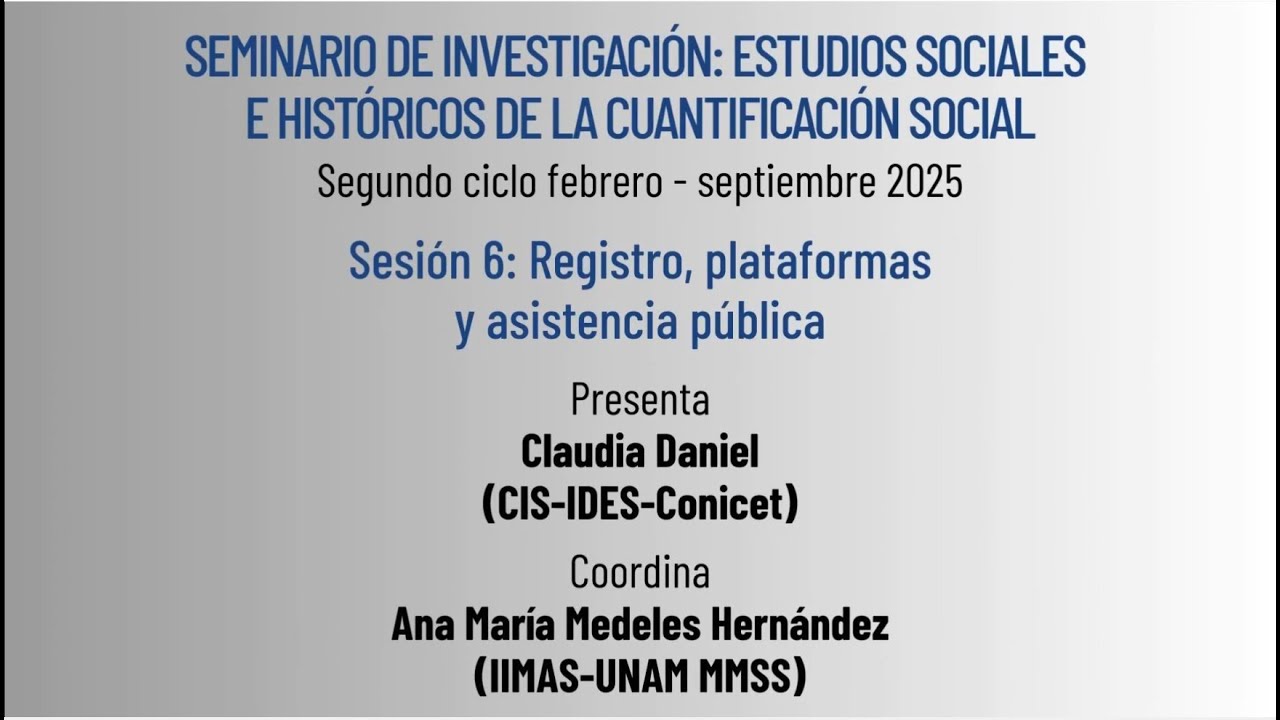
Seminario de inv., Estudios sociales e históricos de la cuantificación social 2o ciclo 2025 sesión 6
Keywords
Summary
190 words
Critical Evaluation
Value of the Information & Strength of the Argument
The value of the information is high, as it provides a detailed, empirically grounded analysis of a contemporary phenomenon: the digitalization of social assistance during a crisis. The argumentation is solid, drawing on a clear theoretical framework that integrates social studies of quantification, digital technologies, and critical social policy. Daniel effectively uses the case of Argentina to challenge assumptions about the enhanced legibility that digital technologies supposedly provide to states, highlighting instead the persistent challenges of informality and the frictions between different state rationalities. The presentation is well-structured, moving from the broader research context to specific policy details and analytical insights.
Scientific Rigor, Source Quality, Title Accuracy
The scientific rigor is high, as the presentation is based on a collective research project and engages with established literature, including references to James Scott and Virginia Eubanks. The sources are appropriately cited within the talk, though no explicit URLs are provided in the description. The title accurately reflects the content, which is a seminar on social and historical studies of quantification, focusing on registration, platforms, and public assistance. The discussion is well-grounded and avoids overgeneralization, acknowledging the specificities of the Argentine context.
199 words
Title / Content Match
The title accurately describes the content: a seminar session on social and historical studies of quantification, specifically focusing on registration, platforms, and public assistance.
Quality & Reliability
8/10
The seminar features a recognized expert in the social history of statistics, Claudia Daniel, who presents a well-structured analysis based on a collective research project. The discussion is grounded in established literature and empirical evidence from Argentina, though it is a seminar presentation rather than a peer-reviewed publication.
Key Moments
Markers derived by PSI from the transcript: the creator did not define chapters.
- Introduction of Claudia Daniel and the seminar context.
- Daniel introduces the research project on public assistance during the pandemic.
- Discussion of the theoretical framework: social studies of quantification and digital technologies.
- Presentation of the IFE and ATP programs and their objectives.
- Analysis of the promises of digitalization: efficiency, reach, and neutrality.
- Discussion of the centralization of power and the role of the 'coding elite'.
- Challenges of digitalization: digital divide, new mediators, and state legibility.
- Conclusion and opening for questions.
Cited Sources
- Political History of Latin American Statistics (2023) — Mentioned as a collective work coordinated by Claudia Daniel and others, providing a comparative study of statistics production in Latin America.
- Los números públicos: las estadísticas en Argentina entre 1990 y 2010 (2013) — Cited as a pioneering work by Claudia Daniel on statistics and the state in Argentina.
- Asistir a distancia, registros y plataformas como mediadores de ayuda pública (2022) — The chapter discussed in the seminar, part of a collective book on state responses to the pandemic.
Concurring Sources
- James C. Scott, Seeing Like a State — Daniel references Scott's work on state legibility, which aligns with her analysis of the challenges of making populations visible.
- Virginia Eubanks, Automating Inequality — Daniel mentions Eubanks' concept of 'digital asylums', which resonates with her discussion of digital welfare and surveillance.
Contribution & Novelties
The presentation offers an original contribution by examining the digitalization of social assistance through the lens of social studies of quantification, highlighting the tensions between state legibility and the realities of informality in Latin America. It provides a nuanced view that challenges the assumption of increased state control through digital technologies.
Pour aller plus loin :
- James C. Scott, Seeing Like a State — Foundational work on state legibility and simplification.
- Virginia Eubanks, Automating Inequality — Critical analysis of digital welfare systems and their biases.
- Dataism — Concept of data as a dominant ideology, relevant to the discussion of data-driven governance.
101 words
Radar Profile
The radar profile shows high scores in information quantity, quality, and reliability, with a slightly lower technical level, reflecting the seminar's focus on social and historical analysis rather than technical details. The overall high scores indicate a well-rounded and credible presentation.